





Levothyroxine Absorption Calculator
Enter your dosing schedule to see how much absorption you're losing. This tool helps you avoid the 36% absorption drop that occurs when taking levothyroxine with food or certain supplements.
Absorption Results
Estimated Absorption:
100%
Expected TSH Impact:
Stable
Warning: Absorption is significantly reduced. Consider adjusting your schedule to improve results.
Recommended Adjustment
To optimize absorption, take levothyroxine on an empty stomach 30-60 minutes before eating or consuming these items.
Getting the right dose of thyroid medication isn’t just about the pill you swallow-it’s about when you take it, what you eat before or after, and what else is in your system. For millions of people on levothyroxine, small mistakes in timing or diet can throw off hormone levels, trigger fatigue, weight gain, or brain fog-even if they’re taking the exact same dose every day.
Why Timing Matters More Than You Think
Levothyroxine, the most common thyroid hormone replacement, has a narrow window for proper absorption. That means even a 10% drop in how much your body takes in can push your TSH levels out of range. Your TSH (thyroid-stimulating hormone) is the main marker doctors use to check if your dose is right. If it’s too high, you’re under-treated. Too low, and you risk heart strain or bone loss. Research shows that taking levothyroxine with food can slash absorption by up to 36%. A 2009 study in the Journal of Clinical Endocrinology & Metabolism found that patients who took their pill with breakfast had TSH levels that were 176% higher than those who took it on an empty stomach. That’s not a small difference-it’s the difference between feeling fine and feeling exhausted all day.The Gold Standard: Take It on an Empty Stomach
The American Thyroid Association and most endocrinologists agree: take levothyroxine first thing in the morning, at least 30 to 60 minutes before eating or drinking anything except water. This gives your body the best shot at absorbing the full dose. Why? Because levothyroxine is absorbed in the upper part of your small intestine, and food, especially high-fiber or fatty meals, slows down digestion and blocks absorption. Even milk, coffee, or orange juice can interfere. A 2017 study in Thyroid showed that coffee alone reduced absorption by 36%. That’s why many patients who switch from taking their pill with breakfast to taking it before breakfast report feeling more alert, losing weight, or having better focus within weeks.What You Must Avoid for 3-4 Hours
It’s not just food. Several common supplements and medications bind to levothyroxine and stop it from being absorbed. You need to space these out by at least 3 to 4 hours:- Calcium supplements - Reduce absorption by 27-36%
- Iron supplements - Cut absorption by 39%
- Antacids and proton pump inhibitors (like omeprazole) - Change stomach pH, making absorption less reliable
- Soy products - Especially soy milk or tofu, which can interfere with absorption
- Multivitamins with minerals - Often contain iron or calcium, so take them at night instead
- Fiber supplements - Like psyllium or Benefiber, which trap the hormone in the gut
Evening Dosing: A Viable Alternative?
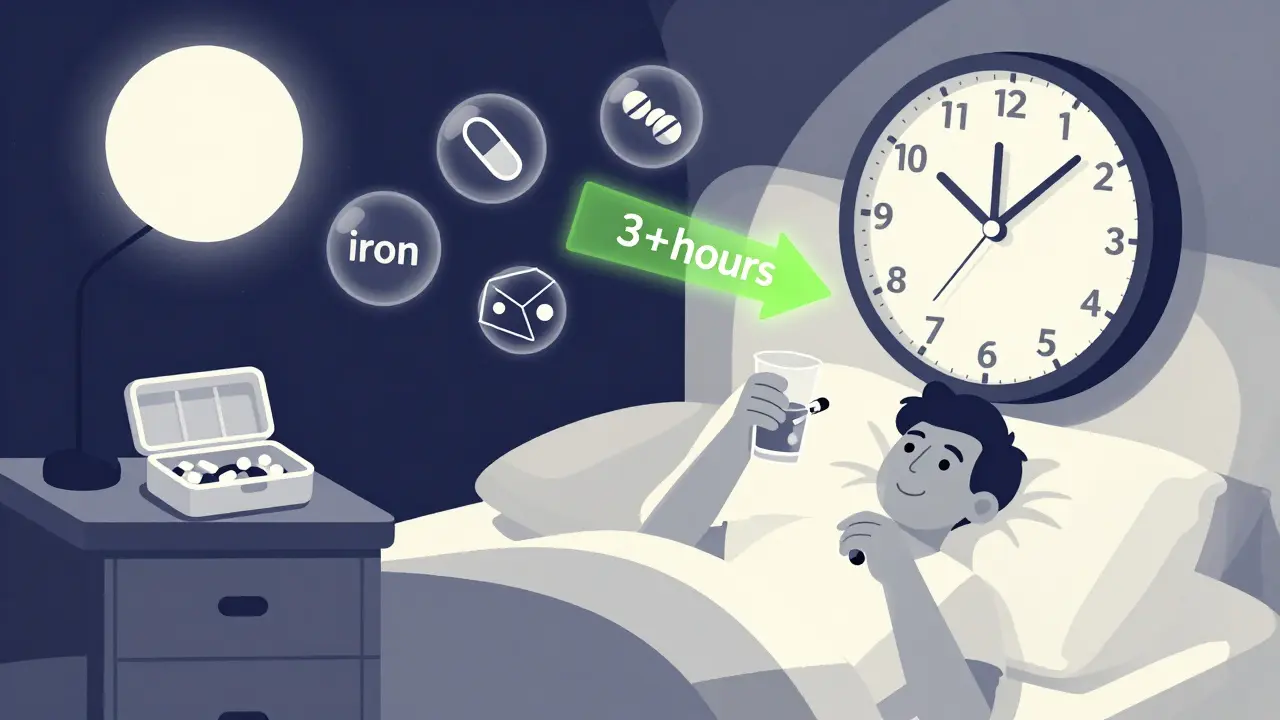
For some people, taking levothyroxine in the morning just doesn’t work. Maybe they’re rushing to get kids to school. Maybe they get nauseous on an empty stomach. Maybe they forget. That’s where evening dosing comes in. A 2020 systematic review of 12 studies found that taking levothyroxine at bedtime-three or more hours after your last meal-led to lower TSH and higher free T4 levels compared to morning dosing. One study of 86 patients found no difference in outcomes between morning and evening dosing. Another patient on a thyroid forum shared: “I switched to bedtime dosing after 10 years of unstable TSH. My levels stayed at 1.2 for 18 months straight.” But here’s the catch: evening dosing only works if you’re consistent. You can’t eat dinner at 7 p.m. and take your pill at 8 p.m. You need to wait until at least 10 or 11 p.m. And you can’t take other meds like calcium or iron right before bed. It’s not easier-it’s just different.Special Cases: Pregnancy, Cancer, and Older Adults
If you’re pregnant, your thyroid needs are higher. The fetus depends on your thyroid hormone in the first trimester, before its own gland kicks in. The American Thyroid Association says pregnant women must take levothyroxine on an empty stomach, 30-60 minutes before breakfast. Skipping this rule can affect your baby’s brain development. For thyroid cancer patients on suppressive therapy, TSH needs to be kept below 0.1. Even small absorption dips can be dangerous. These patients are often told to avoid any variation-no food, no coffee, no supplements within hours of their dose. Older adults are another group at risk. Many take calcium for osteoporosis, iron for anemia, or multiple medications. A 2022 guideline from the Endocrine Society recommends spacing levothyroxine at least 4 hours from other meds. If you’re taking 5 or 6 pills a day, planning your schedule becomes part of your treatment.Newer Formulations: Is There a Better Way?
The good news? Science is catching up. In 2017, the FDA approved Tirosint-SOL, a liquid form of levothyroxine that doesn’t interact with food or coffee. A 2019 study showed patients taking it with breakfast had the same TSH levels as those taking it on an empty stomach. No more waiting 60 minutes before coffee. Another new formulation-a delayed-release tablet-is in phase 3 trials. Early results from the 2023 American Thyroid Association meeting show 92% of patients maintained stable TSH even when taking the pill with meals. That’s huge. But here’s the reality: 89% of prescriptions are still for the old tablet form. Until these new versions become cheaper and more widely available, timing and food rules still matter.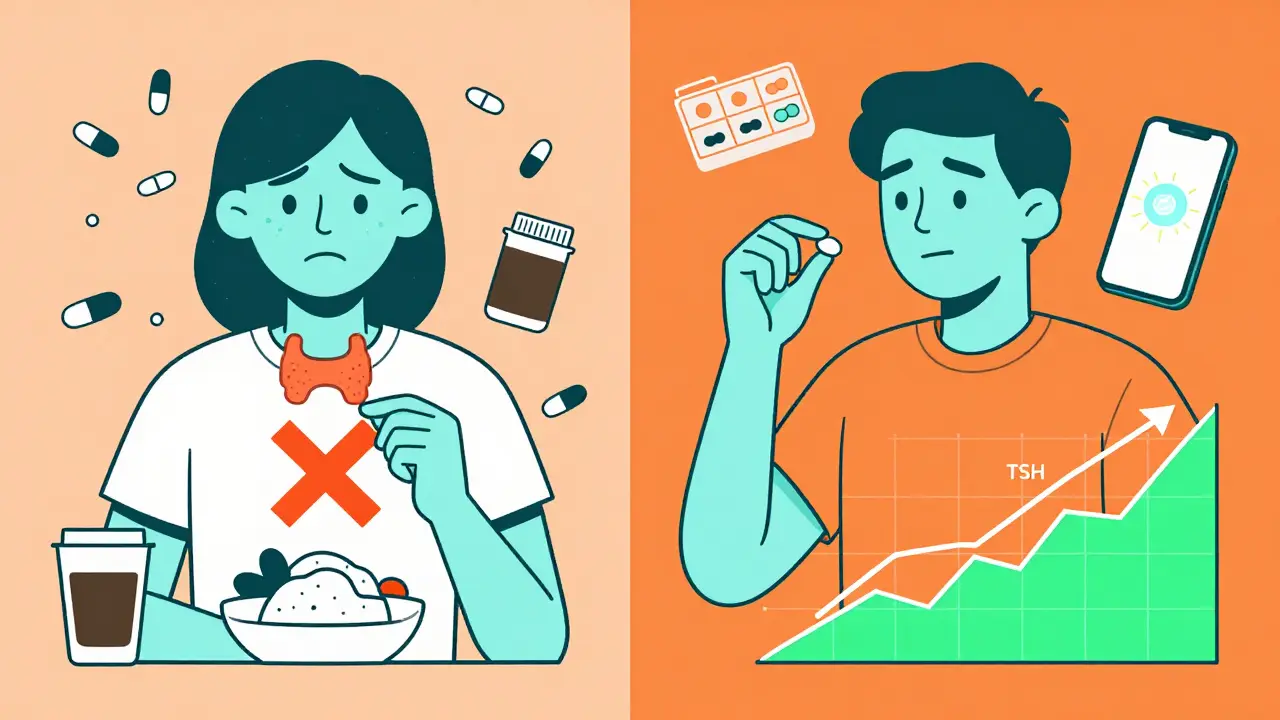
How to Build a Routine That Works
You don’t need to be perfect. You need to be consistent. Here’s what works for real people:- Set a daily alarm - A 2022 study found smartphone reminders improved adherence by 38%.
- Keep your pill next to your toothbrush - If you brush your teeth first thing, take your pill right after.
- Use a weekly pillbox - But only fill it with levothyroxine. Don’t mix it with other meds.
- Write it down - Note what you ate, when you took it, and how you felt. Bring it to your next appointment.
- Don’t switch back and forth - If you move from morning to evening, stick with it. Your body needs time to adjust.
When to Check Your TSH
If you change your dosing time-whether from morning to night, or you start taking calcium again-get your TSH tested in 6 to 8 weeks. That’s how long it takes your body to stabilize. Once you’re stable, annual testing is usually enough. But if you feel off-tired, gaining weight, depressed, or anxious-don’t wait. Get checked sooner. Your TSH might be creeping up.Bottom Line: It’s Not About Perfection-It’s About Consistency
There’s no single right way to take levothyroxine. But there are wrong ways-and they’re common. Taking it with food, coffee, or calcium can turn a perfectly good dose into a wasted one. For most people, morning on an empty stomach still works best. But if that’s not possible, evening dosing is a real alternative. The goal isn’t to follow a rigid rule. It’s to find a routine you can stick to-and then stick to it. Because your thyroid doesn’t care if you’re busy. It just needs you to be consistent.
8 Comments

Poppy Newman
January 7, 2026 AT 20:57
OMG I literally just switched to bedtime dosing last week 🙌 I was taking mine with my morning coffee and felt like a zombie. Now I take it at 11 p.m. after dinner and I swear I have more energy by noon. My TSH dropped from 4.8 to 1.9 in 6 weeks. Who knew my coffee was sabotaging me?? 😅

Anthony Capunong
January 8, 2026 AT 19:17
Look, I don’t care what some journal says. In America, we take our meds when it’s convenient. I take mine with my protein shake at 7 a.m. and I’m fine. You people are overcomplicating this. If you’re not feeling bad, then your doctor’s wrong. Stop listening to overeducated Europeans.

Aparna karwande
January 8, 2026 AT 22:26
How dare you suggest that Indian women, who have been managing thyroid for generations without fancy pills, are now supposed to follow Western timing rituals? My grandmother took ashwagandha at sunrise and ate her roti at noon-no TSH tests, no coffee rituals. We didn’t need 3-hour windows. We had balance. Now you people treat a natural hormone like it’s rocket science. This is cultural arrogance disguised as medicine.
And don’t get me started on soy milk-our ancestors consumed it daily for centuries. Your ‘studies’ are funded by Big Pharma trying to sell you liquid formulations. Wake up.
Stop pathologizing normal bodies. Thyroid isn’t a crisis-it’s a rhythm. Find your rhythm, not someone else’s algorithm.
I’ve been on levothyroxine for 12 years. I take it with water at 6 a.m., eat breakfast at 7:30, and my TSH is 1.1. I don’t track it like a stock portfolio. I live. That’s the real treatment.
And yes, I know the FDA approved ‘Tiroint-SOL.’ I also know it costs $300 a month. Tell me again how this is healthcare and not capitalism in a lab coat.

Elen Pihlap
January 10, 2026 AT 10:49
I’ve been doing the morning thing for 5 years and I still feel awful. I cry every morning. I think my doctor is lying to me. I just want to feel normal again. Why won’t anyone listen? I’m so tired of this.

Sai Ganesh
January 11, 2026 AT 04:24
In India, we often take medications with food due to stomach sensitivity. But I’ve learned from my endocrinologist that levothyroxine is different. I now take it at 5:30 a.m., before chai or roti, and I’ve noticed better focus. It’s not about Western rules-it’s about science. Consistency matters more than tradition or convenience. I respect both, but I choose what works for my body.

Paul Mason
January 12, 2026 AT 23:43
Look, if you’re taking it with coffee, you’re doing it wrong. Simple as that. I’ve seen patients come in with TSH over 10 and swear they ‘followed the instructions.’ Nope. You drank your latte 20 minutes after the pill. That’s not following. That’s guessing. Get a pill organizer. Set a phone alarm. Drink water. Wait 30 minutes. Do it every day. It’s not hard. Stop making excuses. Your thyroid doesn’t care if you’re busy.

Katrina Morris
January 13, 2026 AT 11:20
i switched to night time like 3 months ago and my energy is way better like i dont feel like i need a nap after lunch anymore?? i still forget sometimes but i keep my pill by my bed now and it helps. also i started taking my iron at lunch instead of dinner and i think that helped too. no more brain fog!!

steve rumsford
January 13, 2026 AT 16:06
I used to take mine with breakfast like a chump. Then I started taking it before my morning run. No food, no coffee, just water and 30 minutes of cardio. My TSH dropped from 5.1 to 1.4 in 8 weeks. I’m not saying this is for everyone. But if you’re tired and your doctor says ‘it’s fine’-you’re not fine. Get your numbers checked. And maybe stop drinking coffee for 45 minutes after your pill. It’s not that hard.
Write a comment