


Absolute vs Relative Risk Calculator
This tool helps you understand the real impact of medications by calculating both absolute and relative risk reduction. Simply enter the baseline risk (without treatment) and the risk after treatment to see how much benefit is actually provided.
Enter as a percentage (e.g., 2 = 2%)
Enter as a percentage (e.g., 1 = 1%)
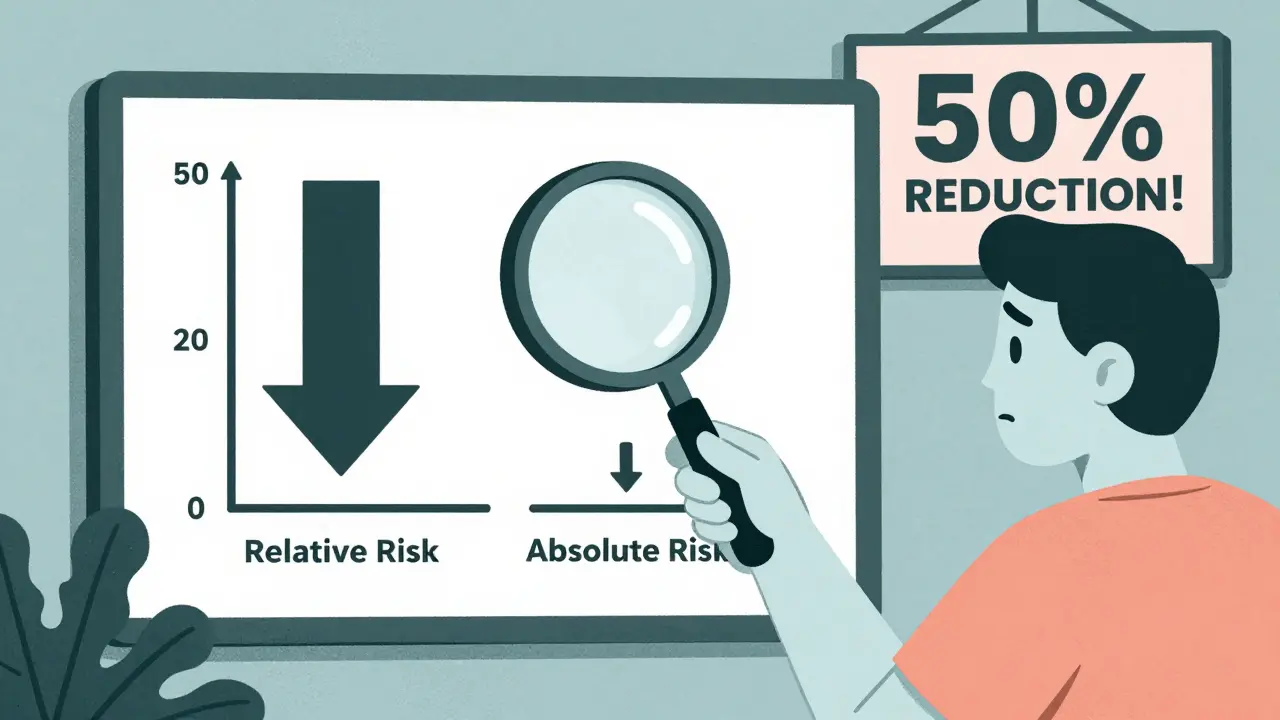
Imagine you see an ad for a new medication. It says, "Reduces heart attack risk by 50%." That sounds impressive, right? You might think, "This drug cuts my chance of a heart attack in half." But what if your actual risk was only 2% to begin with? After taking the drug, it drops to 1%. That’s still a 50% relative reduction-but only a 1 percentage point absolute change. Most people don’t realize the difference between those two numbers, and pharmaceutical companies count on that.
What’s the difference between absolute and relative risk?
Absolute risk tells you the real, everyday chance of something happening to you. It’s a straightforward number: how many people out of 100, 1,000, or 100,000 actually experience a side effect or benefit. For example, if 2 out of every 100 people have a heart attack in a year, their absolute risk is 2%. Relative risk compares two groups. It’s a ratio: how much more or less likely one group is to experience an event compared to another. If a drug lowers heart attack risk from 2% to 1%, the relative risk reduction is 50% because 1% is half of 2%. That sounds big. But the absolute risk reduction is just 1%-the actual difference between 2% and 1%. This isn’t just math. It’s about real decisions. A 50% relative risk reduction sounds like a miracle. A 1% absolute reduction sounds like a small benefit. Both are true. But only one tells you what actually matters for your body.Why do drug ads use relative risk?
Because it makes the numbers look better. Take a drug that reduces the risk of a rare side effect from 1 in 100,000 to 1 in 10,000,000. That’s a 99% relative risk reduction. Sounds amazing. But the absolute risk reduction? Just 0.099%. You’re talking about preventing one case in nearly 100,000 people taking the drug. That’s not nothing-but it’s not a game-changer either. A 2021 study found that 78% of direct-to-consumer drug ads in the U.S. highlight relative risk reduction without ever mentioning the absolute number. Why? Because 90% relative risk sounds way more compelling than 0.099%. It’s not lying. It’s selective storytelling. The same trick works for side effects. A drug might double your risk of nausea. That’s a 100% relative increase. But if the baseline risk is 5%, and it goes up to 10%, that’s only a 5 percentage point absolute increase. Half of all people taking the drug still won’t feel sick. The relative number scares you. The absolute number tells you it’s manageable.How to calculate both types of risk
You don’t need to be a statistician to understand this. Here’s how it breaks down:- Absolute Risk Reduction (ARR) = Risk in control group − Risk in treatment group
- Relative Risk Reduction (RRR) = (ARR ÷ Risk in control group) × 100%

Why absolute risk matters more for patients
Doctors and researchers need both numbers. But patients need to know what it means for them. A 2019 study in JAMA Internal Medicine found that 60% of physicians couldn’t correctly convert a relative risk reduction into an absolute one. If the people giving you advice don’t fully get it, how can you? Consider this real story from a Reddit thread: a patient refused statins because they read online that the drug "cuts heart attack risk in half." They didn’t know their baseline risk was 2%. After taking statins, it dropped to 1%. The patient thought "half" meant they’d go from likely to unlikely. In reality, they went from unlikely to still unlikely-but slightly less so. When patients understand absolute risk, they make better choices. One woman in a medical journal case study was ready to skip a life-saving treatment because she thought the relative risk reduction sounded too small. When her doctor showed her the absolute numbers-her risk dropped from 15% to 12%-she realized the benefit was worth it. That 3% difference meant 1 in 33 people like her would avoid a bad outcome. That’s meaningful.How to spot misleading risk claims
Here’s a quick checklist to use when you see a drug claim:- Find the baseline risk. What’s the chance of the problem happening without the drug? If it’s not stated, ask. A 50% reduction means nothing if the starting risk is 0.1%.
- Ask for the absolute difference. Not the percentage. The actual number. "How many fewer people have the problem?"
- Check the time frame. Is the risk reduction over 1 year? 5 years? 10? A 20% reduction over 10 years is very different from one over 1 year.
- Look for the Number Needed to Treat (NNT). If it’s over 50, the benefit is small for most people. If it’s under 10, it’s significant.
- Ask about side effects. What’s the absolute risk of those? A drug might reduce heart attacks by 2% but increase severe muscle pain by 5%. That’s a trade-off.
What experts say about this
Dr. Steve Woloshin and Dr. Lisa Schwartz from the Dartmouth Institute have spent decades studying how medical numbers are presented. Their research shows that when patients are given absolute risks with visual aids-like pictures of 100 people, with some shaded to show who benefits or gets side effects-62% understand the risk. Without visuals, only 8% get it right. The Cochrane Collaboration, a respected global network of medical researchers, now requires journals to use standardized risk communication templates. They recommend always showing absolute risk first, then relative risk with clear context. In 2023, the FDA released draft guidance pushing for clearer risk reporting in ads. They called out the "potential for misleading interpretations" when only relative risks are shown. But enforcement is still weak. Most ads haven’t changed.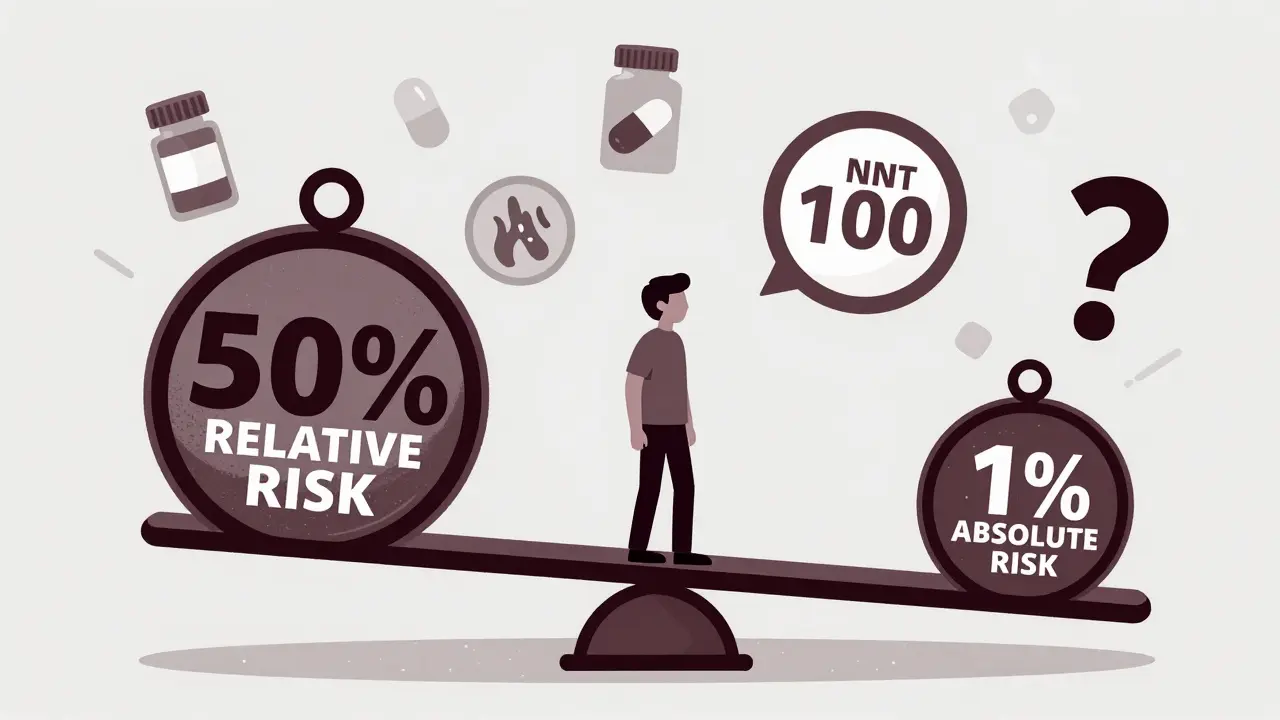
What you should do next
When your doctor talks about a new medication, don’t just nod along. Ask:- "What’s my risk of this problem without the drug?"
- "How much does it lower that risk in real numbers?"
- "How many people like me would need to take this for one to benefit?"
- "What’s the absolute risk of the side effects?"
Common examples you’ll see
Here are real-world comparisons to help you think clearly:| Scenario | Baseline Risk (Control) | After Treatment | Absolute Risk Reduction | Relative Risk Reduction | Number Needed to Treat (NNT) |
|---|---|---|---|---|---|
| Statin for heart attack prevention | 2% | 1% | 1% | 50% | 100 |
| Antidepressant for depression | 30% | 20% | 10% | 33% | 10 |
| Drug reducing rare cancer risk | 0.01% | 0.005% | 0.005% | 50% | 20,000 |
| Drug increasing nausea risk | 5% | 10% | +5% | +100% | N/A |
What to remember
- Absolute risk = what happens to you. Relative risk = what happens compared to someone else. - Big relative numbers often hide tiny real-world benefits. - Side effects sound scarier with relative risk. Always ask for the absolute number. - NNT tells you if the benefit is worth it. Under 10? Strong. Over 50? Weak. - Visuals help. Ask for charts or diagrams showing 100 people. - You have the right to know both numbers. Don’t accept one without the other. The goal isn’t to scare you off medicine. It’s to help you make smart choices. Some drugs save lives. Others barely move the needle. The numbers tell you which is which-if you know how to read them.What’s the difference between absolute risk and relative risk?
Absolute risk is the actual chance of something happening to you-for example, a 2% chance of having a heart attack this year. Relative risk compares that chance to someone else’s-like saying a drug reduces your risk by 50%. That sounds big, but if your original risk was only 2%, the drug lowers it to 1%. The absolute change is just 1 percentage point. Absolute risk tells you what matters for your body. Relative risk tells you how it compares to a group.
Why do drug ads always say "reduces risk by 50%"?
Because 50% sounds impressive. If your risk drops from 2% to 1%, that’s a 50% relative reduction-but only a 1% absolute reduction. Ads use relative risk because it makes the benefit look larger. They don’t lie, but they leave out the baseline number, which is the most important part. Always ask: "50% reduction from what?"
How do I know if a drug is really worth taking?
Look for the Number Needed to Treat (NNT). That’s how many people need to take the drug for one person to benefit. If the NNT is 10 or lower, the benefit is strong. If it’s over 50, the benefit is small for most people. Also check the absolute risk reduction. A 1% reduction means 99 out of 100 people won’t benefit. A 10% reduction means 9 out of 10 will. That’s a big difference.
Should I be worried if a drug doubles my risk of a side effect?
Not necessarily. If the original risk was 1%, doubling it means it’s now 2%. That’s still low. But if the original risk was 10%, doubling it to 20% is serious. Always ask for the starting number. A relative risk increase sounds scary, but the absolute number tells you how real the danger is.
Can I trust my doctor if they only give me relative risk?
You should ask for more. Many doctors know the difference, but they assume patients won’t understand. Don’t assume that. Ask: "Can you show me the absolute numbers?" If they can’t or won’t, it’s a red flag. You have the right to full information. Use the NNT and absolute risk reduction to make your own decision.
13 Comments

Sam Black
December 21, 2025 AT 15:46
Wow. This is one of those posts that makes you realize how much you’ve been manipulated by marketing. I used to think statins were some kind of miracle drug until I saw the NNT was 100. That means 99 people take it for a year, suffer potential muscle pain, and pay hundreds, just so one person avoids a heart attack. And the ad says "50% risk reduction!" Like, cool, but what’s the baseline? If I’m 30 and healthy, my risk is like 0.2%. Halving that is still 0.1%. Am I really going to take a pill every day for that? No thanks.
Doctors need to stop treating patients like they’re too dumb to handle numbers. We’re not idiots. We just need the truth.

Tony Du bled
December 21, 2025 AT 20:38
My uncle took that blood pressure med that "cuts stroke risk by 40%" - turned out his baseline was 0.8%. After the drug, it was 0.5%. He still had a stroke. The doctor never mentioned absolute risk. Now he’s mad at the pharma company. Not the doctor. The system’s rigged.

Kathryn Weymouth
December 23, 2025 AT 09:07
This is exactly why medical literacy is a public health crisis. I’m a nurse, and I’ve seen patients refuse life-saving treatments because they were told "this drug reduces your risk by 70%" - without knowing their baseline risk was 0.3%. The absolute benefit? 0.21%. That’s not a miracle. It’s a marginal gain. Meanwhile, side effects are listed as "doubled risk of nausea" - which sounds terrifying until you realize the original risk was 4%. Now it’s 8%. Still, most people won’t get it. We need plain-language summaries on every prescription bottle.

Nader Bsyouni
December 24, 2025 AT 07:25
Look I get it numbers are tools but you’re treating them like gospel. The entire medical industrial complex is built on fear and profit. Absolute risk? Relative risk? Who cares. The real question is who profits. Big Pharma makes billions off people who think they’re "saving themselves" by popping pills they don’t need. The math is just the glitter on the snake oil. You want to know the truth? Most drugs are designed to make you dependent not healthy. The numbers are just the script they read on TV. Stop believing in statistics. Start questioning power.

Julie Chavassieux
December 26, 2025 AT 01:57
OMG I JUST REALIZED WHY I HATED MY LAST PRESCRIPTION!!
They said "reduces migraines by 60%" but my baseline was 2 per month… so now it’s 0.8? That’s like one every 6 weeks? I was so mad I took it for 3 months and barely felt better. And the side effects? Dizziness. Brain fog. Like I was walking through syrup. I should’ve asked for the absolute number. I’m so mad at myself.
Also why does no one talk about this??

jenny guachamboza
December 27, 2025 AT 07:36
lol this is so basic 😭 but also… what if the FDA is just being paid off? 🤔 I read on a blog that the same people who write the guidelines for drug ads also have stock in Pfizer. And the NNT thing? That’s just a distraction. They don’t want you to know that 99% of people who take statins are just paying for someone else’s health. Also… did you know aspirin has a lower NNT than most of these drugs? But no one ads that. Why? Because it’s free. 💸 #BigPharmaLies #IWantMyNumbersBack 🤖📉

Cara Hritz
December 27, 2025 AT 11:05
Wait so if my risk of a heart attack is 1% and the drug cuts it to 0.5% thats a 50% reduction right? But its only 0.5% absolute? So like… i still have a 0.5% chance? So i’m not safe? But the ad makes it sound like i’ll never have one? I feel so stupid for believing that. I took the pill for 6 months. My doctor said "you’re doing great" but never said what the real numbers were. I’m gonna go yell at her now. 😤

Herman Rousseau
December 29, 2025 AT 10:39
This is one of the most important posts I’ve read all year. Seriously. I work in pharmacy and I’ve seen patients cry because they thought a drug "cured" them - when it just nudged the odds. I always show them the 100-person grid: 2 red dots for heart attacks, now 1. That’s it. They get it. Visuals change everything. And NNT? I print it out. If it’s over 50, I say: "This won’t help you. It might help someone else. But you? You’re paying for a statistical whisper. Is it worth it?" Most say no. And that’s okay. We need more honesty, not more hype.

Ajay Brahmandam
December 31, 2025 AT 08:39
Indian doctors do this too. My aunt was told "this tablet reduces diabetes risk by 70%" - but her fasting sugar was 98. Normal range. She took it for a year. Lost 10kg. Got dizzy. Blood work fine. No benefit. I showed her the numbers. She stopped. No one warned her. This is global. We need transparency. Not just in the US.

Tarun Sharma
January 2, 2026 AT 05:15
Well-articulated. The disconnect between relative and absolute risk is a well-documented cognitive bias in medical communication. The NNT metric is underutilized in clinical practice despite its predictive value. Regulatory bodies must mandate disclosure of absolute risk figures in advertising. Patient autonomy depends on accurate information.

Art Van Gelder
January 2, 2026 AT 12:16
Let me just say this - we live in a world where a 50% reduction sounds like a miracle because we’ve been trained to think in percentages, not in human terms. What does 1% mean? It means 99 out of 100 people take the pill, suffer side effects, spend money, and never see a single benefit. That’s not medicine. That’s a lottery. And the drug companies? They’re selling tickets to people who think they’re buying safety. But safety isn’t a percentage. It’s a feeling. And you can’t feel 1%. You can only feel the nausea, the cost, the guilt of taking something you don’t need. We’re not data points. We’re people. And we deserve to know what’s really happening to our bodies - not just what the ad wants us to believe.

Candy Cotton
January 2, 2026 AT 16:12
It is imperative to note that the United States Food and Drug Administration has established rigorous standards for the dissemination of medical information. Any assertion that pharmaceutical companies are intentionally misleading the public is not only unsubstantiated but also a disservice to the thousands of scientists and regulatory professionals who dedicate their careers to public health. The use of relative risk is scientifically valid and widely accepted in peer-reviewed literature. To suggest otherwise is to undermine evidence-based medicine and promote dangerous misinformation.

Jamison Kissh
January 3, 2026 AT 07:07
What’s interesting is that this isn’t really about math. It’s about fear. We’re terrified of dying. So we grab at any number that says "you’re safer now." But safety isn’t a number. It’s a relationship between you and your body. The drug doesn’t make you safe. It just changes the odds. And sometimes, the cost of those odds - your sleep, your energy, your trust - is higher than the benefit. Maybe the real question isn’t "how much does it reduce risk?" but "how much of myself am I willing to give up for a few extra days?"
Write a comment