



When you're pregnant and dealing with a headache, fever, or back pain, the last thing you want is to guess whether your go-to painkiller is safe. It’s a common question: acetaminophen or NSAIDs? And when exactly is each one okay-or not? The answer isn’t as simple as "avoid everything," but it’s not a free pass either. Let’s cut through the noise with clear, evidence-based facts about what’s safe, when, and why.
Acetaminophen: The Go-To for All Trimesters
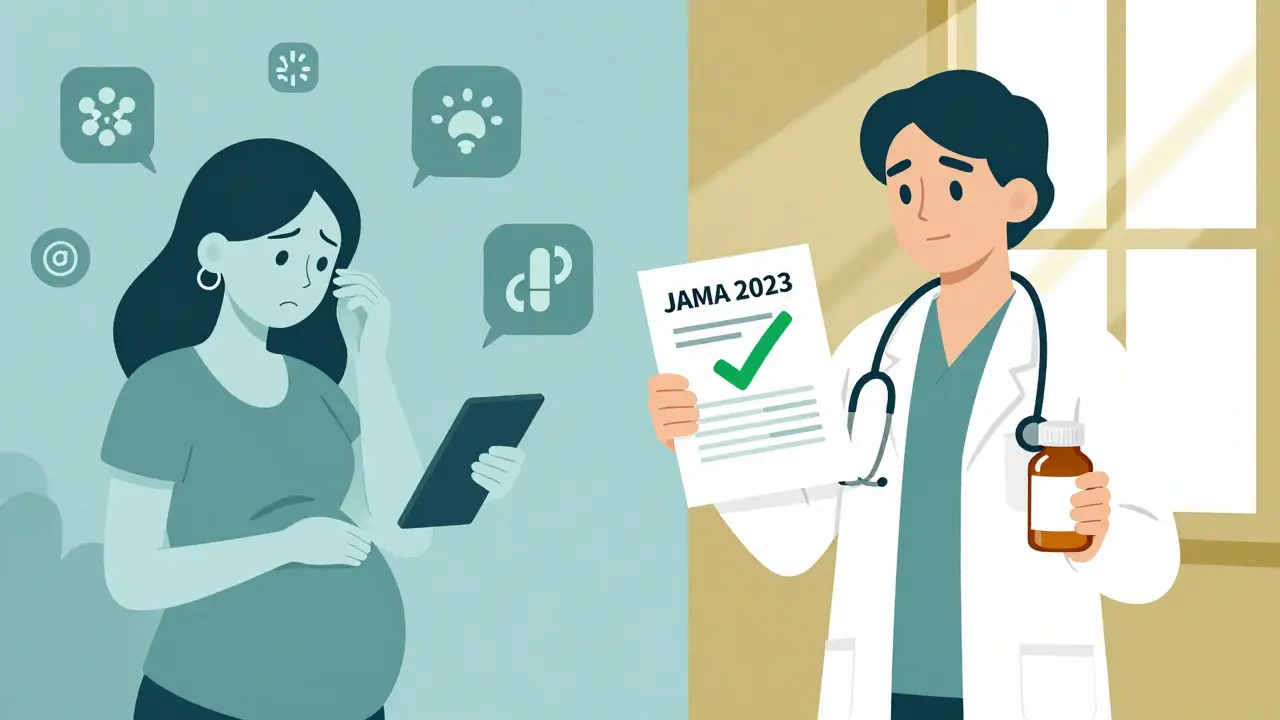
Acetaminophen (also known as paracetamol) is the only over-the-counter pain reliever recommended for use throughout pregnancy by major medical groups like the American College of Obstetricians and Gynecologists (ACOG) and the Society for Maternal-Fetal Medicine. It’s been used for decades, and research continues to back its safety. A 2023 study in JAMA Network Open tracking over 97,000 mother-child pairs found no link between acetaminophen use during pregnancy and autism, ADHD, or intellectual disability in children. The adjusted odds ratios? Nearly 1.0-meaning no increased risk.
It works as both a painkiller and fever reducer. That’s important because untreated fever during pregnancy can be dangerous. A 2017 study in Birth Defects Research found that a fever above 102°F in the first trimester more than doubles the risk of neural tube defects. So if you have a fever, acetaminophen isn’t just optional-it’s protective.
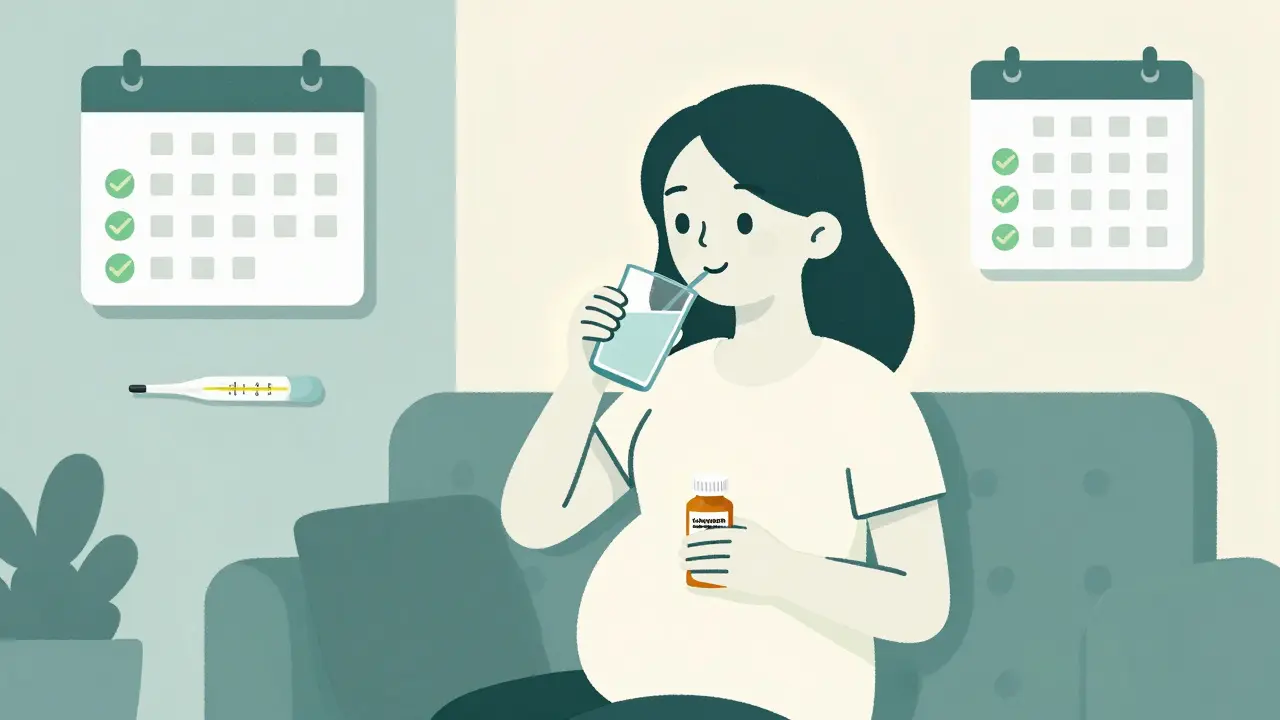
Standard dosing is 325-1,000 mg every 4-6 hours, not exceeding 4,000 mg in 24 hours. Most providers recommend starting with 500 mg and using it only as needed. If you’re taking it for more than 3-5 days straight, check in with your doctor. There’s no evidence that short-term use causes harm, and the benefits of managing pain or fever often outweigh any theoretical concerns.
NSAIDs: The Red Flag After 20 Weeks
NSAIDs-including ibuprofen (Advil, Motrin), naproxen (Aleve), and diclofenac (Voltaren)-are a different story. These drugs block inflammation, which is why they work so well for sprains or arthritis. But in pregnancy, that same mechanism can interfere with fetal development.
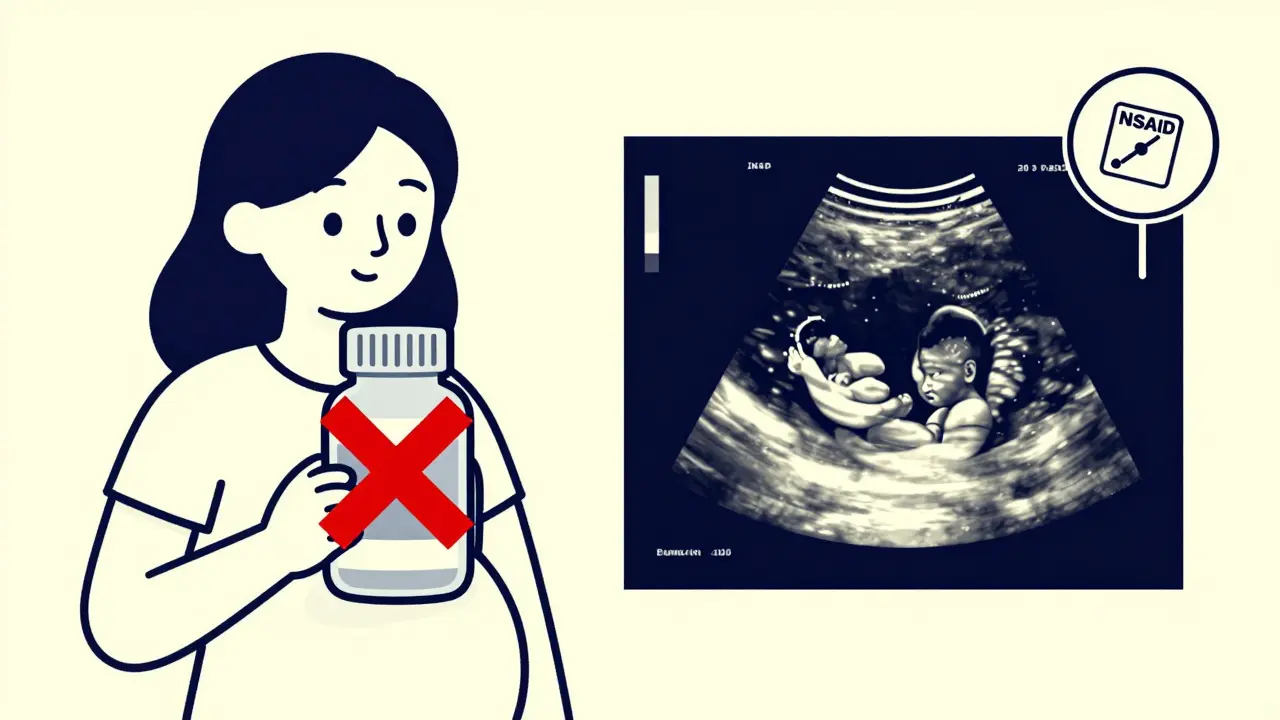
The FDA updated its warning in October 2020: avoid NSAIDs at 20 weeks or later. Before that, the cutoff was 30 weeks. Why the change? Research showed that even short-term exposure to NSAIDs after 20 weeks can cause fetal kidney problems. This leads to low amniotic fluid (oligohydramnios), which can affect lung development and limb positioning. Studies show this happens in 1-2% of cases when NSAIDs are used after 20 weeks, compared to just 0.1% in unexposed pregnancies.
And it doesn’t take long. Problems can show up within 48-72 hours. If you accidentally take an NSAID between 20 and 30 weeks, stop immediately and call your provider. An ultrasound may be needed to check amniotic fluid levels. After 30 weeks, there’s an added risk: premature closure of the ductus arteriosus-a blood vessel that’s critical for fetal circulation. This can lead to serious heart complications.
Here’s the kicker: NSAIDs are hiding in plain sight. About 30% of over-the-counter cold and flu remedies contain them. Read the Drug Facts label. If you see "ibuprofen," "naproxen," or "NSAID," avoid it after 20 weeks. Even aspirin is risky-unless it’s the low-dose 81 mg version prescribed for preeclampsia prevention. That’s an exception.
Why the Confusion? Misinformation Is Real
You’ve probably seen headlines like "Painkiller in Pregnancy Linked to Autism." They’re scary. But here’s the truth: those studies show correlation, not causation. Just because some moms took acetaminophen and some kids were later diagnosed with autism doesn’t mean one caused the other. The 2023 JAMA study controlled for everything-genetics, maternal health, smoking, income, education-and still found no link.
A 2023 survey by the American Academy of Family Physicians found 68% of pregnant women avoided all pain meds out of fear. And 42% of them specifically avoided acetaminophen because of social media rumors. Dr. Magloire, a family physician, says it’s common: "I’ve had patients stop taking prescribed acetaminophen because they read a blog post. They’d rather suffer than risk it."
Reddit threads and TikTok videos amplify fear. Comments like "I took Tylenol and my kid was diagnosed with ADHD" are emotionally powerful-but scientifically meaningless. The data doesn’t support it. ACOG’s president, Dr. Steven Fleischman, put it bluntly: "In more than two decades of research, not a single reputable study has concluded that acetaminophen causes neurodevelopmental disorders."
What About the "Endocrine Disruption" Concern?
Yes, a 2021 consensus statement in Nature Reviews Endocrinology suggested pregnant people "forego acetaminophen unless medically indicated." That caused a stir. But here’s the context: the authors were raising a theoretical concern based on lab studies, not human outcomes. They weren’t saying it’s dangerous-they were calling for more research.
Since then, real-world data has kept coming. The FDA’s September 2025 notice acknowledges "some studies have described that the risk may be most pronounced when acetaminophen is taken chronically throughout pregnancy," but still concludes it remains "the safest over-the-counter alternative in pregnancy among all analgesics and antipyretics."
Dr. Salena Zanotti, an OB/GYN at Cleveland Clinic, says it plainly: "Acetaminophen is still the safest known drug to take during pregnancy for problems like fever and pain. It’s okay to turn to medication for help when symptoms are making your daily life difficult."
What to Do: Practical Guidelines
- First Trimester (Weeks 1-12): Acetaminophen is safe. Use it if you have fever, headache, or muscle pain. Avoid NSAIDs unless directed by your provider.
- Second Trimester (Weeks 13-26): Acetaminophen remains the best choice. NSAIDs are not recommended after 20 weeks. If you’re unsure how far along you are, skip NSAIDs entirely.
- Third Trimester (Weeks 27-40): Only use acetaminophen. NSAIDs are strictly contraindicated. Even one dose after 20 weeks can be risky.
If you need pain relief for more than a few days, talk to your provider. They may suggest physical therapy, heat packs, or other non-drug options. But if you’re in real pain or running a fever, don’t suffer. Acetaminophen is your safest bet.
What’s Changing? What’s Next?
The U.S. market for pregnancy-safe pain relievers hit $1.2 billion in 2024, with acetaminophen making up 87% of sales. That’s not because it’s the most profitable-it’s because it’s the most trusted.
The FDA now requires all NSAID packaging to include the 20-week warning. But a 2023 review found 38% of combination products (like cold medicines) still don’t label it clearly. Always check the active ingredients.
Research is ongoing. The NIH is running the Acetaminophen Birth Cohort Study, tracking 10,000 pregnant women through 2027 to study long-term child development. Early results are expected by 2028. Meanwhile, a 2024 study found that 15% of pregnant women have a genetic variation (CYP2E1) that affects how they process acetaminophen. This could lead to personalized dosing in the future-but for now, stick to standard guidelines.
One thing is clear: the risks of untreated fever and unmanaged pain are far greater than the risks of properly used acetaminophen. ACOG’s Dr. Fleischman says it best: "The conditions people use acetaminophen to treat during pregnancy are far more dangerous than any theoretical risks."
Is acetaminophen safe in the first trimester?
Yes. Acetaminophen is considered safe throughout all trimesters, including the first. It’s the only over-the-counter pain reliever recommended by ACOG and the FDA for use during early pregnancy. Untreated fever in the first trimester can increase the risk of neural tube defects, so using acetaminophen to bring down a fever is not only safe-it’s medically advised.
Can I take ibuprofen before 20 weeks?
While some providers may allow occasional use before 20 weeks, it’s not recommended. NSAIDs like ibuprofen can interfere with fetal development even in early pregnancy, and many women don’t know exactly how far along they are. The safest choice is to avoid all NSAIDs and use acetaminophen instead. If you’ve taken ibuprofen before realizing you were pregnant, don’t panic-single, early exposure is unlikely to cause harm, but avoid further use.
What if I took an NSAID after 20 weeks by accident?
Stop taking it immediately. Call your provider. If you took it for less than 48 hours, the risk is low-but they may still recommend an ultrasound to check amniotic fluid levels. Oligohydramnios (low fluid) can develop quickly, and early detection means better outcomes. Don’t wait for symptoms-act fast.
Is Tylenol the same as acetaminophen?
Yes. Tylenol is a brand name for acetaminophen. Any product with "acetaminophen" or "paracetamol" as the active ingredient is the same. Check the Drug Facts label to confirm. Avoid products with added ingredients like decongestants or antihistamines unless approved by your provider.
Are there natural alternatives to acetaminophen?
Yes-heat packs, massage, rest, and gentle stretching can help with muscle pain. For headaches, hydration, fresh air, and sleep often help. But for fever, these won’t lower your temperature. Fever is dangerous in pregnancy; don’t rely on natural remedies alone. Acetaminophen is the only proven, safe way to reduce fever during pregnancy.
10 Comments

Skilken Awe
February 13, 2026 AT 13:03
Let me get this straight - we’re now treating pregnant women like fragile porcelain dolls who can’t handle a single pill without risking the fetus’s entire future?
Acetaminophen is the gold standard because it’s been used by millions without catastrophe, yet somehow every TikTok mom with a PhD in Google Scholar thinks it’s a covert pharmaceutical plot.
The 2023 JAMA study had 97,000 pairs. Ninety-seven thousand. And you’re still scared because some guy on Reddit said his kid ‘turned weird’ after he took Tylenol?
Meanwhile, untreated fever doubles neural tube defect risk. But sure, let’s let Mama suffer through migraines and 103°F fevers because ‘natural remedies’ are more spiritually aligned.
Also, NSAIDs after 20 weeks? Yeah, that’s a real red flag. But let’s not forget that 38% of OTC cold meds still don’t label it. So we’re not just fighting misinformation - we’re fighting lazy drug manufacturers.
And don’t get me started on ‘endocrine disruption’ theories from lab rats in petri dishes. We’re not talking about 10,000x human dosage. We’re talking about 500mg every 6 hours.
Stop weaponizing fear. Start trusting science. And for God’s sake, read the damn FDA notice instead of the comments section of a blog written by a vegan yoga instructor.

Steve DESTIVELLE
February 14, 2026 AT 20:37
When we speak of medication in pregnancy we are not merely speaking of chemistry but of the metaphysical threshold between autonomy and responsibility
Acetaminophen is not a substance but a symbol of modernitys surrender to the illusion of control
The body is not a machine to be tuned with pills but a sacred vessel that speaks in fever and pain as warnings from the ancestral realm
NSAIDs after 20 weeks are not just pharmacologically dangerous they are ontologically transgressive
They interrupt the natural rhythm of fetal development as if the fetus were a guest in a house that demands silence
Yet we have forgotten that silence is not safety but erasure
And so we reach for Tylenol as if it were a prayer without faith
And still the child is born
And still the mother weeps
Because the truth is not in the study but in the silence between the data points
Where the soul of the unborn whispers what no statistic can capture

Stephon Devereux
February 15, 2026 AT 06:38
Look - I get it. Pregnancy is terrifying. Every sneeze feels like a threat to the baby.
But here’s the thing: science isn’t here to scare you - it’s here to empower you.
Acetaminophen isn’t just ‘safe’ - it’s the only tool we have to protect the baby from *real* dangers like high fever. Untreated fever? That’s the real villain. Not Tylenol.
NSAIDs after 20 weeks? Yeah, that’s a hard stop. Not because they’re evil, but because they interfere with kidney development. Simple biology.
And listen - if you’re avoiding acetaminophen because of some viral TikTok, you’re not being ‘cautious’ - you’re being manipulated.
Real precaution isn’t fear. It’s informed action.
Use acetaminophen when needed. Avoid NSAIDs after 20. Read labels. Talk to your provider.
You’re not failing as a mom if you take a pill to feel better. You’re succeeding if you’re thinking critically.
And if you’re still scared? That’s okay. But don’t let fear make decisions for you. Let facts do that.
You’ve got this.

athmaja biju
February 16, 2026 AT 06:21
Why do Western medicine always assume they know better?
India has been using natural remedies for thousands of years - turmeric, ginger, rest, cold compresses - and our mothers gave birth to strong children without a single pill.
Now you come with your ‘FDA guidelines’ and ‘JAMA studies’ as if truth only exists in American labs?
What about the millions of women in Africa, Asia, South America who never heard of acetaminophen?
Are their children less intelligent? Less healthy?
There is a deep arrogance in believing that Western pharmacology is the only path to safety.
Yes, fever is dangerous - but so is overmedicating.
Why not combine wisdom? Use heat packs, hydration, rest - and only if absolutely necessary, then Tylenol.
But don’t tell me your science is the only science. That’s colonial thinking.
Respect traditional knowledge. It’s not outdated - it’s timeless.

Reggie McIntyre
February 17, 2026 AT 04:16
Okay - imagine your body is a spaceship.
Acetaminophen? It’s the gentle thruster - just enough to nudge you out of discomfort without blowing a fuse.
NSAIDs? Those are the overpowered rocket boosters - great for lifting heavy cargo on Earth… but in space, they destabilize the whole damn ship.
And yeah, the FDA’s warning? That’s not bureaucracy - that’s a lifeline.
Meanwhile, the ‘natural remedies’ crowd? They’re like telling you to fix a broken engine with affirmations and crystals.
Hydration? Great. Massage? Perfect. But if you’re running a fever? You need a coolant - not a mantra.
The real hero here? Data.
97,000 mother-child pairs. Zero meaningful link to neurodevelopmental issues.
So if you’re holding back on Tylenol because of a Reddit post? Honey - you’re not being a warrior. You’re being a hostage to misinformation.
Take the pill. Breathe. You’re doing better than you think.

Jack Havard
February 18, 2026 AT 07:16
Let’s be honest - this whole thing is a distraction.
Who benefits from telling pregnant women to avoid NSAIDs after 20 weeks? Pharmaceutical companies.
Acetaminophen is cheaper. It’s easier to patent. It’s in every OTC product.
And the ‘evidence’? All funded by NIH or FDA-aligned institutions.
What about the 2021 Nature paper that flagged endocrine disruption? Ignored.
Why? Because it doesn’t fit the narrative.
And don’t even get me started on the ‘97,000 pairs’ study. Correlation doesn’t equal causation - but they’re treating it like gospel.
Meanwhile, real risks like glyphosate, BPA, air pollution? Never mentioned.
They want you to focus on Tylenol so you stop asking harder questions.
Trust no one. Question everything. Even ‘science’.

Gloria Ricky
February 19, 2026 AT 16:24
i just took tylenol for my headache and i felt so guilty lmao like why am i scared to take something so common?? i think we need to stop shaming pregnant people for needing relief. you're not a bad mom for using medicine. you're a good mom for knowing when to use it.

Stacie Willhite
February 21, 2026 AT 11:46
I just wanted to say thank you for writing this.
I had a fever at 14 weeks and was so scared to take anything - I sat there shivering for hours because I was convinced I’d hurt the baby.
When I finally took acetaminophen, I cried. Not from pain - from relief.
This post didn’t just inform me - it gave me permission to care for myself.
And that matters more than you know.

Jason Pascoe
February 21, 2026 AT 12:22
Appreciate the clarity here.
One thing I’d add - if you’re unsure whether you’re over 20 weeks, err on the side of caution.
Many women don’t know exact dates, especially if they’re not tracking closely.
And for anyone reading this who’s been scared to take acetaminophen - you’re not alone.
But the data is solid. It’s not perfect, but it’s the best we’ve got.
And in medicine? That’s often enough.

Sonja Stoces
February 22, 2026 AT 21:00
OMG I’m so glad someone finally said this 😭
My OB told me to avoid NSAIDs after 20 weeks but I’ve been reading these ‘natural health’ blogs that say acetaminophen causes autism - and now I’m paralyzed with fear.
Like… what if I’ve been poisoning my baby this whole time? 😭😭😭
Can someone please tell me I’m not a monster? I just wanted to sleep through a migraine.
Also - why do we even have to think about this? Why isn’t it just… simple?
Write a comment