


When a child needs medicine, getting the dose right isn’t just important-it’s life-or-death. A 10-pound difference in weight can mean the difference between a cure and a hospital stay. That’s why weight-based dosing is the gold standard in pediatric medicine. It’s not a suggestion. It’s a rule. And if you’re a parent, caregiver, or healthcare worker, you need to know how to do it right.
Why Weight Matters More Than Age
Age-based dosing sounds simple. Give a 3-year-old this much, a 6-year-old that much. But here’s the problem: a 3-year-old can weigh anywhere from 9 to 15 kilograms. That’s a 67% difference in body mass. If you give the same dose to both, one might get too little medicine-and the infection won’t clear. The other might get too much-and risk liver damage or seizures. That’s why doctors don’t use age anymore. They use weight. Every major hospital system-from Children’s Hospital Colorado to St. Louis Children’s Hospital-uses weight-based calculations. The formula is straightforward: total dose = weight in kg × dose per kg. But the details? They’re where mistakes happen.The Three Steps to Get It Right
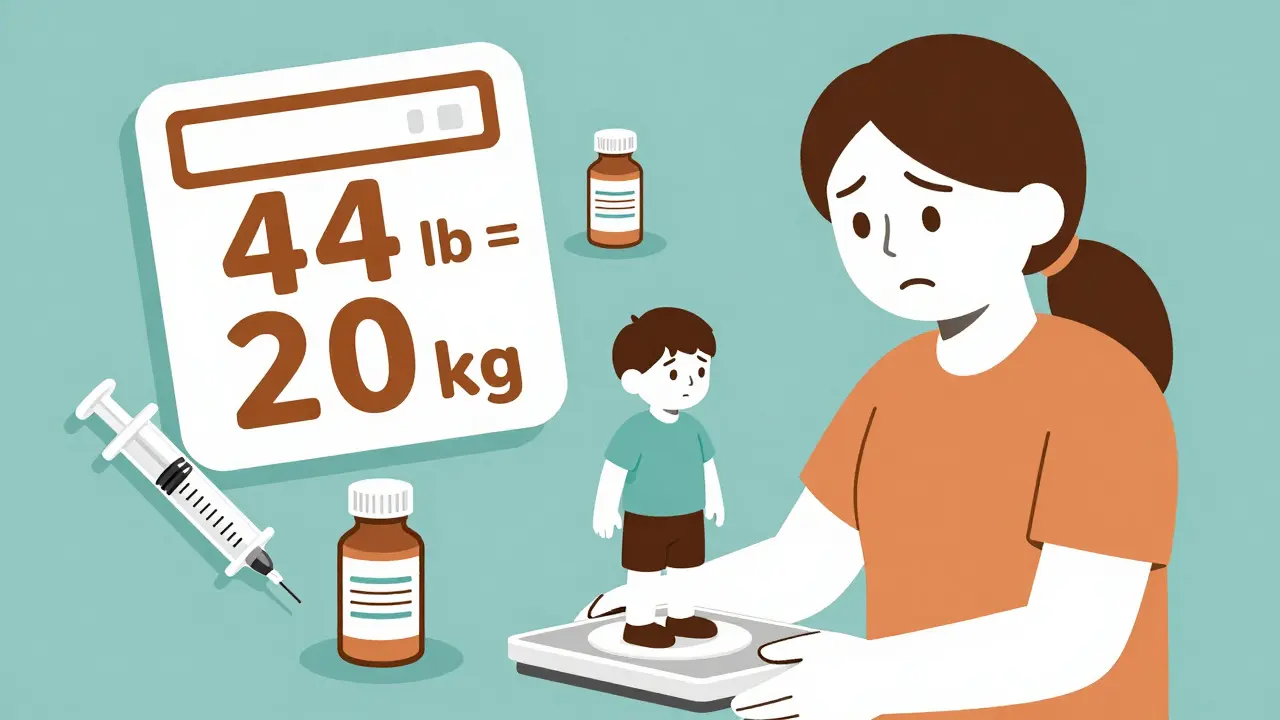
There are three non-negotiable steps to calculate a pediatric dose correctly. Skip one, and you risk harm.- Get the weight in kilograms. Most scales in the U.S. show pounds. But every medication chart uses kg. So if your child weighs 44 pounds, divide by 2.2. That’s 20 kg. Never estimate. Never guess. Measure it. If you’re at home and the scale only shows pounds, write it down and convert it before giving any medicine.
- Use the right dose per kg. The prescription might say “15 mg/kg/day.” That’s the total for the whole day. If it’s given twice a day, you divide that total by two. So 15 mg/kg/day for a 20 kg child = 300 mg total per day. Split into two doses? That’s 150 mg per dose.
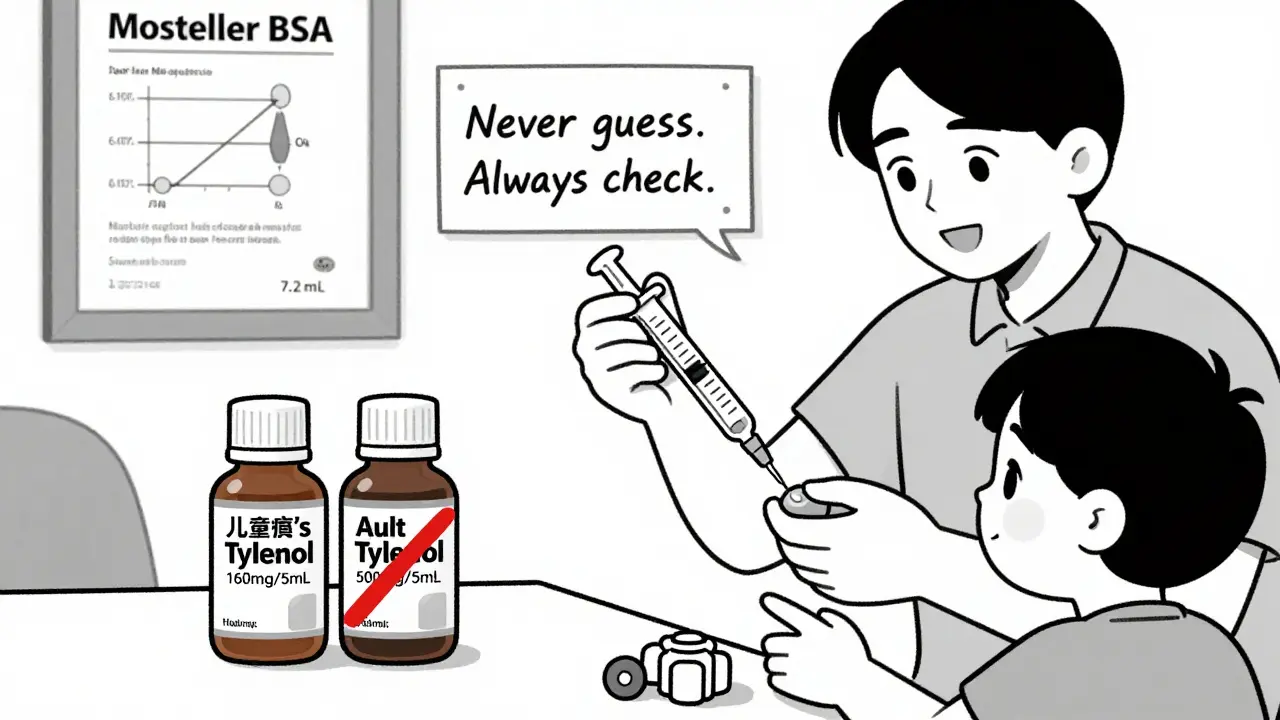
- Convert to volume if needed. Liquid medicines come in different strengths. One bottle of acetaminophen might be 160 mg per 5 mL. Another might be 500 mg per 5 mL. That’s not a typo. That’s a trap. If you use the wrong concentration, you could give five times too much. Always check the label. Write down the concentration. Then calculate: volume = total dose ÷ concentration.
Example: Your child weighs 18 kg. The doctor ordered amoxicillin at 40 mg/kg/day, split into two doses. The liquid is 250 mg/5 mL.
- 18 kg × 40 mg/kg = 720 mg/day
- 720 mg ÷ 2 = 360 mg per dose
- 360 mg ÷ (250 mg / 5 mL) = 360 ÷ 50 = 7.2 mL per dose
That’s 7.2 mL. Not 7. Not 8. 7.2. Use a syringe. Don’t guess with a spoon.
The Biggest Mistake: Unit Confusion
The Institute for Safe Medication Practices says 80% of pediatric dosing errors come from one thing: mixing up pounds and kilograms. That’s not a small error. It’s a tenfold mistake. Think about it. A 22-pound baby is 10 kg. But if you accidentally treat them as 22 kg, you’re giving them more than double the dose. That’s what happened in a 2021 case reported in the Journal of Pediatric Pharmacology and Therapeutics. A 15 kg child got 10 times the right amount of amoxicillin because the nurse misread the weight as 150 pounds instead of 15 pounds. The child ended up in the ICU with severe vomiting and dehydration. That’s why hospitals now require weights to be entered in both pounds and kilograms in electronic systems. If you’re doing it by hand, write both numbers down. Circle the kg. Double-check the math. Use a calculator. Don’t trust your brain.
Why BSA Matters for Some Drugs
Most kids get dosed by weight. But some drugs-especially chemotherapy agents like vincristine or certain antibiotics-are dosed by body surface area (BSA). Why? Because these drugs affect the whole body in a way that’s tied to how much skin and organ surface the child has, not just how heavy they are. The Mosteller formula is the standard: BSA (m²) = √[height in cm × weight in kg ÷ 3600]. Example: A child is 97 cm tall and weighs 16.8 kg.- 97 × 16.8 = 1629.6
- 1629.6 ÷ 3600 = 0.4527
- √0.4527 = 0.67 m²
Now, if the drug is dosed at 1.5 mg/m², multiply 0.67 × 1.5 = 1.005 mg. That’s the dose.
It’s more complex, but for cancer drugs, it’s safer. Hospitals use calculators or apps for this. If you’re a parent, you won’t need this-but your doctor will. Make sure they’re using it.
What You Must Never Do
Some medications are dangerous in kids-even if the weight calculation looks right.- Never give Benadryl (diphenhydramine) to children under 2 years unless a doctor specifically says to. The risk of seizures and breathing problems is too high.
- Never use adult formulations. Children’s Tylenol and adult Tylenol look similar. But one is 160 mg/5 mL. The other is 500 mg/5 mL. Using the wrong one is like giving a toddler a full adult pill.
- Never trust “mg/kg/d” on a prescription. That abbreviation is confusing. It could mean “per day” or “per dose.” Always call the prescriber and ask: “Is this total daily dose or per dose?”
These aren’t opinions. These are warnings from St. Louis Children’s Hospital, the American Academy of Pediatrics, and the FDA. Ignore them at your child’s risk.
How Hospitals Keep Kids Safe
Hospitals don’t rely on one person doing the math. They use systems.- Double-checks. Two nurses verify every weight-based dose for high-risk medications.
- Electronic alerts. Systems like Epic and Cerner auto-calculate doses when weight is entered. If the dose is outside normal range, it flags the order.
- Standardized order sets. Instead of free-text orders, doctors pick from pre-set options like “Amoxicillin for 10-20 kg child.”
- AI tools. Children’s Hospital of Philadelphia is testing AI that compares the calculated dose to thousands of past doses. If something looks off, it warns the doctor before the medicine is given.
These systems have cut dosing errors by more than half. But they’re not perfect. Human judgment still matters.
What Parents Should Do at Home
You’re not a nurse. You don’t have a hospital system. But you can still protect your child.- Always ask for the dose in mg per kg. Write it down.
- Always confirm the concentration of the liquid. Take a picture of the bottle label.
- Use a syringe-not a teaspoon or cup. Teaspoons vary. Syringes don’t.
- Don’t use leftover medicine from another child, even if they “look similar.”
- If you’re unsure, call the pharmacy or your pediatrician. Don’t guess.
One parent told me they gave their 12 kg child 10 mL of amoxicillin because the bottle said “5 mL = 160 mg.” They thought the dose was 20 mL. It wasn’t. The child got sick. The doctor said, “You used the right math, but you misread the concentration.” That’s the kind of mistake that happens every day.
The Bottom Line
Weight-based dosing isn’t complicated. It’s just precise. And precision saves lives. Whether you’re a nurse, a pharmacist, or a parent, your job isn’t to be perfect. It’s to be careful. To double-check. To ask questions. To never assume.Medicine for children isn’t just adult medicine in smaller bottles. It’s a different science. And getting it right starts with one thing: knowing your child’s exact weight-and using it correctly every single time.
How do I convert my child’s weight from pounds to kilograms?
Divide the weight in pounds by 2.2. For example, if your child weighs 33 pounds, divide 33 by 2.2 to get 15 kg. Always write down both numbers: 33 lb = 15 kg. Never round until the final step.
Can I use a kitchen spoon to give liquid medicine?
No. Kitchen spoons vary in size and can hold anywhere from 3 to 15 mL. Always use the syringe or dosing cup that comes with the medicine. It’s marked in milliliters (mL) and gives you exact amounts.
Why do some medications say “mg/kg/day” and others say “mg/kg/dose”?
“mg/kg/day” means the total amount for the whole day. You need to divide it by how many times you give it. “mg/kg/dose” means that’s the amount for each time you give it. Always clarify with the doctor or pharmacist if you’re not sure.
Is it safe to give my child medicine based on age if I don’t know their weight?
No. Age-based dosing is outdated and dangerous. Two children of the same age can weigh 50% more or less than each other. That’s why hospitals require weight. If you don’t know your child’s weight, get it measured before giving any medication.
What should I do if I think I gave the wrong dose?
Call your pediatrician or poison control immediately. Do not wait for symptoms. Even if your child seems fine, some overdoses take hours to show effects. Have the medicine bottle ready when you call-include the concentration and the amount given.
Final Thoughts
Medication errors in kids are preventable. But they only stop when people stop guessing. Whether you’re holding a syringe in a hospital or at home, the same rule applies: weight in kg, concentration on the label, double-check everything. There’s no shortcut. There’s no magic formula. Just careful, step-by-step math-and the courage to ask, “Are you sure?”
8 Comments

Nicki Aries
February 2, 2026 AT 02:31
This post is absolutely vital-seriously, every parent, grandparent, babysitter, and daycare worker should print this out and tape it to the fridge. I used to think ‘just give half a teaspoon’ was fine until my niece had a reaction because we used an adult bottle by accident. I didn’t know the concentrations were different. Now I take pictures of every label. Always. No exceptions.

Lilliana Lowe
February 2, 2026 AT 16:17
While the intent is commendable, the article contains several grammatical inconsistencies. For instance, ‘15 mg/kg/day’ is correctly punctuated with forward slashes, yet later it is inconsistently rendered as ‘mg/kg/d’-a nonstandard abbreviation that undermines credibility. Furthermore, the phrase ‘That’s 7.2 mL. Not 7. Not 8. 7.2.’ is rhetorically redundant and stylistically juvenile. Precision demands clarity, not emphasis through repetition. Also, ‘BMI’ is incorrectly referenced as ‘BSA’ in the heading-this is a critical conflation that could mislead clinicians.

Bob Cohen
February 4, 2026 AT 03:00
Wow. Someone actually wrote a 2,000-word essay on pediatric dosing and didn’t say ‘just call your doctor.’ That’s like finding a unicorn that does taxes. Seriously though-this is the kind of thing that should be mandatory reading before you’re allowed to hold a syringe. Even if you’re just giving Tylenol to your kid after a fall. I once gave my nephew 10 mL of ‘children’s’ ibuprofen because I thought the bottle said 100 mg per 5 mL. It was 50 mg. I panicked. He was fine. But I cried. And then I bought a digital scale.

Nidhi Rajpara
February 4, 2026 AT 16:39
Dear author, I am from India and I found your article very helpful. But I think you should mention that in many rural areas, parents do not have access to digital scales. We use old balance scales and sometimes estimate weight by comparing with known objects. Also, in many pharmacies, liquid medicines come without proper syringes. I have seen mothers using spoons from the kitchen because they cannot afford a dosing cup. Perhaps you can suggest low-cost alternatives? Thank you for your work.

Jamie Allan Brown
February 5, 2026 AT 05:07
I work in a pediatric ER in London, and I’ve seen too many cases where the error wasn’t the math-it was the assumption. Someone saw ‘15 kg’ and thought ‘oh, that’s a big toddler,’ and gave a dose meant for a 20 kg child. We had a child brought in with lethargy after a weekend of ‘just a little extra’ amoxicillin. The parents were terrified. They weren’t careless-they were trusting. That’s why this post matters. Not because it’s complex, but because it reminds us: children aren’t small adults. They’re different. And that difference deserves respect.

Lisa Rodriguez
February 6, 2026 AT 17:27
Just wanted to say thank you for the part about the syringe. I used to use a measuring cup until my kid spit it all out. Now I use the syringe and just squirt it on the inside of the cheek. Game changer. Also, I always write the weight in kg next to the bottle label. I keep a sticky note on my fridge with the conversion chart. 1 lb = 0.45 kg. Easy. I wish I’d known this when my first kid was sick. I almost gave him a double dose because I mixed up the concentration. I’m still embarrassed.

vivian papadatu
February 8, 2026 AT 07:15
I’m a pediatric nurse in Chicago and I’ve used this exact guide in training new staff. The BSA section? Gold. We use it for chemo every day. Also-YES to the AI tools. Our hospital just rolled out a new system that flags doses outside historical norms. It saved us last month when a new resident ordered 400 mg of amoxicillin for a 4 kg preemie. The system popped up: ‘WARNING: 10x typical dose for weight.’ She thanked me later. I told her: ‘Don’t thank me. Thank the algorithm. And the person who wrote this post.’ 🙏

Deep Rank
February 10, 2026 AT 03:29
Look, I read this whole thing and I have to say, it’s kind of terrifying how many ways you can accidentally kill a child with a bottle of medicine. I mean, I get it, weight matters, but honestly, how many parents are really going to calculate BSA with a square root? And why is everyone so obsessed with milliliters? I grew up in a household where we just used a spoon and prayed. And guess what? We’re all still alive. Maybe we’re just lucky. Or maybe the human body is tougher than we think. I mean, my cousin took 30 mL of cough syrup once because he thought it was juice. He slept for 12 hours. No hospital. No seizures. Just a very sleepy 7-year-old. Maybe we’re overcomplicating this. Just use common sense. And if you’re really worried? Don’t give the medicine at all.
Write a comment