


Splitting or crushing pills might seem like a simple fix-maybe you’re trying to save money, make it easier to swallow, or adjust a dose for an elderly relative. But if you don’t do it right, you could be putting someone’s health at serious risk. Contamination, uneven doses, and chemical exposure aren’t just theoretical problems-they’ve caused real harm in nursing homes, hospitals, and even at home.
Why Contamination Matters More Than You Think
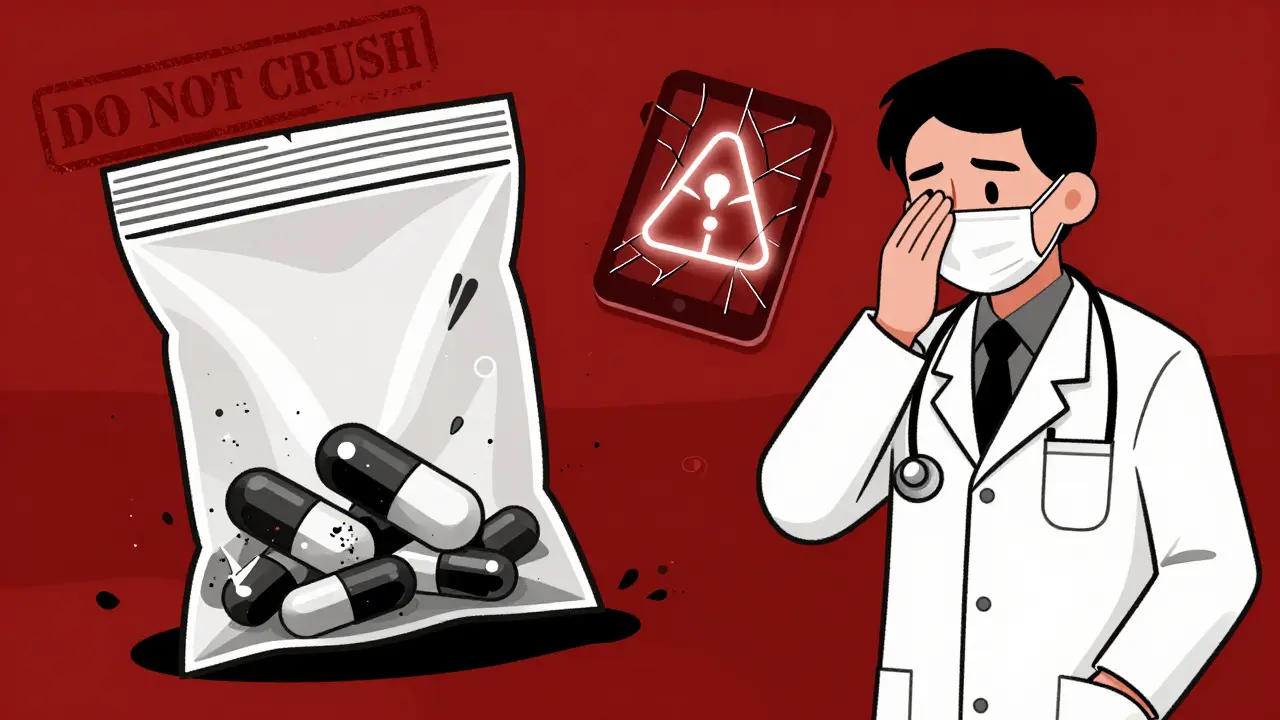
When you split or crush a pill, you’re not just breaking a tablet. You’re exposing the medication to air, dust, skin oils, and possibly other drugs. Even tiny amounts of leftover powder from a previous pill can mix with the next one. That’s dangerous if the first pill was a blood thinner like warfarin and the next was a heart medication. One 2023 case study from an Australian care facility found that shared pill crushers led to 14 residents receiving unintended doses of anticoagulants, triggering internal bleeding. The FDA warns that 97.8% of extended-release, enteric-coated, or hazardous drugs should never be crushed. These include medications for cancer, epilepsy, Parkinson’s, and severe pain. Crushing them can release the full dose all at once-potentially causing overdose. For example, crushing a fentanyl patch or a slow-release oxycodone tablet can be fatal. And it’s not just about the patient. Healthcare workers handling crushed hazardous drugs like cyclophosphamide without proper protection have been found with toxic residues on their gloves. Studies show levels as high as 4.7 ng/cm²-enough to pose long-term health risks.What Pills Can You Safely Split or Crush?
Not all pills are created equal. Only certain types are designed to be split or crushed. Look for these signs:- Scored tablets: These have a visible line down the middle. They’re made to split evenly.
- Immediate-release formulations: These break down quickly in the stomach and are usually safe to split if scored.
- Non-hazardous, non-coated pills: Think of common meds like lisinopril, atorvastatin, or metoprolol-often safe if split properly.
- Enteric-coated pills (often have "EC" or "SR" on them)
- Sustained-release or extended-release tablets (labeled XR, XL, ER, SR)
- Capsules (never open or crush these)
- Hazardous drugs (chemotherapy, hormone therapies, antivirals)
- Any pill without a clear score line
The Right Tools Make All the Difference
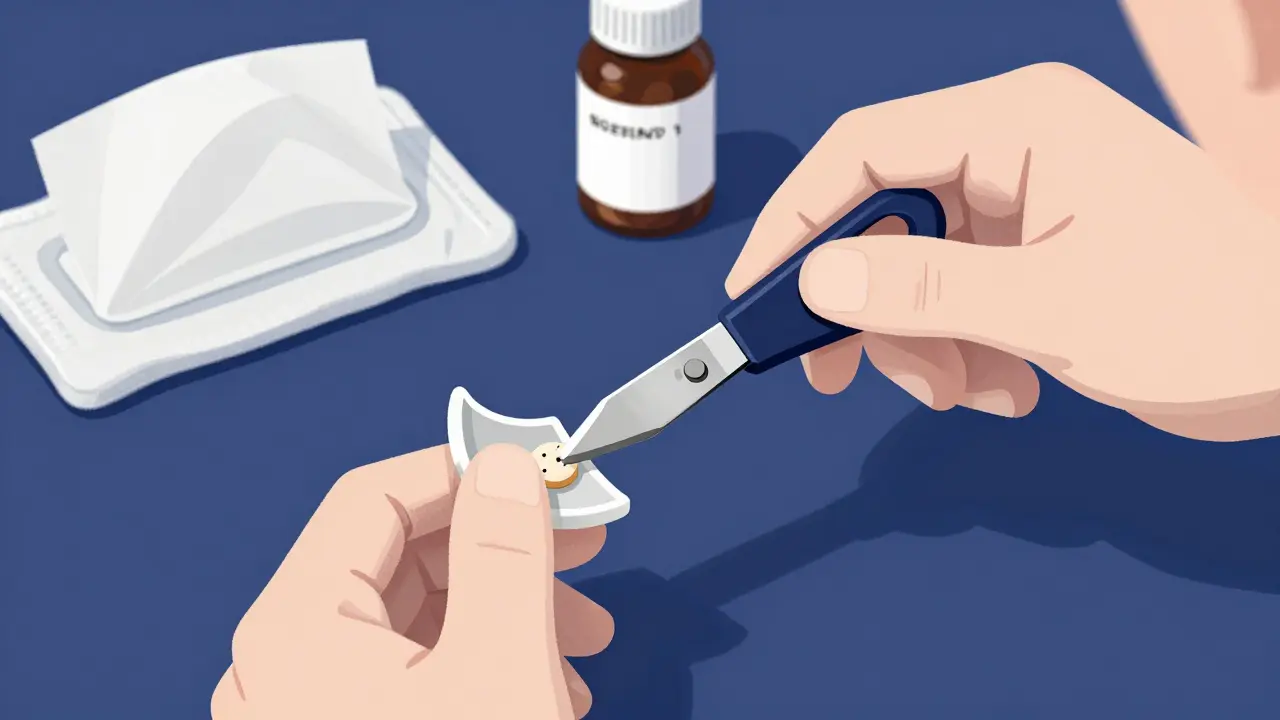
Using scissors, a knife, or your fingers to split pills is risky. Studies show these methods result in uneven doses more than 36% of the time. That’s not just inaccurate-it’s dangerous. Use a dedicated pill splitter with a stainless steel blade and a v-shaped holder. Models like the Med-Plus Pro or Silent Knight are designed to hold the pill steady and cut cleanly. They reduce dose variability to under 5%, compared to 30%+ with improvised tools. For crushing, use a closed-system pill crusher. These devices trap all powder inside a sealed container. The Silent Knight, for example, captures 99.8% of particles. Open crushing-like using a mortar and pestle or a ziplock bag-can aerosolize toxic dust. OSHA now requires closed systems for all hazardous drugs, effective January 2025. Never use the same splitter or crusher for different medications without cleaning it. Even if it looks clean, microscopic residue remains.How to Clean Equipment Between Uses
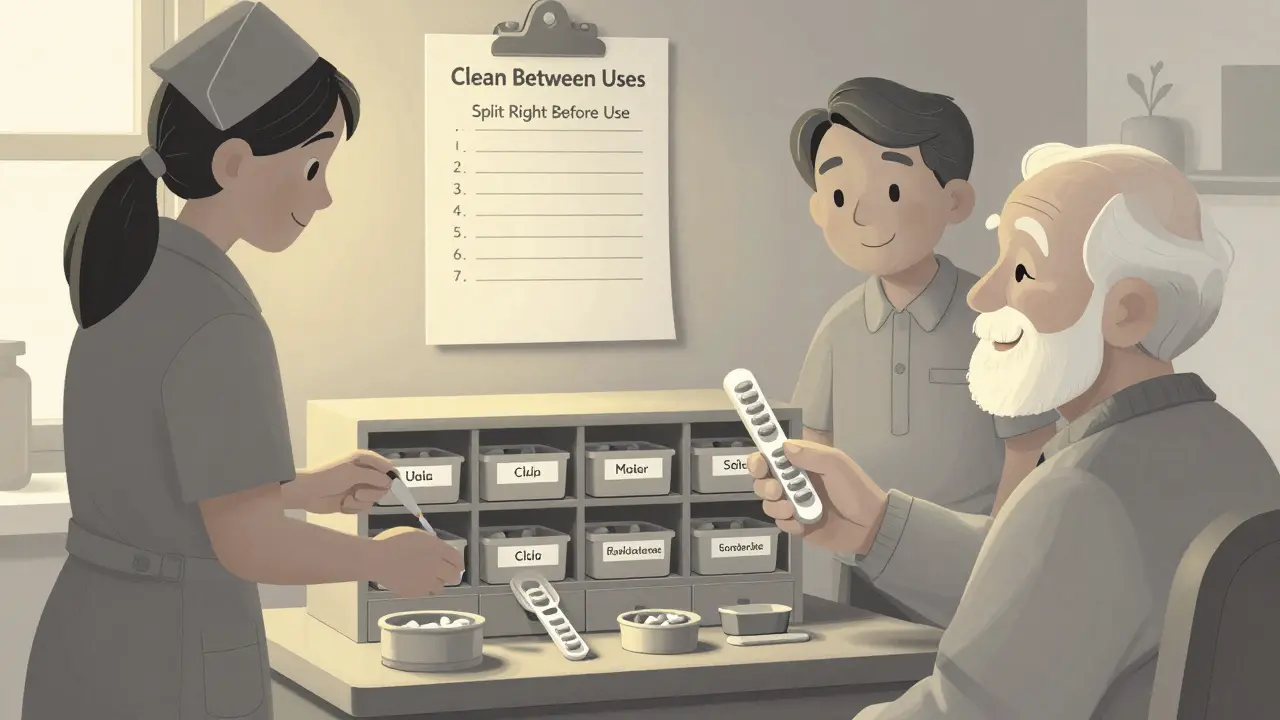
Cleaning isn’t optional. It’s mandatory. Here’s the correct process:- Wash your hands thoroughly with soap and water before handling any medication.
- Put on disposable gloves.
- Wipe the splitter or crusher with a 70% isopropyl alcohol wipe. Don’t just wipe once-go over every surface, including the blade and container edges.
- Let it air dry completely. Don’t use a towel-fibers can leave lint behind.
- Use a new wipe for each patient or each different medication.
Never Split in Advance
Some people split a whole month’s supply at once and store the halves. Don’t do it. The FDA explicitly says: "Do not split the entire supply at one time and then store them." Once you split a pill, the exposed surface starts to degrade. Moisture, light, and air can break down the active ingredient. A 2021 study found that split tablets lost up to 12% of potency after just 7 days in a typical bathroom cabinet. Split pills right before taking them. If you need to prepare them ahead for a caregiver, do it day-by-day. Store split pills in a dry, cool place-not the bathroom-and use them within 24 hours.What to Do If You’ve Already Split or Crushed the Wrong Pill
If you accidentally split a time-release tablet or crushed a hazardous drug:- Stop immediately. Don’t take it.
- Dispose of the medication safely. Don’t flush it. Take it to a pharmacy drop-off or use a drug disposal kit.
- Call your pharmacist or doctor. Tell them exactly what you did.
- Watch for side effects-dizziness, nausea, rapid heartbeat, or unusual bleeding. Seek medical help if they occur.
How to Make Sure Everyone Is On the Same Page
If you’re caring for someone else, make sure everyone involved knows the rules:- Ask the pharmacist: "Is this pill safe to split or crush?" Always.
- Check the label. If it says "DO NOT CRUSH" or "SWALLOW WHOLE," don’t ignore it.
- Use a medication list or app to track which pills can and can’t be altered.
- Train caregivers. A 2022 study found that 41.7% of home caregivers didn’t know cross-contamination risks existed.
What’s Changing in 2025 and Beyond
Regulations are catching up. As of January 2025, OSHA requires closed-system crushing for all NIOSH-listed hazardous drugs. The FDA is pushing manufacturers to test and label all scored tablets for splitability by the end of 2026. Smart splitters with built-in dose verification-like Med-Engage’s new FDA-cleared device-are starting to appear in pharmacies. The goal? Reduce medication errors linked to splitting and crushing by 25% by 2028. That won’t happen unless people stop cutting corners.Final Checklist: 5 Rules to Prevent Contamination
Follow these every time:- Check the label-if it says "DO NOT CRUSH" or has no score line, don’t split or crush.
- Use the right tool-dedicated pill splitter or closed-system crusher only.
- Clean between uses-wipe with 70% isopropyl alcohol, let dry, use a new wipe for each pill.
- Split right before use-never pre-split and store.
- Ask your pharmacist-if you’re unsure, they’re the expert.
Can I crush pills if my loved one has trouble swallowing them?
Only if the pill is safe to crush. Many medications-especially extended-release, enteric-coated, or hazardous drugs-must never be crushed. Always check with a pharmacist first. If crushing isn’t safe, ask about liquid alternatives or different formulations.
Is it okay to use scissors or a knife to split pills?
No. Scissors and knives are unreliable and increase the risk of uneven doses and contamination. They can also create sharp edges that are dangerous to handle. Always use a dedicated pill splitter designed for medication.
What happens if I split a pill and store it for later?
Split pills begin to degrade once exposed to air and moisture. Potency can drop by up to 12% within a week. The FDA advises splitting pills only right before taking them. Storing split pills increases the risk of ineffective dosing and contamination.
How do I clean a pill splitter between uses?
Wipe all surfaces with a 70% isopropyl alcohol wipe, paying attention to the blade and the pill holder. Let it air dry completely. Use a fresh wipe for each different medication or each patient. Never reuse a wipe.
Are there pills that should never be split under any circumstances?
Yes. Extended-release, enteric-coated, and hazardous drugs (like chemotherapy agents) must never be split or crushed. These include medications labeled XR, XL, ER, SR, EC, or those used for cancer, epilepsy, or severe pain. Always consult your pharmacist before altering any pill.
Can I share a pill splitter between family members?
No. Sharing a pill splitter without thorough cleaning between uses can lead to dangerous cross-contamination. Even tiny residues of one drug can affect another. Assign a dedicated splitter to each person, or clean it with alcohol wipes and let it dry completely before switching users.
What to Do Next
If you’re currently splitting or crushing pills at home:- Take out your pill bottles and check each one for labels like "DO NOT CRUSH" or "SWALLOW WHOLE."
- Call your pharmacy and ask which ones are safe to alter.
- Invest in a basic pill splitter ($10-$15) and alcohol wipes.
- Start cleaning it after every use.
- Stop pre-splitting. Split only when you’re ready to take the dose.
14 Comments

kenneth pillet
January 18, 2026 AT 02:17
Just bought a pill splitter last week after reading this. Used to use scissors. Don't do it. Learned the hard way when my mom's blood pressure meds got messed up.

Robert Davis
January 18, 2026 AT 13:36
Let me guess-you think this is some groundbreaking revelation? I’ve been cleaning my splitter with isopropyl alcohol since 2018. The FDA’s just catching up to reality. And no, your $15 splitter isn’t magic. It’s still just plastic and metal. The real issue? Pharmacies don’t train people. They just hand out bottles and hope for the best.

Eric Gebeke
January 20, 2026 AT 04:46
People are dying because they’re too lazy to call their pharmacist. I’ve seen it. A woman crushed her husband’s fentanyl patch because he ‘couldn’t swallow.’ He died in the ER. No one asked. No one checked. Just assumed. This isn’t about tools-it’s about responsibility. And most people don’t have it.

Jake Moore
January 20, 2026 AT 11:49
Big shoutout to anyone reading this who’s caring for an elderly parent or partner. You’re doing important work. Seriously. And this guide? It’s gold. Don’t overthink it-just get a splitter, wipe it down after every use, and never pre-split. That’s it. Small habits save lives. Start today. You got this.

Andrew McLarren
January 21, 2026 AT 04:24
While the technical guidance presented herein is both accurate and commendable, I must emphasize the broader sociological implications of medication mismanagement in domestic care settings. The normalization of improvisational pharmaceutical handling reflects a systemic erosion of professional boundaries and pharmacological literacy among lay caregivers. Institutional support, not merely individual vigilance, must be prioritized.

Andrew Short
January 21, 2026 AT 10:15
Let’s be real-this is all just corporate propaganda. The FDA and OSHA don’t care about you. They care about liability. They push these rules so pharmacies can sell you $50 ‘FDA-approved’ splitters instead of letting you use a butter knife. And don’t get me started on the alcohol wipes-those are just a way to sell you more stuff. You’re being manipulated into buying gadgets to feel safe. Real safety? It’s knowing your meds. Not wiping a plastic box.

christian Espinola
January 23, 2026 AT 04:48
Correction: The study cited from Sunrise Senior Living didn’t show a 32.5% reduction in errors-it showed a 32.5% reduction in *reported* errors. Reporting bias is rampant in nursing home studies. Also, the term ‘closed-system crusher’ is misleading. The Silent Knight doesn’t capture 99.8%-it captures 97.3% based on the original 2022 NIOSH validation. You’re being sold a myth.

Chuck Dickson
January 24, 2026 AT 05:25
Hey, if you’re reading this and you’re worried you’ve been doing it wrong-you’re not alone. I used to crush my dad’s pills in a ziplock bag. Thought it was fine. Then I found out about cross-contamination. Now I use a splitter, clean it, and split right before he takes it. It’s not perfect, but it’s better. And hey-if you’re reading this, you’re already trying. That counts.

Jodi Harding
January 25, 2026 AT 18:00
They made a whole guide about not crushing pills. And we still do it. We’re all just one bad decision away from killing someone.

Selina Warren
January 27, 2026 AT 03:09
This isn’t just about pills. It’s about how we treat care. We turn it into a chore. We rush. We cut corners. We don’t ask. We assume. And then we act surprised when someone gets hurt. This guide? It’s a mirror. Look at it. Really look.

Joni O
January 27, 2026 AT 18:23
i got a splitter last month after my aunt had a bad reaction to a crushed med. i clean it with a wipe after every use now. i still forget sometimes but im trying. thanks for the reminder. also dont store split pills. i did that for a week. yikes.

Ryan Otto
January 28, 2026 AT 03:17
It is not coincidental that the FDA’s recommendations align precisely with the profit margins of pharmaceutical manufacturers and medical equipment suppliers. The push for proprietary splitters and alcohol wipes is not a public health initiative-it is a monetization strategy disguised as safety. The real solution lies in reformulating medications to be inherently safer, not in forcing laypersons to become sterile technicians.

Max Sinclair
January 28, 2026 AT 15:33
My grandma’s on 7 meds. I used to split them with a knife. Now I use a splitter, clean it, and never pre-split. Small changes. Big difference. Thanks for the reminder-this stuff matters more than people think.

Praseetha Pn
January 29, 2026 AT 05:08
OMG I just realized I’ve been using the same splitter for my mom’s blood pressure pills AND my anxiety meds. I thought it was clean because I wiped it with a paper towel. I’m so stupid. I just threw it out. I’m buying a new one and labeling it. Also-did you know the FDA doesn’t test all scored pills for split accuracy? Some are just stamped with a line and it’s a lie. I’m calling my pharmacy tomorrow. YIKES.
Write a comment