




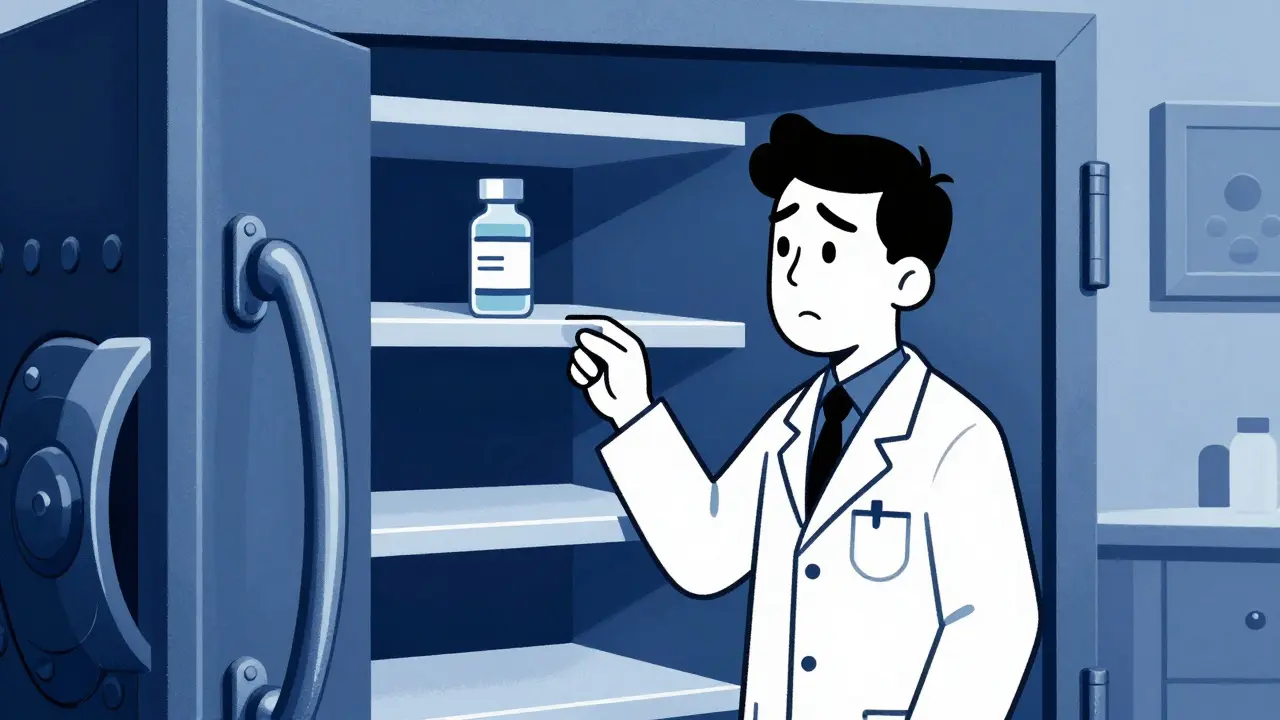
Imagine opening your pharmacy vault and finding a vial of saline where a dose of fentanyl should be. The patient is waiting, the chart says they received medication, but the inventory system shows a discrepancy that doesn't add up. This isn't just an administrative headache; it’s a sign of drug diversion, a critical failure in healthcare security that puts patients at risk and facilities under intense regulatory scrutiny.
Storing controlled substances correctly is not about being paranoid. It is about creating a closed loop where every milligram of medication is accounted for from the moment it enters your facility until it is administered or disposed of. With the Drug Enforcement Administration (DEA) increasing inspection frequencies by 37% between 2019 and 2022, and civil penalties averaging $187,500 for storage violations, getting this right is non-negotiable.
Understanding the Regulatory Framework
To store these medications safely, you first need to understand the rules governing them. The cornerstone of this regulation is the Controlled Substances Act (CSA) of 1970. This law created a "closed system" of distribution, requiring all handlers to register with the DEA and maintain strict accounting.
The specific operational guidelines come from 21 CFR Part 1301, which mandates that registrants provide effective controls to guard against theft and diversion. But regulations alone aren't enough. You also have the ASHP Guidelines on Preventing Diversion of Controlled Substances (2018). These guidelines break down prevention into six domains, including chain of custody, storage, internal controls, prescribing, administration, and disposal.
Why does this matter? Because the International Health Facility Diversion Association estimates there are roughly 37,000 annual diversion incidents in U.S. healthcare facilities. That number is likely higher, as many cases go unreported until a DEA audit catches them. Your storage protocols are the first line of defense in this massive statistical battle.
Physical Storage Requirements and Security Measures
Physical security is the most visible part of diversion prevention. The DEA requires that controlled substances be secured in a manner adequate for safeguarding. What does "adequate" look like in practice?
- Limited Access: UCLA Environmental Health & Safety recommends limiting access to only one or two individuals. Fewer keys mean fewer opportunities for theft.
- Visibility: Personal lockers for staff should not be hidden from view. They must be positioned so that supervisors can see if someone is accessing them improperly.
- No Personal Items: The NIH analysis of large-scale diversion incidents highlights a simple but dangerous habit: carrying bags and purses into pharmacy areas. This was a contributing factor in 31% of diversion cases. Ban personal bags in medication areas entirely.
- Schedule III-V Security: Even if state laws don’t require locking Schedule III-V drugs, bring them into locked storage anyway. The NIH explicitly advises this to prevent low-level diversion that often escalates.
Think about the layout of your dispensary. If a non-pharmacy personnel member can walk behind a counter and open a cabinet without triggering an alarm or needing a key, your physical security has failed. Position your storage areas so they are naturally surveilled by workflow traffic.
Automated vs. Manual Storage Systems
One of the biggest decisions you’ll face is whether to invest in automated technology or stick with manual locks and logs. The data here is stark. Facilities using manual inventory tracking experience diversion rates 4.2 times higher than those with fully integrated electronic systems.
| Feature | Manual Storage (Locks/Logs) | Automated Dispensing Cabinets (ADCs) |
|---|---|---|
| Diversion Risk Points | Vulnerable at 87% of identified risks | Reduces vulnerability to 23% of risk points |
| Audit Trail | Prone to human error and falsification | Real-time, tamper-proof digital logs |
| Staff Time Requirement | 37% more time for inventory management | Automated counting reduces manual labor |
| Initial Cost | Low ($500 - $2,000 for high-security cabinets) | High ($45,000 - $75,000 per unit) |
| Best For | Small clinics (<100 beds), low-volume facilities | Hospitals (>200 beds), high-volume ORs |
Automated Dispensing Cabinets (ADCs) are the industry standard for larger facilities. When implemented with dual authentication protocols, they reduce diversion incidents by 73%. However, they come with a price tag. Basic implementation costs between $45,000 and $75,000 per unit, with annual maintenance contracts averaging 15% of the purchase price. For a small critical access hospital, this might be cost-prohibitive.
If you can’t afford ADCs, you must compensate with rigorous manual controls. This means dual-control protocols, where two authorized personnel must be present for any access. It’s slower, but it creates a witness system that deters theft.
Identifying High-Risk Handoff Points
Storage isn't just about the box the drug sits in; it's about the movement of the drug. The highest-risk scenarios occur during compounding or when transferring stock from the central pharmacy to floor-level ADCs. In 68% of large-scale diversion cases reviewed by the DEA between 2019 and 2022, the gap existed because one side of the transaction was documented manually while the other was electronic.
You need to map your process. Look at every handoff:
- Receiving shipment from the distributor.
- Counting into the main vault.
- Refilling the ADCs.
- Nurse pulling from the ADC.
- Administration to the patient.
If any step relies on a paper log that isn't cross-referenced immediately, you have a blind spot. Electronic transactions, such as scanning a barcode to move stock from the vault to an ADC, are far easier to monitor. Manual transactions require additional controls, like immediate pharmacist verification.
Surveillance, Auditing, and Behavioral Monitoring
Technology and locks are useless if no one is watching the data. Dr. Katherine Takla, Chair of ASHP's Controlled Substances Workgroup, emphasizes that limiting physical access while maximizing electronic audit trails creates the strongest defense.
This means daily reviews. A pharmacist should review CS vault access and dispensing cabinet records every day. They aren't looking for normal patterns; they are looking for outliers. Is Nurse A always pulling extra doses? Is Pharmacist B consistently over-dispensing to the oncology ward?
New technologies are helping here. AI-powered anomaly detection systems, piloted at institutions like Johns Hopkins and Mayo Clinic, can identify 92% of diversion incidents within 48 hours while reducing false positives by 63%. These systems flag unusual behavior before it becomes a major loss.
Behavioral monitoring is equally important. Dr. Karen Berge of Mayo Clinic notes that securing supplies and limiting access can reduce risk by up to 89% when combined with behavioral observation. Watch for staff who seem overly protective of their drawers, refuse to take breaks, or exhibit sudden changes in financial status. These are red flags that warrant a gentle but firm investigation.
Implementation Challenges and Staff Buy-In
You can have the best policy in the world, but if your staff hates it, they will find ways around it. The PharmTech Society’s 2022 survey found that 63% of facilities reported significant staff pushback during storage protocol enhancements.
Why do people resist? Often, it’s because new protocols slow them down. One OR pharmacist shared a story where cost-cutting led to only one ADC for 12 operating rooms. This created workflow bottlenecks, causing manual overrides to increase by 200%, which ironically led to two diversion incidents in six months. Efficiency and security must work together.
To overcome resistance:
- Train Thoroughly: Allocate 40 hours of training per full-time equivalent pharmacy position. Explain the 'why' behind the rules.
- Set Clear Expectations: Make it clear that moving bags or boxes out of the pharmacy without authorization is grounds for immediate disciplinary action.
- Enforce Consistently: After six months of consistent enforcement, 89% of facilities noted improved security awareness among staff.
Disposal and Waste Management
Preventing diversion doesn't end when the drug is used. Improper disposal is a major loophole. Unused portions of controlled substances, especially partial doses drawn up in syringes, are frequent targets for diversion.
Facilities must have a clear protocol for waste. This includes:
- Using witnessed destruction methods where two staff members verify the drug is flushed or destroyed.
- Maintaining detailed logs of wasted amounts, matching them to the original dispensed quantity.
- Ensuring that waste containers are secure and emptied regularly to prevent accumulation.
The DEA requires that theft or significant loss be reported within one business day. During inspections, investigators examine storage areas in 92% of onsite visits. If your waste logs don't match your usage logs, you will be flagged.
Next Steps for Your Facility
If you are looking to improve your current setup, start with a gap analysis. Use the ASHP Assessment Tool, which provides a 147-point framework. Most facilities need 8-12 weeks for comprehensive implementation.
Begin by auditing your physical space. Are your locks adequate? Can you see your lockers? Then, review your digital trails. Are you reviewing outlier reports daily? Finally, talk to your staff. Listen to their pain points regarding workflow, and adjust your processes to minimize bottlenecks without sacrificing security. Remember, the goal is patient safety. Every protocol you implement is a promise to keep harmful substances out of the wrong hands.
What are the DEA requirements for storing controlled substances?
The DEA requires that controlled substances be stored in a securely locked, substantially constructed cabinet. For Schedule II drugs, this is strictly enforced. The facility must maintain effective controls and procedures to guard against theft and diversion, as mandated by 21 CFR Part 1301. This includes limiting access to authorized personnel and maintaining accurate inventory records.
Do I need an Automated Dispensing Cabinet (ADC) for compliance?
No, the DEA does not explicitly mandate ADCs. However, facilities using manual systems have diversion rates 4.2 times higher than those with electronic systems. While ADCs are not legally required, they are considered best practice for hospitals with over 200 beds due to their superior audit trails and security features.
How soon must I report stolen controlled substances?
You must report theft or significant loss of controlled substances to the DEA Diversion Control Division within one business day of discovering the loss. Failure to report promptly can result in severe civil penalties and increased scrutiny during future inspections.
Can I store Schedule III-V drugs in unlocked shelves?
While federal law may allow some flexibility for Schedule III-V drugs, the NIH and ASHP strongly recommend bringing all controlled substances into locked storage. Many states have stricter laws than the federal government. Best practice is to lock all controlled substances regardless of schedule to prevent low-level diversion.
What is the role of behavioral monitoring in diversion prevention?
Behavioral monitoring involves observing staff for signs of substance abuse or suspicious activity, such as excessive overtime, changes in appearance, or unusual inventory patterns. When combined with strict access controls, it can reduce diversion risk by up to 89%. It is a proactive measure that complements physical and technological security.