




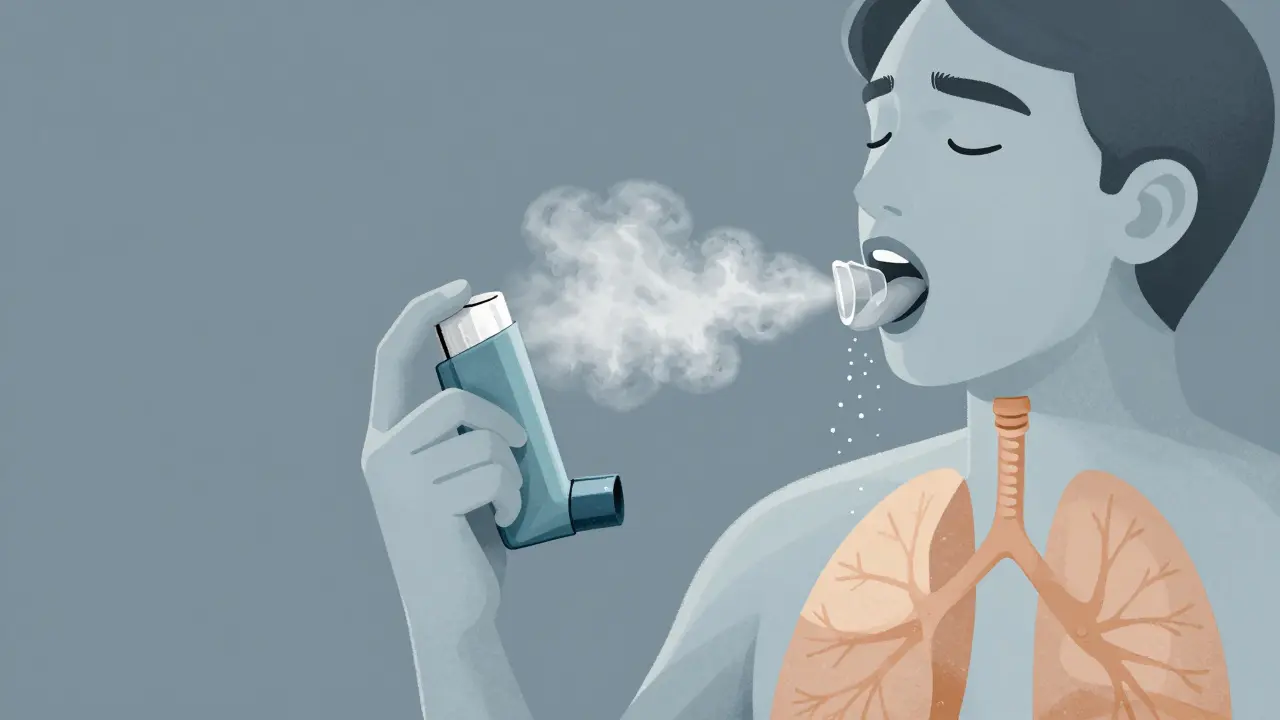
When you have asthma, your lungs are constantly on edge. Inflammation tightens your airways, making breathing feel like trying to suck air through a straw. Inhaled corticosteroids (ICS) are the most reliable tool doctors have to calm that inflammation. For millions of people, these tiny puffs from an inhaler mean fewer attacks, less wheezing, and the freedom to live without fear. But here’s the thing no one always tells you: inhaled steroids aren’t harmless. They’re powerful. And if you don’t use them right, they can cause problems you didn’t sign up for.
What Happens When You Use an Inhaler?
Inhaled steroids like fluticasone, budesonide, and mometasone don’t float around your whole body. They’re designed to land in your lungs and stay there. That’s the goal. But not all of it makes it. About 70-90% of the dose sticks to your throat and mouth. That’s why you get side effects like a sore throat, hoarse voice, or white patches in your mouth - oral thrush. It’s not the medicine attacking your lungs. It’s the medicine sitting where it shouldn’t be.Here’s the reality: if you don’t rinse your mouth after using your inhaler, you’re leaving the drug right where it can cause trouble. A 2019 Cochrane review showed that rinsing and spitting cuts thrush risk by half. That’s not a suggestion. That’s a medical necessity. And it’s not just about thrush. Long-term use, especially at higher doses, can lead to thinning skin, easy bruising, and even changes in your adrenal glands - the ones that make your body’s natural stress hormones.
Not All Steroid Inhalers Are the Same
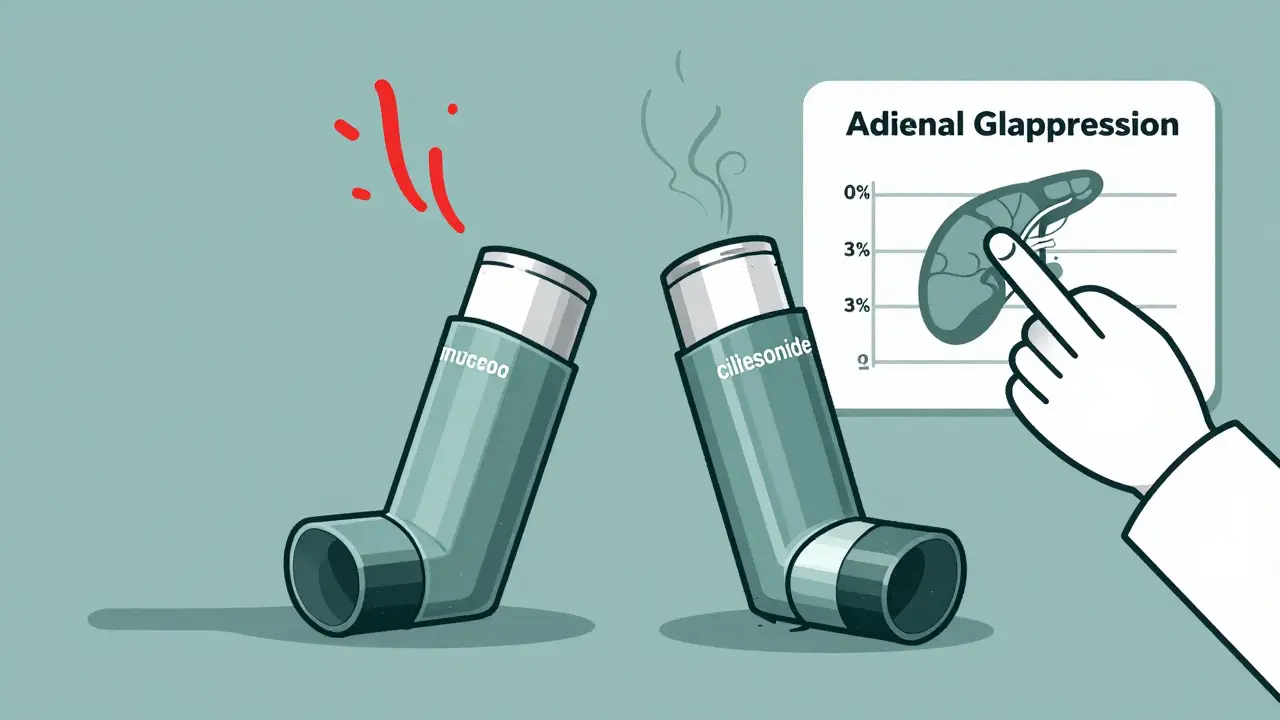
You might think all inhalers are created equal. They’re not. Some are designed to be absorbed less into your bloodstream. Ciclesonide and mometasone, for example, are newer and have much lower systemic exposure. Studies show ciclesonide has less than 3% of its dose entering your blood, compared to 30-40% with fluticasone. That’s a huge difference. It’s why some doctors now recommend switching from fluticasone to budesonide or ciclesonide if you’re on a higher dose or have had side effects.Fluticasone is effective, no doubt. But if you’re on 500 mcg or more per day, your risk of adrenal suppression - where your body stops making enough cortisol - goes up nearly threefold compared to budesonide at the same dose. That’s not a small risk. It means you could feel constantly tired, get sick more often, or even have a dangerous drop in blood pressure during stress or illness.
And it’s not just about the drug. Delivery matters. Pressurized inhalers (pMDIs) without a spacer send most of the dose straight into your throat. But add a spacer - that plastic tube you attach to your inhaler - and lung delivery jumps from 10-20% to 60-80%. That means less drug in your mouth, less thrush, less hoarseness, and more medicine where it actually works.
The Real Culprit: Poor Technique
Here’s a startling stat: 72% of people who experience serious side effects from inhaled steroids never got proper instruction on how to use their inhaler. That’s not their fault. It’s a system failure. Too many doctors hand out an inhaler and say, “Use this twice a day.” No demo. No check-in. No asking if they’re rinsing.People think they’re using it right because they feel the puff. But if you press the inhaler and breathe in at the wrong time, if you don’t hold your breath after inhaling, if you don’t clean the mouthpiece - the medicine doesn’t reach your lungs. It lands on your tongue. And that’s where the problems start.
Simple fixes work. Rinse with water after every use. Spit it out. Don’t swallow. Use a spacer with every pMDI. Clean the mouthpiece weekly. Check your technique every six months with your doctor or asthma nurse. One study found that routine technique reviews caught errors in 45-60% of patients. That’s half the people who thought they were doing it right - and they weren’t.
Who’s at Higher Risk?
Not everyone faces the same level of danger. Children on standard doses (under 400 mcg/day of beclomethasone equivalent) might grow a tiny bit slower - about 0.7 cm per year - but their final adult height isn’t affected. That’s reassuring. But if a child is on high doses (over 800 mcg/day), their risk of cataracts jumps more than double. That’s why pediatricians now monitor eye health in kids on long-term, high-dose therapy.Older adults are another group at risk. If you’re over 65 and on more than 500 mcg/day, your chance of pneumonia goes up. And if you’re already at risk for osteoporosis, high-dose steroids can make bone fractures more likely. One study found a 31% higher fracture risk in seniors on doses over 500 mcg/day. That’s why doctors should check bone density if you’ve been on high-dose ICS for more than five years.
Pregnant women need special care too. Budesonide is the go-to during pregnancy because it’s been studied the most - over 15 years of data show no increased risk of birth defects. Fluticasone? Not as well studied. It’s not banned, but budesonide is the safer bet unless there’s a clear reason to switch.
Monitoring: What Your Doctor Should Be Checking
You shouldn’t have to guess whether your inhaler is harming you. Your doctor should be watching for signs. Here’s what should happen regularly:- Every 3-6 months: Check for thrush, hoarseness, or throat irritation. A quick look in your mouth takes 10 seconds.
- Annually for those over 65: Skin thinning and bruising. Look at your arms, legs, and hands. Easy bruising? That’s a red flag.
- Every 5 years if you’re on high-dose ICS (>750 mcg/day): Bone density scan. Especially if you’re postmenopausal or have a family history of osteoporosis.
- If you’re on more than 500 mcg/day and feel constantly tired: A simple saliva test for cortisol levels. If it’s below 3 mcg/dL, your adrenal glands might be shutting down.
And here’s something new: smart inhalers. These devices track when you use your inhaler and whether you’re inhaling correctly. They send data to your phone and your doctor. One study showed they catch technique errors with 92% accuracy. If your doctor hasn’t mentioned this, ask. It’s not a luxury. It’s a safety tool.

What You Can Do Right Now
You don’t need to stop your inhaler. You need to use it better. Here’s your action list:- Ask your doctor what dose you’re on - and if it’s the lowest possible dose to keep your asthma under control.
- If you’re on fluticasone and your dose is above 250 mcg/day, ask if switching to budesonide or ciclesonide could lower your side effect risk.
- Get a spacer if you use a pressurized inhaler. They cost under $10 and are reusable.
- Rinse your mouth with water after every puff. Spit. Don’t swallow.
- Book a technique check-up with your doctor or asthma nurse. Even if you think you’re doing it right.
- Watch for bruising, fatigue, or white patches in your mouth. Don’t ignore them.
The Future Is Changing
The good news? We’re moving beyond steroids. New biologic drugs like dupilumab and mepolizumab target specific inflammation pathways in severe asthma. In trials, they’ve cut ICS doses by 70% in patients who used to need high doses just to stay stable. That’s huge. And in the next few years, even newer inhaled steroids like AZD7594 are coming - designed to work in the lungs with almost zero absorption into the blood. Early results show 90% less adrenal suppression than fluticasone.But until those become widely available, the best tool you have is the one you’re already using - if you use it right. Inhaled steroids are not the enemy. Poor use, lack of monitoring, and outdated practices are.
Your asthma doesn’t need to control your life. But your inhaler shouldn’t either. With the right dose, the right technique, and the right checks, you can breathe easy - without paying the price.
Can inhaled steroids cause weight gain?
Inhaled steroids rarely cause weight gain because they don’t flood your body with steroids like oral pills do. Weight gain is a common side effect of oral corticosteroids, but with inhaled versions, the amount that enters your bloodstream is very low - especially if you rinse after use. If you’re gaining weight, it’s more likely due to other factors like reduced activity from asthma symptoms or other medications.
How long does it take for side effects to appear?
Local side effects like thrush or hoarseness can show up within weeks, especially if you’re not rinsing. Systemic effects - like adrenal suppression or bone thinning - take longer. They usually appear after months to years of high-dose use. That’s why monitoring matters. You can’t wait until you feel terrible to check.
Is it safe to stop using my steroid inhaler if I feel fine?
No. Stopping suddenly can cause your asthma to flare badly, even if you feel fine. Inhaled steroids work by reducing underlying inflammation - you don’t feel that, but it’s still there. Always talk to your doctor before making any changes. They can help you reduce your dose safely if it’s appropriate.
Do children outgrow the growth delay from inhaled steroids?
Yes. Studies show that while children on inhaled steroids may grow slightly slower in the first year or two, they catch up over time. Their final adult height is not affected when they’re on standard, low-to-moderate doses. High doses (over 800 mcg/day) are the exception and should be avoided unless absolutely necessary.
Can I use a spacer with a dry powder inhaler?
No. Spacers are only designed for pressurized metered-dose inhalers (pMDIs). Dry powder inhalers (DPIs) like Diskus or Turbuhaler work differently - you breathe in hard and fast to pull the powder out. Using a spacer with a DPI blocks the airflow and prevents the medicine from working. Always check what type of inhaler you have before using accessories.
What should I do if I think my inhaler is causing side effects?
Don’t stop taking it. Write down your symptoms - when they started, how often they happen, and what you’re doing differently. Bring this to your doctor. They can check your technique, review your dose, test for adrenal function if needed, and possibly switch you to a safer inhaler. Most side effects are reversible if caught early.
9 Comments

Darren Gormley
February 1, 2026 AT 03:45
bro i just started using a spacer last month and my throat stopped feeling like i swallowed sand. also, no more white stuff in my mouth 🤯 i thought it was just me being gross, turns out i was just dumb. spacer = 10/10, would rinse again.

Mike Rose
February 2, 2026 AT 15:08
why do they make us use this stuff at all? why not just give us pills? i dont wanna rinse my mouth every time i breathe. sounds like a hassle.

Russ Kelemen
February 3, 2026 AT 18:14
This is one of those posts where you realize the real enemy isn’t the medicine-it’s the system that lets people fall through the cracks. I’ve seen too many folks handed an inhaler like it’s a candy wrapper and told to ‘figure it out.’ The fact that 72% of side effects come from bad technique? That’s not patient error. That’s healthcare failure. If your doctor hasn’t watched you use your inhaler in person, they’re not doing their job. And spacers? They’re not optional. They’re basic. Just like washing your hands before surgery. No one should have to beg for this level of care.

Diana Dougan
February 5, 2026 AT 16:38
soooo... if i dont rinse, im basically just sucking in steroids and letting them rot my mouth? lmao why is this not on every damn ad? someone get this to the FDA before another kid loses their teeth.

Bobbi Van Riet
February 7, 2026 AT 00:39
I’ve been on budesonide for 8 years and honestly? I didn’t know about the spacer thing until last year. My doctor just said ‘use it twice a day’ and I thought I was doing great. Then I started getting hoarse and got thrush - thought it was a cold. Turns out I was spraying it on my tongue like a spray tan. Got a spacer, started rinsing, and my voice came back. Also, switched from fluticasone to budesonide after reading this - my energy levels shot up. I used to nap after work. Now I walk my dog. Small changes, huge difference. If you’re on a high dose and feel tired all the time? Ask for a cortisol test. It’s simple. It’s cheap. It could save your life.

Holly Robin
February 8, 2026 AT 09:51
THEY’RE HIDING THIS. I swear, the pharmaceutical companies don’t want you to know how dangerous these are. I had adrenal shutdown. I collapsed at the grocery store. They told me it was ‘stress.’ No. It was the inhaler. My doctor didn’t test me for 3 years. This is a cover-up. They profit off your suffering. I’m not the only one. Google ‘steroid inhaler adrenal crisis’ - the stories are everywhere. Why isn’t this on the box? Why isn’t it a TV commercial? Because they don’t want you to stop. Wake up.

Gaurav Meena
February 9, 2026 AT 04:54
From India here - we don’t have spacers in most clinics. People just use the inhaler and hope for the best. I’m glad someone wrote this. My cousin’s daughter had thrush for months - we thought it was sugar. Now she uses a spacer made from a plastic bottle. No cost. Big difference. 🙏 Stay safe, everyone. Your lungs matter more than your pride.

Katie and Nathan Milburn
February 9, 2026 AT 10:49
I appreciate the thoroughness of this post. The data presented is both clinically significant and accessible to laypersons. One might argue that the emphasis on technique reflects a broader systemic issue in chronic disease management - namely, the assumption of patient competency without adequate education. The introduction of smart inhalers represents a promising step toward precision adherence monitoring, though accessibility remains a concern in underserved populations.

Marc Bains
February 11, 2026 AT 02:03
I’m a Black man with asthma. I’ve been to 3 different doctors who never asked me how I used my inhaler. One even laughed when I asked about spacers. ‘You’re fine.’ I wasn’t. I had to Google this stuff myself. This post? It’s the kind of info that saves lives in communities that get ignored. Thank you. And if you’re reading this and you’re not rinsing? Do it now. Your throat will thank you.
Write a comment