


When you can’t hear the doorbell, the phone, or someone whispering your name - but loud sounds still feel muffled - it’s not just bad luck. It could be conductive hearing loss. This isn’t about your inner ear or nerves. It’s about sound getting stuck before it even reaches the cochlea. The problem? Your middle ear. Something’s blocking, stiffening, or breaking the tiny chain of bones that normally carries sound from your eardrum to your inner ear.
Unlike sensorineural hearing loss - which comes from damaged hair cells in the cochlea - conductive hearing loss often has a clear, fixable cause. And here’s the good news: in many cases, surgery can restore hearing completely. No hearing aids. No lifelong dependency. Just a well-placed repair.
What’s Really Going On in Your Middle Ear?
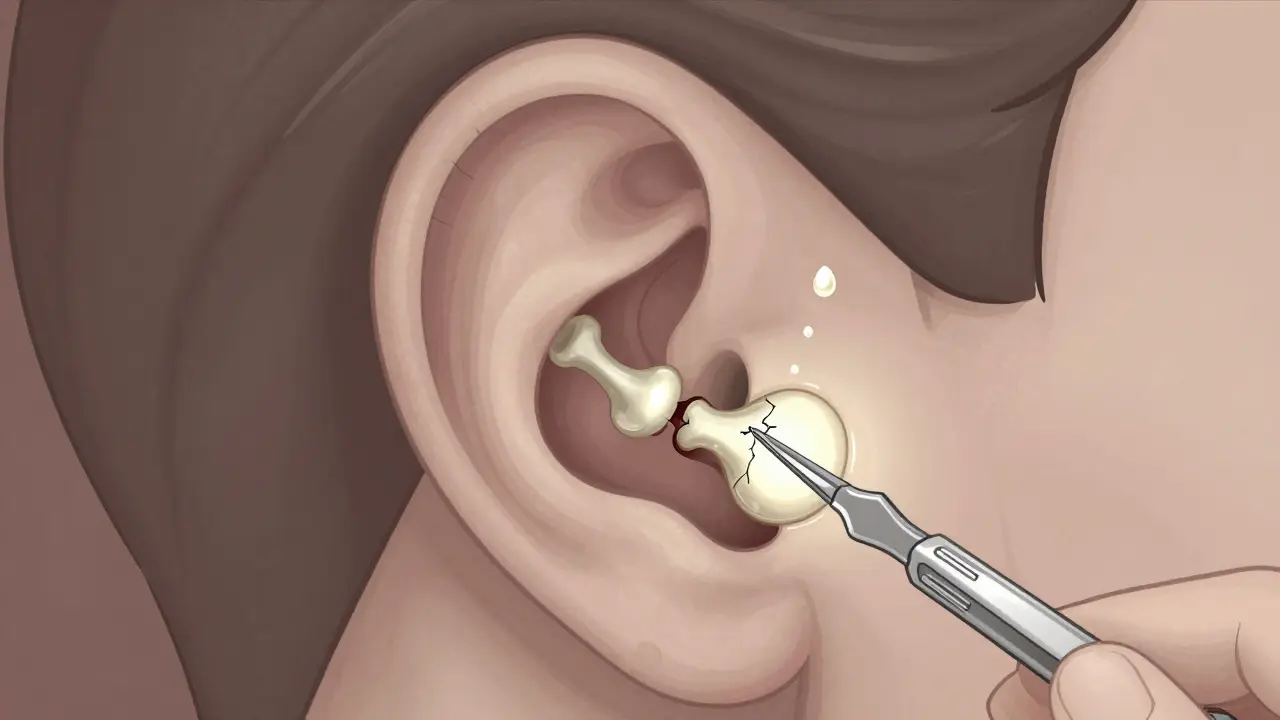
Your middle ear is a small, air-filled space behind the eardrum. Inside it, three tiny bones - the malleus, incus, and stapes - work like a lever system. They pick up vibrations from your eardrum and push them into the fluid-filled cochlea. If any part of this chain breaks, gets blocked, or fuses together, sound can’t pass through. That’s conductive hearing loss.
Common culprits? Earwax buildup is the easiest to fix - but it’s not always the cause. More serious issues include:
- Fluid behind the eardrum - often from colds or allergies. In kids, this is called "glue ear" and affects up to 80% of children by age 3.
- Perforated eardrum - from trauma, loud noises, or ear infections. About 15-20% of adult cases come from this.
- Otosclerosis - a genetic condition where the stapes bone fuses to the inner ear wall. It usually starts in young adults and gets worse over time.
- Cholesteatoma - a skin cyst that grows in the middle ear. It doesn’t sound dangerous, but it eats away at bone. Left untreated, it can destroy hearing, balance, and even cause brain infections.
- Aural atresia - a birth defect where the ear canal never formed. It happens in about 1 in 10,000 babies.
Each of these has a different path to repair. And that’s why guessing won’t cut it.
How Do You Know It’s Conductive - Not Just "A Little Deaf"?
Big box stores sell hearing tests for $20. They’re useless for this. Conductive hearing loss needs a real audiologist - not a kiosk.
The gold standard is a hearing test that compares air conduction (sound through the ear canal) and bone conduction (sound through the skull). If sound travels better through bone than through air, you’ve got an air-bone gap. That’s the fingerprint of conductive loss.
Typical gaps range from 15 to 60 decibels. A 30 dB gap means you can’t hear a whisper, but you’ll still hear a vacuum cleaner. A 50 dB gap? You’ll miss normal conversation unless someone shouts.
Tympanometry adds another layer. It measures how well your eardrum moves. A flat line (Type B) means fluid is trapped behind it - common in kids with chronic ear infections. A stiff eardrum? Could mean otosclerosis.
And if the doctor suspects cholesteatoma or a malformed ear canal? A high-res CT scan of the temporal bone is next. It shows bone erosion, cysts, or missing structures in stunning detail. Out-of-pocket cost? $800-$1,200 in the U.S. - but it’s worth every penny if surgery is on the table.
Surgery: When and What Type?
Not every case needs surgery. In kids, 65% of conductive hearing loss clears up with time or medicine. But if hearing stays below 25-30 dB for more than 3-4 months, it’s time to talk surgery.
Tympanoplasty - Fixing the Eardrum
If your eardrum has a hole - from trauma, infection, or old tubes - tympanoplasty rebuilds it. Surgeons take a tiny graft, usually from your own temporalis muscle or cartilage, and patch the tear. Success rates? 85-95% for small holes. Even large ones heal in 70-85% of cases.
Recovery takes 6-8 weeks. No swimming. No blowing your nose hard. No flying without ear pressure plugs. But once healed, hearing often jumps back to near-normal.
Stapedectomy - Unfreezing the Stapes
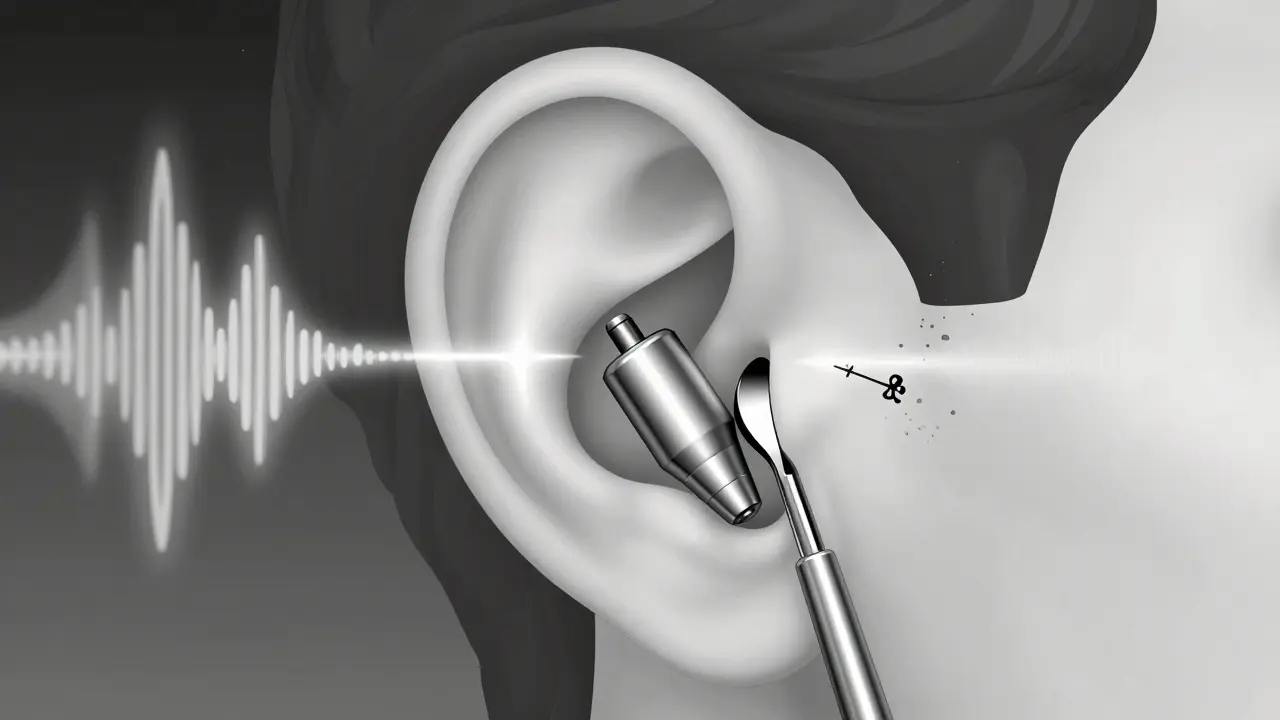
Otosclerosis locks the stapes bone in place. It can’t vibrate. So surgeons remove the fixed part and replace it with a tiny piston - usually made of platinum or titanium. Modern laser-assisted stapedotomies cut complication rates from 15% down to under 2%.
Post-op, 80-90% of patients close their air-bone gap to within 10 dB. That means normal conversations, no more turning up the TV. Some report temporary dizziness or taste changes - the nerve to the tongue runs right through the middle ear. But 87% of patients on Mass Eye and Ear’s patient platform say they can hear whispers again.
Myringotomy with Tubes - For Kids with Glue Ear
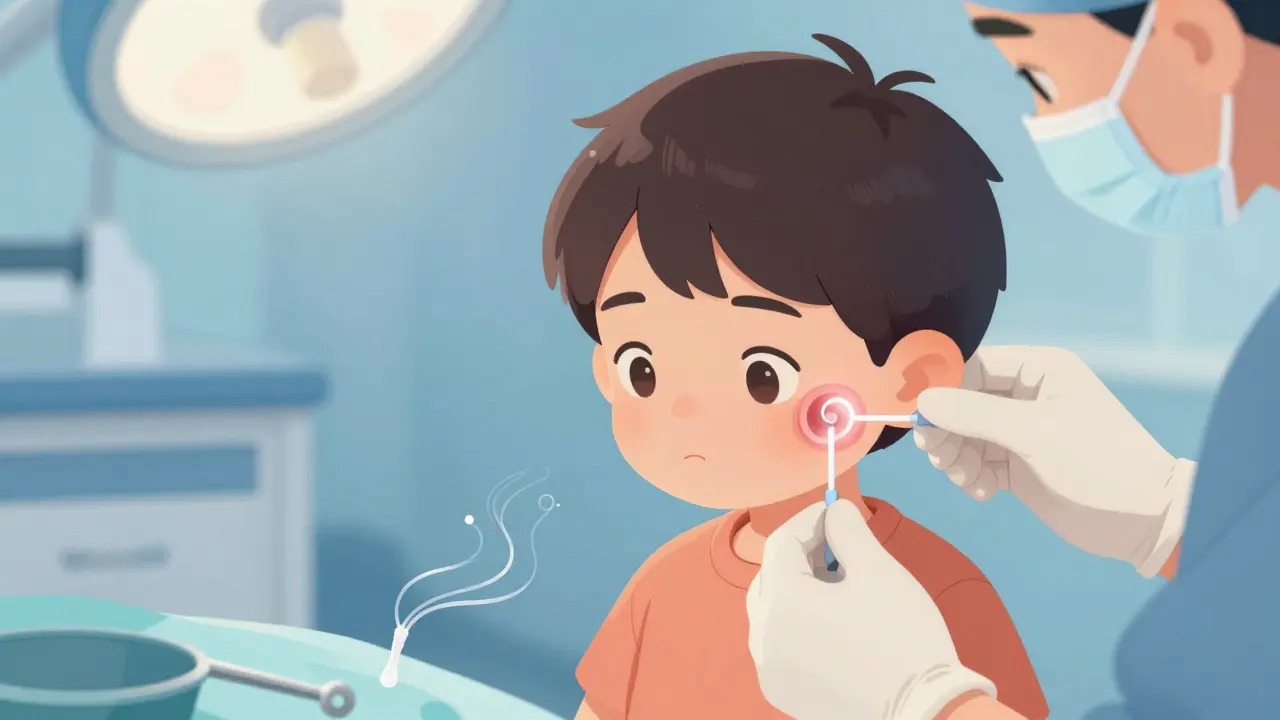
Over 667,000 U.S. kids get this every year. A tiny incision in the eardrum, fluid is suctioned out, and a plastic tube is inserted. It drains fluid for 6-12 months, then falls out on its own.
Parents report 92% satisfaction. Ear infections drop. Speech delays reverse. School performance improves. A few kids (18%) have persistent drainage - but antibiotics fix it 90% of the time.
Canalplasty - Building an Ear Canal
For babies born without an ear canal (aural atresia), surgeons create one. They use bone grafts, skin flaps, and sometimes 3D-printed implants. Success? 60-70% gain functional hearing. But it often takes two or three surgeries over years. The goal isn’t perfect hearing - it’s enough to hear speech clearly and avoid isolation.
Cholesteatoma Removal - Emergency Surgery
This isn’t elective. Cholesteatomas grow like roots. They erode bone. They can rupture the inner ear. They can kill.
Surgery removes the cyst and reconstructs the middle ear. The goal? A safe, dry ear. Hearing recovery is secondary - but still possible. Reconstruction success varies: 60-75% of patients regain usable hearing. Recovery? 4-6 weeks. Many patients say the noise level feels "off" at first - like listening underwater. That’s because the ear’s natural acoustics are rebuilt from scratch.
What’s New in Middle Ear Surgery?
Surgery isn’t stuck in the 1980s. Here’s what’s changing:
- 3D-printed ossicles - Custom-made tiny bones, printed from patient scans, fit like a glove. Trials at Mass Eye and Ear show 94% hearing improvement - better than standard prostheses.
- Endoscopic surgery - No large incisions. A thin camera goes in through the ear canal. Surgeons see everything. Recovery time drops by half. By 2028, 60% of procedures will use this method.
- Bioengineered grafts - Instead of pulling tissue from your own body, doctors use lab-grown materials. They stick better. Infection risk drops. Take rate? 92% vs. 85% for old-school grafts.
- Intraoperative navigation - Like GPS for the skull. 78% of ENT practices now use it. It cuts surgical errors by 35%.
The global market for middle ear devices is growing at 8.4% a year. That’s because the tech works - and people want their hearing back.
What to Expect After Surgery
Recovery isn’t instant. Even with a successful operation, your brain needs time to relearn sound.
For the first week: avoid water, pressure changes, and loud noises. Don’t fly. Don’t lift heavy things. Don’t sneeze with your mouth closed - that pressure can pop your graft.
After 6 weeks, most people return to normal. But hearing doesn’t jump to 100% overnight. It takes 2-3 months for fluid to clear, nerves to heal, and the brain to adjust.
Side effects? They’re rare but real:
- Temporary dizziness (7% of stapedectomy patients)
- Altered taste (4%) - from nerve irritation
- Worsened tinnitus (3%) - usually fades
And yes - some people report "weird" sound quality. One Reddit user said, "It’s like I’m hearing through a phone." That’s because the middle ear’s natural filtering is rebuilt. Your brain adapts. It just takes time.
When Surgery Isn’t the Answer
Some cases don’t need surgery. If you have mild, temporary fluid - wait. If you’re over 60 and the loss is slow - hearing aids might be smarter. Surgery carries risks. It’s not a magic fix.
And if your hearing loss is mixed - part conductive, part sensorineural - surgery helps, but won’t cure everything. That’s why accurate diagnosis is everything.
Final Thought: Hearing Is a Right - Not a Luxury
Conductive hearing loss isn’t just about missing a word here or there. It’s about missing birthdays. Not hearing your child laugh. Not knowing when someone says "I love you."
For kids, untreated conductive loss delays speech, learning, and social development. For adults, it isolates you. It makes work harder. It wears you down.
But here’s the truth: in most cases, this is fixable. Not with a miracle. With science. With precision. With a skilled surgeon and the right diagnosis.
If you’ve been told "it’s just aging" - get a second opinion. If your child has recurrent ear infections - don’t wait. If you’ve had a sudden drop in hearing - see an ENT today. This isn’t something to ignore.
Can conductive hearing loss be cured without surgery?
Yes, in many cases - especially in children. Fluid behind the eardrum (otitis media with effusion) often clears on its own within 3 months. Antibiotics, nasal sprays, or time can resolve the issue. About 65% of pediatric cases don’t need surgery. Even in adults, earwax removal or treating allergies can restore hearing. But if the problem persists beyond 3-4 months or causes hearing loss over 25-30 dB, surgery becomes the best option.
Is middle ear surgery risky?
All surgery carries risks, but middle ear procedures are among the safest in ENT. Complication rates for stapedectomy have dropped from 15% to under 2% thanks to laser techniques and navigation tools. The biggest risks are temporary dizziness, altered taste, or tinnitus - all usually resolve in weeks. Permanent hearing loss is rare, occurring in less than 1% of cases. Cholesteatoma surgery has higher complexity, but the risk of not operating - including brain infection - is far greater.
How long does recovery take after middle ear surgery?
Recovery varies by procedure. Tympanoplasty and stapedectomy typically require 6-8 weeks of activity restrictions - no swimming, flying, or heavy lifting. Most people return to work in 1-2 weeks, but full healing takes longer. Hearing improves gradually over 2-3 months as swelling goes down and the brain adapts. For cholesteatoma, recovery can take 4-6 weeks before returning to normal activity, and up to 6 months for full sound quality to stabilize.
Can children have middle ear surgery?
Yes - and it’s common. Myringotomy with ear tubes is the most common pediatric surgery in the U.S., with over 667,000 performed annually. Tympanoplasty and canalplasty are also done in children with chronic infections or congenital atresia. Surgeons use smaller instruments and adjust techniques for developing anatomy. Outcomes are excellent: 92% of parents report resolved ear infections and improved speech after tube placement.
What’s the difference between tympanoplasty and stapedectomy?
Tympanoplasty repairs the eardrum (tympanic membrane), often due to a hole or retraction. Stapedectomy treats otosclerosis - a stiff stapes bone - by replacing it with a prosthetic piston. Tympanoplasty fixes a leaky barrier; stapedectomy fixes a frozen lever. Both restore sound transmission, but they target different parts of the middle ear. Success rates are high for both: 85-95% for tympanoplasty, 80-90% for stapedectomy.
8 Comments

Jonathan Noe
February 11, 2026 AT 17:03
Man, I had glue ear as a kid and my parents thought it was just "being loud" until I failed a speech test in 2nd grade. That tube surgery? Life-changing. Suddenly I could hear my teacher without leaning forward like a weirdo. Now I’m 34 and still tell every parent I know: don’t wait. If your kid’s always saying "what?" - get it checked. It’s not laziness, it’s physics.

Pat Mun
February 13, 2026 AT 03:06
I’ve been reading up on this for months because my mom’s got otosclerosis and the doc said "wait and see." But after reading this post, I realized we’ve been treating it like a slow fade when it’s actually a locked door. The part about the piston replacement blew my mind - like replacing a rusty hinge with a carbon fiber one. I’m scheduling the CT scan this week. Also, 87% hearing whispers again? That’s not a stat - that’s a miracle. Thanks for writing this. Seriously.

Kristin Jarecki
February 13, 2026 AT 20:35
Thank you for this meticulously researched and compassionate overview. As a hearing healthcare professional, I appreciate the clarity with which you distinguish conductive from sensorineural loss - too often, the public conflates the two. The inclusion of tympanometry and air-bone gap metrics is particularly valuable, as it empowers patients to ask informed questions. I would only add that insurance coverage for high-resolution CT scans varies significantly; some require pre-authorization via audiologist referral. Always confirm coverage before proceeding.

Gloria Ricky
February 15, 2026 AT 03:44
so i had a stapedectomy last year and honestly? the first week was wild. everything sounded like a robot talking underwater. but after 2 months? i heard my dog sigh for the first time. like, a real sigh. not a snort. a sigh. i cried. also, my taste changed for like 3 weeks - everything tasted like metal. weird, right? but it went away. if you’re scared - don’t be. your brain will catch up. i promise.

Skilken Awe
February 16, 2026 AT 16:50
Oh wow, another one of those "surgery is magic" fairy tales. Let me guess - you also believe 3D-printed bones are going to fix your tinnitus and make you a better listener? Newsflash: middle ear surgery doesn’t fix your brain’s inability to focus. I’ve seen 12 patients post-op who still couldn’t follow conversations in noisy rooms. The tech is cool, sure. But don’t sell this as a cure-all. And that "hear whispers" stat? That’s cherry-picked. Where’s the long-term data? Where’s the control group? This reads like a Medtronic ad.

Jim Johnson
February 18, 2026 AT 07:06
Skilken, chill. You’re acting like this post is selling snake oil. I had cholesteatoma surgery last year - it was a nightmare, but it saved my life. My ear was eating into my skull bone. Yeah, I had weird sounds at first - like listening to a tin can with a sock in it. But now? I hear my daughter say "I love you, Daddy" without her having to scream. That’s not marketing. That’s real. And yeah, 3D-printed ossicles? They’re not sci-fi anymore. I had one. My surgeon called it "the perfect fit." And guess what? It worked. Stop being a cynic and help someone who needs it.

Suzette Smith
February 18, 2026 AT 19:15
Okay but what about the guy who got a stapedectomy and then couldn’t taste chocolate anymore? That’s a trade-off I didn’t sign up for. I mean, sure, hearing my cat purr is nice, but I also like my desserts. And what if I’m 45 and I just want to nap in peace? Maybe I don’t need to hear the fridge hum. Maybe I’m fine with turning up the TV. Why is everyone so desperate to "fix" this? Not every quiet life is a tragedy. Just saying.

Sonja Stoces
February 20, 2026 AT 07:54
Ugh. So we’re romanticizing ear surgery now? 🤦♀️ "Hear your child laugh" - yeah, that’s cute. But what about the 12% who get facial nerve damage? Or the 8% who develop chronic vertigo? And don’t even get me started on the 3D-printed bones - they’re literally made from patient scans, so if your scan was blurry? Congrats, you got a prosthetic that doesn’t fit. This post is dangerously optimistic. I’ve seen too many people go in with hope and come out with a new set of problems. And yes, I’m the toxic analyst. And yes, I’m here to ruin your happy ending. 💔
Write a comment