




After weight loss surgery, your body changes in ways you can’t see. Your stomach is smaller. Your intestines are rerouted. And your ability to absorb the nutrients you need? That’s changed too. Standard multivitamins won’t cut it anymore. If you skip your bariatric vitamins, you’re not just risking a tired feeling-you could be setting yourself up for nerve damage, bone fractures, or even permanent neurological issues.
Why Regular Vitamins Don’t Work After Bariatric Surgery
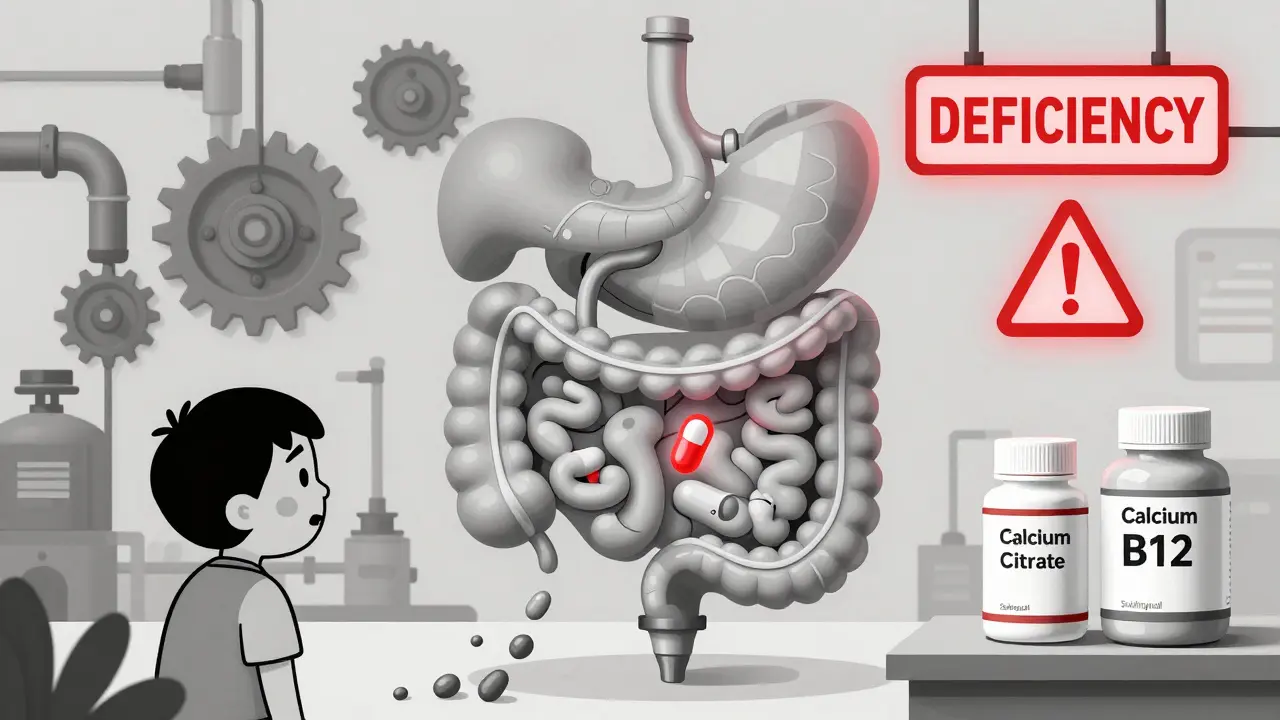
Think of your digestive system like a factory. Before surgery, it processed food normally: stomach acid broke down pills, enzymes helped absorb vitamins, and your intestines pulled out what your body needed. After a gastric bypass or sleeve gastrectomy, that factory is reconfigured. Parts are removed. Others are bypassed. The result? Your body can’t absorb nutrients the way it used to. Take vitamin B12, for example. It needs stomach acid and a protein called intrinsic factor to be absorbed. After a Roux-en-Y gastric bypass (RYGB), both are often missing. Studies show that 60% of RYGB patients develop B12 deficiency within the first year if they don’t take specialized supplements. Without enough B12, you might feel numb in your hands or feet, lose your balance, or even struggle with memory and mood. These aren’t side effects-they’re warning signs of irreversible nerve damage. Vitamin D is another big one. Up to 90% of patients come into surgery already low in vitamin D. After surgery, that number doesn’t drop-it gets worse. Your body needs vitamin D to absorb calcium. Without it, your bones thin out. A simple fall could lead to a fracture. The Mayo Clinic says most patients need 3,000 IU of vitamin D3 daily just to stay in the normal range.What’s in Bariatric Vitamins-and What’s Not
Bariatric vitamins aren’t just stronger versions of your old multivitamin. They’re engineered for a broken system. The American Society for Metabolic and Bariatric Surgery (ASMBS) sets the gold standard. Their 2019 guidelines say every post-op patient needs:- 18 mg of iron-to prevent anemia
- 500 mcg of vitamin B12-oral or sublingual, not just a pill
- 1,000-1,200 mg of calcium-split into two or three doses
- 3,000 IU of vitamin D3-not D2
- 5,000-10,000 IU of vitamin A-but not more, or you risk toxicity
- 400 mcg of folic acid-critical for red blood cell production
- Thiamine (B1) at 100 mg daily-often overlooked, but vital for brain function
And here’s the catch: calcium carbonate won’t cut it. After surgery, your stomach makes less acid. Calcium carbonate needs acid to dissolve. Calcium citrate doesn’t. That’s why every reputable bariatric supplement uses citrate. Same goes for iron. Ferrous sulfate causes constipation and nausea in nearly half of patients. Ferrous fumarate is gentler and better absorbed.
It’s Not One-Size-Fits-All
Your surgery type changes everything. A sleeve gastrectomy removes part of your stomach but leaves the intestines intact. You still absorb most nutrients. But a gastric bypass? That’s a whole different story. It skips the duodenum-the part of the small intestine where iron, calcium, and many vitamins are absorbed. Here’s how the risks break down:| Nutrient | RYGB Risk | Sleeve Gastrectomy Risk |
|---|---|---|
| Iron | 20-47% | 15-30% |
| Vitamin B12 | 60% | 25-30% |
| Vitamin D | 12-73% | 10-40% |
| Thiamine (B1) | 29.5% | 15-20% |
| Folic Acid | 47% | 10-15% |
That’s why some supplements are labeled for RYGB patients only. Others are designed for sleeve. Taking the wrong one means you’re missing key nutrients. A 2023 study in Cureus Journal found that patients on the wrong supplement were twice as likely to develop deficiencies within 18 months.
Form Matters More Than You Think
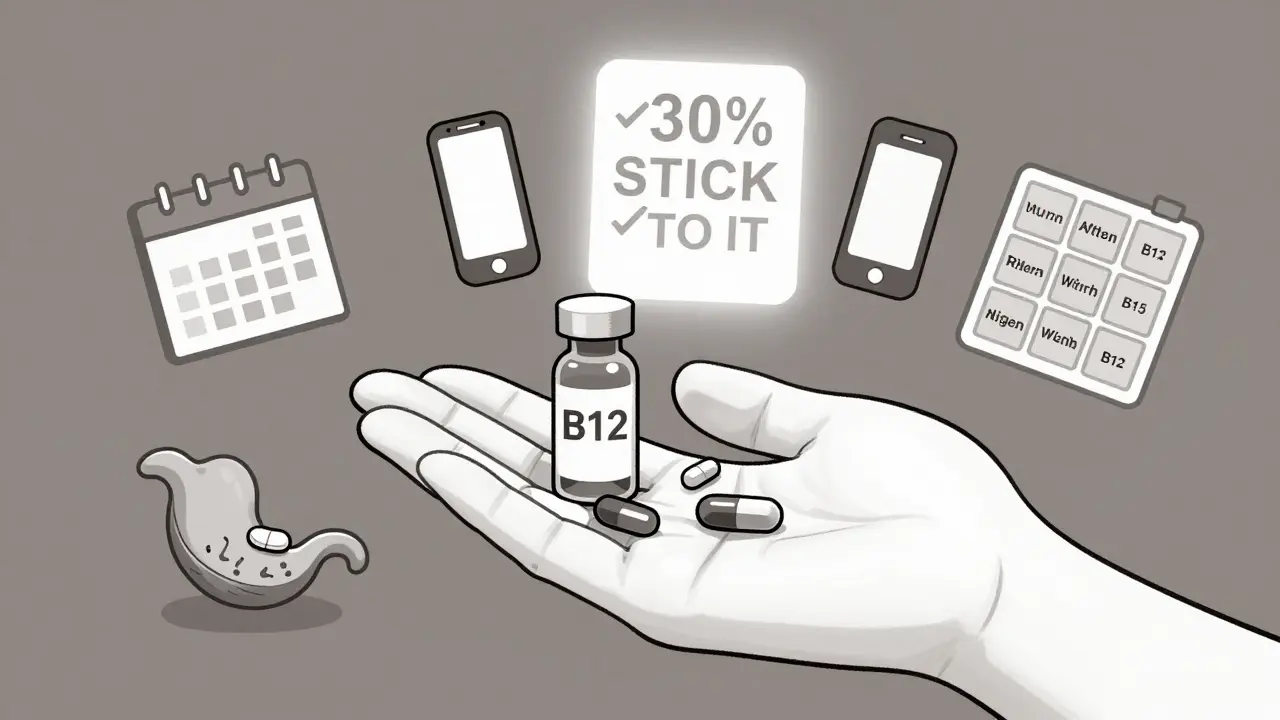
You can’t just swallow a big pill after surgery. Your stomach is the size of a walnut. Pills can get stuck. They can cause nausea. Or worse-they won’t dissolve at all. For the first 3 to 6 months, you need chewables or liquids. Many patients swear by liquid B12. One Reddit user, 'BariatricWarrior2022,' wrote: "My neuropathy disappeared within 3 months of starting 1,000 mcg sublingual B12 daily after my RYGB in 2021." That’s not luck-that’s science. Sublingual B12 bypasses the gut entirely and absorbs through the tissue under your tongue. Even after that initial phase, many people stick with chewables. Why? Because they’re easier to tolerate. A 2023 review in Pharmacy Times found that patients who switched from pills to chewables improved adherence by 40%.Adherence Is the Real Problem
You’ve got the right vitamins. You know the right dose. You’re taking them at the right time. But are you taking them every day? Here’s the hard truth: Only 30-50% of patients stick with their supplement regimen after five years. That’s not because they don’t care. It’s because it’s overwhelming. Imagine this: 2 multivitamins. 2 calcium tablets. 1 iron pill. 1 B12. 1 zinc. 1 copper. That’s 7 pills a day. Add in a liquid B12. Now you’re at 8. And you’re supposed to space them out-calcium with meals, iron on an empty stomach, B12 separate. No wonder people give up. Solutions? Use a pill organizer. Set phone alarms. Try a once-daily option. Brands like Bariatric Fusion and Nature’s Bounty now offer single-tablet formulas that combine the essentials. They’re not perfect-calcium content is often still too low-but they cut the pill burden in half.What Happens When You Skip Them
You might feel fine for months. Maybe even a year. But deficiencies don’t show up as a sore throat or a fever. They creep in slowly. - Iron deficiency → fatigue, pale skin, shortness of breath. Easy to blame on stress. Hard to connect to a missed pill. - Vitamin D deficiency → bone pain, muscle weakness. You think you’re just out of shape. Meanwhile, your bones are crumbling. - B12 deficiency → tingling in hands, trouble walking, brain fog. This one can become permanent if not caught early. - Thiamine deficiency → confusion, memory loss, vomiting. In severe cases, it leads to Wernicke’s encephalopathy-a brain injury that can be fatal. Dr. Kelly O’Donnell from UVA Health puts it bluntly: "Vitamin deficiencies can cause serious, irreversible damage." You can’t reverse nerve damage. You can’t rebuild bone density overnight. Prevention isn’t optional-it’s survival.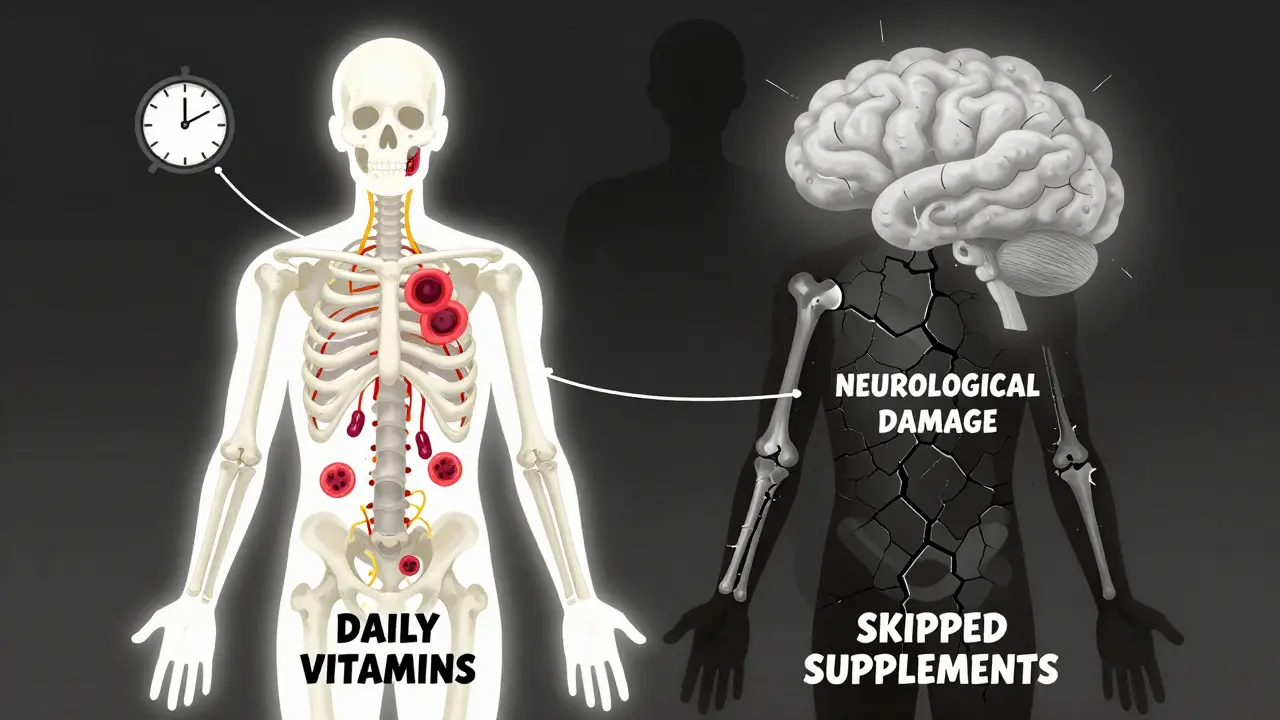
How to Stay on Track
Here’s what works for the people who stick with it:- Get blood work done every 3-6 months for the first two years, then yearly after that. Don’t wait until you feel bad.
- Use a pill organizer with morning, afternoon, and night slots. Label them.
- Take calcium with meals. Space doses at least 4 hours apart.
- Take iron on an empty stomach-but not with calcium. They compete. Wait 2 hours.
- Try sublingual B12 if swallowing is hard. It’s just as effective.
- Track your intake in a journal or app. Seeing your streak helps.
- Ask your dietitian for samples. Many clinics offer free starter packs.
Cost is a real barrier. A full regimen can run $30-$60 a month. But skipping it costs more. A single hospital visit for a fractured hip or neurological damage can run tens of thousands. Insurance rarely covers supplements. But it will cover the emergency care you’ll need if you get sick.
What to Look for When Buying
Not all bariatric vitamins are created equal. Here’s what to check:- Iron form: Look for ferrous fumarate or ferrous sulfate (but fumarate is gentler).
- Calcium form: Must be calcium citrate. If it says "carbonate," walk away.
- Vitamin D: Must say D3 (cholecalciferol), not D2.
- B12: At least 500 mcg. Sublingual or chewable is best.
- Thiamine: At least 100 mg daily. Many brands leave this out.
- Size: If you can’t chew it or swallow it easily, it’s not right for you.
Amazon’s top-rated bariatric multivitamin? Nature’s Bounty Bariatric Formula. It’s popular-but 1,247 reviews also say it lacks enough calcium. You’ll still need to add a separate calcium citrate supplement. That’s common. Don’t assume one pill does it all.
You’re Not Alone
This isn’t about willpower. It’s about biology. Your body changed. Your needs changed. The fact that you’re reading this means you’re already ahead of most people. The goal isn’t perfection. It’s consistency. Miss a day? Take it tomorrow. Forget your pills on vacation? Pack them in your carry-on. Your future self will thank you.After surgery, your vitamins aren’t optional. They’re your lifeline. Take them. Every day. No exceptions.
Do I need bariatric vitamins if I had a sleeve gastrectomy?
Yes. Even though sleeve gastrectomy is less invasive than a bypass, it still reduces stomach size and acid production. This affects how well you absorb iron, calcium, B12, and vitamin D. Most patients need at least a daily high-potency multivitamin, calcium citrate, and vitamin D3. Some also need extra iron and B12 depending on blood work.
Can I take regular multivitamins after bariatric surgery?
No. Regular multivitamins don’t contain enough of the key nutrients you need after surgery. For example, most contain only 12 mg of iron-but you need 18 mg. They also use calcium carbonate, which doesn’t absorb well without stomach acid. And they often lack sufficient B12, vitamin D, and thiamine. Using a standard supplement puts you at high risk for deficiencies.
Why do I need to take calcium in divided doses?
Your body can only absorb about 500-600 mg of calcium at once. Taking 1,200 mg all at once means over half of it passes through your system unused. Splitting it into two or three doses-say, 600 mg with breakfast, 300 mg with lunch, and 300 mg with dinner-ensures maximum absorption. Always take calcium citrate with food.
What if I can’t swallow pills after surgery?
You’re not alone. For the first 3-6 months, use chewables or liquids. Many brands offer B12 in sublingual drops or sprays, calcium in liquid form, and multivitamins in chewable tablets. Some patients use a pill crusher or mix powders into smoothies. Talk to your dietitian-they can help you find alternatives that work for you.
Can I get too much of a vitamin after bariatric surgery?
Yes, especially with fat-soluble vitamins like A, D, E, and K. These store in your body and can build up to toxic levels. Vitamin A toxicity can cause liver damage, dizziness, and blurred vision. That’s why dosing matters. Stick to the recommended range: 5,000-10,000 IU of vitamin A daily. Never take more than your doctor recommends. Blood tests are the only way to know if you’re in the safe zone.
13 Comments

Milad Jawabra
March 4, 2026 AT 15:35
This is the kind of post that saves lives. I'm 3 years post-RYGB and still take 8 pills a day. Some days I hate it, but I'd rather be alive and annoyed than dead and 'done'. B12 sublingual saved my nerves. Don't skip. Ever. 🙌

Pankaj Gupta
March 6, 2026 AT 10:45
The data presented here is meticulously accurate. It is imperative to note that calcium citrate is non-negotiable in postoperative regimens due to its solubility in low-acid environments. Furthermore, the distinction between vitamin D2 and D3 is biochemically significant and cannot be overstated.

Alex Brad
March 6, 2026 AT 13:15
7 pills a day. That's brutal. But worth it. I lost 120 lbs and I'm not going back to being sick.

Chris Beckman
March 7, 2026 AT 19:12
I tried the cheap amazon ones and ended up in the er with low b12. My doc said i was one step away from permanent nerve damage. Dont be dumb. Get the good stuff. And dont trust your instincts. Your body is broken now. Treat it like a broken phone. You dont use a 2015 charger on a 2024 model. Same thing.

Levi Viloria
March 9, 2026 AT 18:50
I'm from the Philippines and we don't have access to branded bariatric vitamins here. I'm taking a local multivitamin with extra B12 drops and calcium citrate powder mixed in my smoothie. It's not perfect, but it's better than nothing. I check my labs every 4 months. You adapt.

Zacharia Reda
March 11, 2026 AT 06:43
So you're telling me the only reason I haven't turned into a human ghost is because I'm taking a $50/month pill habit? I guess my willpower is just a supplement. Thanks for the guilt trip.

Matt Alexander
March 11, 2026 AT 18:43
B12 under the tongue works. I tried pills for 6 months. Numb hands didn't go away. Switched to drops. 3 weeks later, I could feel my fingers again. No joke.

Gretchen Rivas
March 13, 2026 AT 13:04
I take mine with my coffee. Iron on empty stomach. Calcium with lunch. B12 before bed. Set 3 alarms. I forget sometimes. But I never miss 2 days in a row. It's a habit now.

Mike Dubes
March 13, 2026 AT 18:50
I used to think this was all hype. Then I got dizzy walking up stairs. My doc said my B12 was lower than a vegan's in december. I started sublingual B12 and now I run 5k on weekends. Don't be like me. Be smarter.

Helen Brown
March 15, 2026 AT 10:46
I read somewhere that big pharma makes these vitamins just to keep us hooked. What if the real problem is that surgery messes with your gut bacteria? Maybe we should be taking probiotics instead of pills? I'm not saying this is true. But I'm asking.

John Cyrus
March 16, 2026 AT 01:46
If you're not taking 3000iu of D3 and 100mg of thiamine you're just asking for trouble. I've seen too many people ignore this and end up in wheelchairs. Stop being lazy. Your future self is begging you

John Smith
March 17, 2026 AT 23:18
I used to be a walking ghost. Pale. Shaky. Can't remember my own damn birthday. Then I found Bariatric Fusion. Now I'm lifting weights. Traveling. Living. This isn't medicine. This is my new superpower. And yeah I take 7 pills a day. I'd rather be a pill-popping badass than a corpse in a hoodie.

Raman Kapri
March 19, 2026 AT 03:59
I find it concerning that this article presents the ASMBS guidelines as absolute truth. In my clinical experience, many patients do well with lower doses. The risk of toxicity from excessive supplementation is underreported. A one-size-fits-all approach is not evidence-based.
Write a comment