






Bromocriptine Dosing & Side Effect Tracker
Start Your Plan
Standard protocol increases dose by 0.8 mg weekly.
Your Action Plan
Target Daily Dose:
0.8 mg
Based on standard titration protocol.
Recommended Strategies
- Select options and click Generate to see strategies.
Morning Routine Timeline
Wake Up
Start the 2-hour window immediately.
Within 2 Hours
Take dose with dry food (toast/crackers).
+15 Minutes
Wait before vigorous activity to avoid dizziness.
Starting a new diabetes medication is often a balancing act. You want better blood sugar control, but you also want to keep your daily life normal. With Bromocriptine, marketed as Cycloset, the rules are different than with most other drugs. It doesn't just lower glucose; it requires you to wake up at a specific time and take it within a narrow window. If you miss that window, or if the side effects hit hard, it can feel like a chore rather than a cure.
This guide cuts through the medical jargon to explain how bromocriptine works, why timing is everything, and practical ways to handle the two biggest complaints: nausea and dizziness. Whether your doctor just prescribed this or you're considering switching, here is what you need to know to make it work for you.
How Bromocriptine Actually Works
Most diabetes drugs work on your pancreas or your gut. Metformin stops your liver from dumping too much sugar into your blood. Insulin replaces what your body isn't making. Bromocriptine takes a completely different route. It targets your brain.
Specifically, it acts on dopamine receptors in the hypothalamus, the part of your brain that controls your circadian rhythm and stress response. In many people with type 2 diabetes, the sympathetic nervous system (your "fight or flight" mode) is stuck in overdrive. This constant stress state raises blood sugar and damages blood vessels. Bromocriptine helps reset this tone, calming the system down.
| Drug Class | Primary Target | Effect on Weight | Hypoglycemia Risk |
|---|---|---|---|
| Bromocriptine (Cycloset) | Hypothalamus (Brain) | Weight Neutral | Very Low (0.2%) |
| Metformin | Liver & Intestines | Slight Loss | Low |
| Sulfonylureas | Pancreas (Insulin Secretion) | Weight Gain | High (16.4%) |
| SGLT2 Inhibitors | Kidneys (Sugar Excretion) | Weight Loss | Low |
Because it works on the brain's clock, the drug’s effectiveness is tied directly to when you take it. Clinical trials show that patients who stick to the strict morning schedule see an HbA1c reduction of about 0.7%, while those who are inconsistent see significantly less benefit. It’s not just about taking the pill; it’s about taking it at the right biological moment.
The Golden Rule: Timing Is Everything
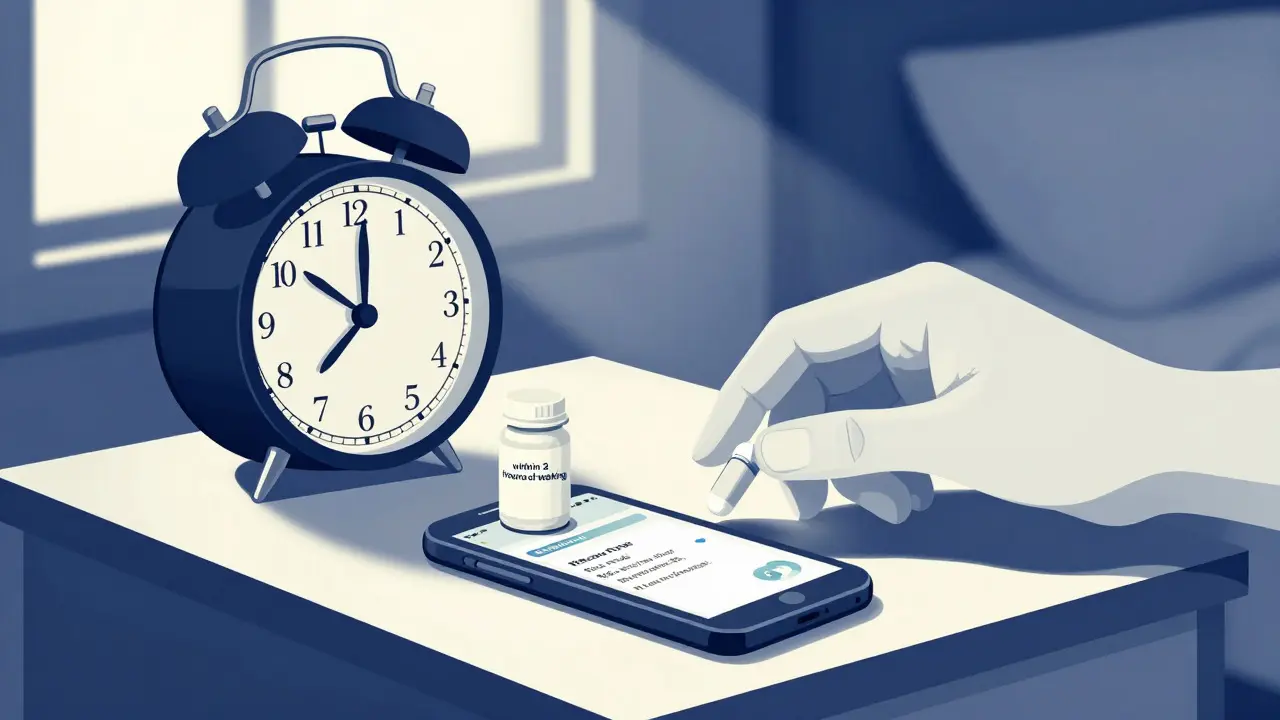
If you remember one thing about bromocriptine, let it be this: **Take it within 2 hours of waking up.**
This isn't a suggestion; it's the core mechanism of action. The drug needs to align with your body's natural cortisol spike and circadian rhythm shift that happens when you open your eyes. If you sleep in until noon on weekends, your dose moves to noon. If you wake up at 5 AM on weekdays, your dose is at 5 AM.
Here is how to structure your morning:
- Set a dedicated alarm: Don't rely on memory. Set an alarm labeled "Medicine Time" that goes off 30 minutes after your usual wake-up time.
- Keep it bedside: Place the bottle next to your phone. Friction kills adherence. If you have to walk to the kitchen cabinet, you might delay.
- Consistency matters more than perfection: While the 2-hour window is ideal, try to keep your wake-up times consistent across the week. Night shift workers often struggle with this because their "morning" changes. If your schedule varies wildly, talk to your doctor; bromocriptine might not be the best fit for irregular sleep patterns.
One patient on Reddit noted, "I'm a night shift worker and the 2-hour after waking rule makes this impossible to use effectively." This is a real-world constraint. If your life revolves around erratic sleep, this drug adds unnecessary stress.
Taming the Nausea
Nausea is the number one reason people quit bromocriptine. About 26-32% of users report it, especially in the first few weeks. Why? Because stimulating dopamine receptors in the brain can trigger the vomiting center.
But you don't have to suffer through it. Here are three proven strategies to manage it:
- The Titration Method: Never start at the full dose. The standard protocol is to start with 0.8 mg once daily for one week. Then increase by 0.8 mg each week until you reach the target dose (usually 4.8 mg). Studies show this slow ramp-up reduces nausea incidence from 32% to 18%. Give your body time to adjust.
- The Dry Toast Trick: Take the pill with a small amount of dry food, like half a slice of toast or two crackers. Avoid heavy meals or large amounts of liquid immediately after. One study found that 78% of successful users reported this simple trick helped settle their stomachs.
- Ginger Supplements: Taking 250 mg of ginger powder 30 minutes before your dose has been shown to reduce nausea severity by 40%. Keep some ginger capsules or tea ready for the first month.
Most people find that the nausea peaks in the first two weeks and then fades significantly by week four. If it persists beyond a month, it’s worth calling your doctor to discuss dosage adjustments.
Handling Dizziness and Lightheadedness
Dizziness affects about 11-15% of users. Unlike nausea, which feels internal, dizziness can feel dangerous-like you might fall. This is caused by orthostatic hypotension, a temporary drop in blood pressure when you stand up.
To stay safe:
- Move Slowly: When you get out of bed, sit on the edge for 30 seconds. Stand up slowly. Don't rush to the bathroom or the kitchen.
- The 15-Minute Pause: Try to delay vigorous activity for 15-20 minutes after taking the dose. Use this time to brush your teeth, check messages, or sip water. Let the peak plasma concentration pass before you start moving fast.
- Hydrate: Dehydration worsens dizziness. Drink a glass of water with your pill, but avoid chugging large volumes all at once.
For most patients, this lightheadedness resolves within 2-4 weeks as the body adapts to the dopamine modulation. However, if you have a history of fainting or migraines associated with low blood pressure, tell your doctor before starting.

Who Should Consider Bromocriptine?
Bromocriptine isn't for everyone. It’s a niche therapy, capturing less than 1% of the diabetes market. But for specific groups, it offers unique benefits that other drugs don't.
It’s a strong option if:
- You have cardiovascular disease: A major 52-week trial showed a 40% reduction in cardiovascular events (heart attack, stroke, death) compared to placebo. If heart health is a primary concern, this is a powerful advantage.
- You can't tolerate metformin: For patients who get severe GI issues from metformin, bromocriptine offers a different pathway with weight-neutral results.
- You fear hypoglycemia: Since it doesn't stimulate insulin secretion, the risk of dangerously low blood sugar is extremely low (0.2%).
It’s probably not for you if:
- Your schedule is chaotic: If you can't commit to a consistent wake-up time, the efficacy drops.
- You have severe kidney disease: It is contraindicated if your eGFR is below 30 mL/min/1.73m².
- You are sensitive to side effects: If mild nausea ruins your day, you might prefer a DPP-4 inhibitor or SGLT2 inhibitor.
Practical Next Steps
If your doctor prescribes bromocriptine, treat the first month as a trial period. Track your symptoms in a notebook or app. Note the time you wake up, the time you take the pill, and any nausea or dizziness. This data helps you and your doctor fine-tune the dose.
Don't hesitate to ask for support. The manufacturer offers a "Cycloset Success" program with coaching on timing and side effect management. Additionally, consider pairing this medication with lifestyle changes that support circadian health, like getting morning sunlight and avoiding screens before bed. These habits amplify the drug's brain-based mechanism.
Finally, keep an eye on upcoming research. The BROADEN-CV trial, expected to release results in late 2025, will provide more data on long-term cardiovascular benefits. Until then, bromocriptine remains a specialized tool-one that requires discipline but offers distinct rewards for those who master its timing.
Can I take bromocriptine if I am on shift work?
Shift work makes bromocriptine challenging because the drug requires dosing within 2 hours of waking up to align with your circadian rhythm. If your wake-up time changes drastically between days, the efficacy may decrease. Discuss this with your doctor; they might suggest a medication with more flexible timing.
Does bromocriptine cause weight gain?
No, bromocriptine is considered weight-neutral. Clinical trials show no significant change in body weight (mean difference of 0.1 kg) compared to placebo over 24 weeks. This is a key advantage over sulfonylureas and insulin, which often cause weight gain.
What should I do if I miss my morning dose?
If you miss the 2-hour window after waking up, it is generally recommended to skip that dose and wait until the next morning. Taking it late in the day can disrupt your sleep cycle and increase side effects without providing significant glucose-lowering benefits. Consistency is more important than catching up on missed doses.
Is bromocriptine safe for people with kidney problems?
Bromocriptine does not require dose adjustment for moderate renal impairment (eGFR 30-59 mL/min/1.73m²). However, it is contraindicated in severe renal impairment (eGFR <30 mL/min/1.73m²). Always inform your doctor about your kidney function before starting.
How long does it take for bromocriptine to work?
You may see improvements in fasting blood sugar within the first few weeks. However, significant changes in HbA1c typically take 3 months to become apparent. The cardiovascular benefits observed in clinical trials were measured over longer periods, such as 52 weeks.
Can I drink alcohol while taking bromocriptine?
Moderate alcohol consumption is generally acceptable, but alcohol can worsen dizziness and interact with blood sugar levels. Since bromocriptine already carries a risk of dizziness, limit alcohol intake and monitor how your body reacts. Avoid binge drinking.
Why is bromocriptine not prescribed more often?
Despite its cardiovascular benefits, bromocriptine has a strict dosing requirement and higher rates of nausea compared to newer drugs like GLP-1 agonists or SGLT2 inhibitors. Many patients and doctors prefer medications with easier adherence profiles and additional benefits like weight loss.
14 Comments

Simon-Pierre Bouchard
August 13, 2026 AT 10:13
Oh joy, another drug that demands I wake up at the exact same time every single day like a Victorian schoolmaster. Because clearly, my life was lacking enough rigid schedules.

Saher Ghattas
August 14, 2026 AT 06:44
The mainstream medical establishment wants you to believe this is about "circadian rhythms" and "dopamine receptors." It's not. It's about keeping the population docile with strict morning routines so they don't have the energy to question why their blood sugar is high in the first place. The pharmaceutical complex profits from your confusion and your compliance. Wake up people. The real cure is avoiding processed seed oils and fluoride, but sure, take your little pill within a two-hour window if you want to remain a sheep.

Ella Mentry
August 14, 2026 AT 10:11
I literally cannot believe no one mentioned how exhausting it is to explain this to family members who just want you to eat cake. You think you're managing diabetes? You're managing everyone else's disappointment. And honestly, if you can't handle waking up on time, maybe you just aren't committed enough to your own survival. It's harsh but true. I had to fire my sister for bringing me muffins after I explained the nausea issue. Boundaries are key. Also, does anyone know if ginger tea works better than capsules because I tried both and I still felt like I was going to throw up my soul?

Marc-Alexandre Rizzo
August 16, 2026 AT 08:17
It is truly fascinating how our biology is tied to the sun's position, isn't it? We are creatures of rhythm, yet we live in a world that encourages chaos. I find that treating this medication less like a chore and more like a sacred morning ritual helps immensely. Think of it as anchoring yourself before the storm of the day begins. It requires patience, yes, but the stability it brings to your internal landscape is worth the initial discomfort. Be kind to yourself during those first few weeks when your body is recalibrating.

Dennis Leeftink
August 17, 2026 AT 08:50
Most people fail because they are lazy. Simple as that. If you can't set an alarm, you deserve the side effects.

jackie healey
August 18, 2026 AT 19:36
Oh! I completely agree with the point about titration!!! Many patients rush into the full dose without realizing that their dopamine receptors need time to adjust gently!!! It is absolutely crucial to start low and go slow!!! I always tell my friends to keep a journal!!! Tracking symptoms helps identify patterns!!! And don't forget hydration!!! Water is your best friend here!!!

Veronica Agbanyim
August 19, 2026 AT 07:30
We have lost our way as a society when we rely on chemical interventions for problems caused by poor lifestyle choices. This drug is merely a band-aid on a gaping wound of moral decay. We should be focusing on discipline, fasting, and spiritual clarity rather than manipulating our hypothalamus with synthetic compounds. The fact that we accept dizziness as a normal trade-off for convenience is a testament to our collective weakness. True health comes from within, not from a bottle prescribed by a doctor who sees you for fifteen minutes.

Ambria St louis
August 20, 2026 AT 19:28
One must consider the deeper implications of aligning our pharmacological intake with our circadian biology; it suggests a profound interconnectedness between mind, body, and environment. Is it not remarkable that a substance targeting the brain's stress response can yield such systemic benefits? Perhaps we are witnessing a shift towards more holistic understandings of metabolic health, where timing is not merely a logistical detail but a philosophical stance on living in harmony with natural rhythms. Let us ponder this carefully.

Anna Salamon
August 22, 2026 AT 03:39
In many cultures, the morning routine is a time for preparation and centering. Adding this medication to that existing structure makes sense. It is not about restriction but about adding a new layer of care to your daily practice. I recommend pairing the dose with a moment of quiet reflection or deep breathing to help mitigate the anxiety that often accompanies starting a new treatment. Consistency builds confidence.

Michelle Alavaski
August 22, 2026 AT 22:22
It is imperative to note that the efficacy of bromocriptine is contingent upon strict adherence to the temporal parameters outlined in clinical literature. Deviation from the prescribed two-hour window post-awakening may result in suboptimal therapeutic outcomes. Furthermore, the contraindications regarding renal function must be observed with rigorous precision. One would do well to consult primary sources rather than relying on anecdotal evidence found in informal digital forums.

Darcy Galway
August 23, 2026 AT 01:00
I just take it with toast. Works for me. No big deal.

Morikeoluwa Ayodeji
August 24, 2026 AT 07:05
Hey everyone! Listen up! This stuff actually works if you respect the process! I started taking mine right after I brush my teeth and it changed my game! Don't let the nausea scare you off! Just start slow! Trust me! Your heart will thank you later! Keep pushing forward!

Sansaray Jones
August 25, 2026 AT 15:52
i sit on the edge of the bed for a minute then stand up slowly. helps with the dizzy part. rest is fine.
Saher Ghattas
August 26, 2026 AT 17:03
They say "weight neutral" but watch your waistline expand once the dopamine hits. It's all about controlling the narrative. The FDA approves these things based on shoddy data paid for by Big Pharma. You're not healing; you're being managed.
Write a comment