





Pharmaceutical costs are a massive headache for healthcare systems worldwide. For years, the answer was supposed to be biosimilars, which are biologic medical products highly similar to an already approved reference biologic product with no clinically meaningful differences in safety, purity, and potency. But if you look at the data from 2024 and early 2026, something strange happens when you compare the two biggest players: Europe and the United States. Europe started first, built a mature ecosystem, and is now seeing steady growth. The US had a rocky start but is currently sprinting ahead with aggressive growth projections. Why does this divergence exist, and where is the money actually going?
The Core Difference: Timing and Regulation
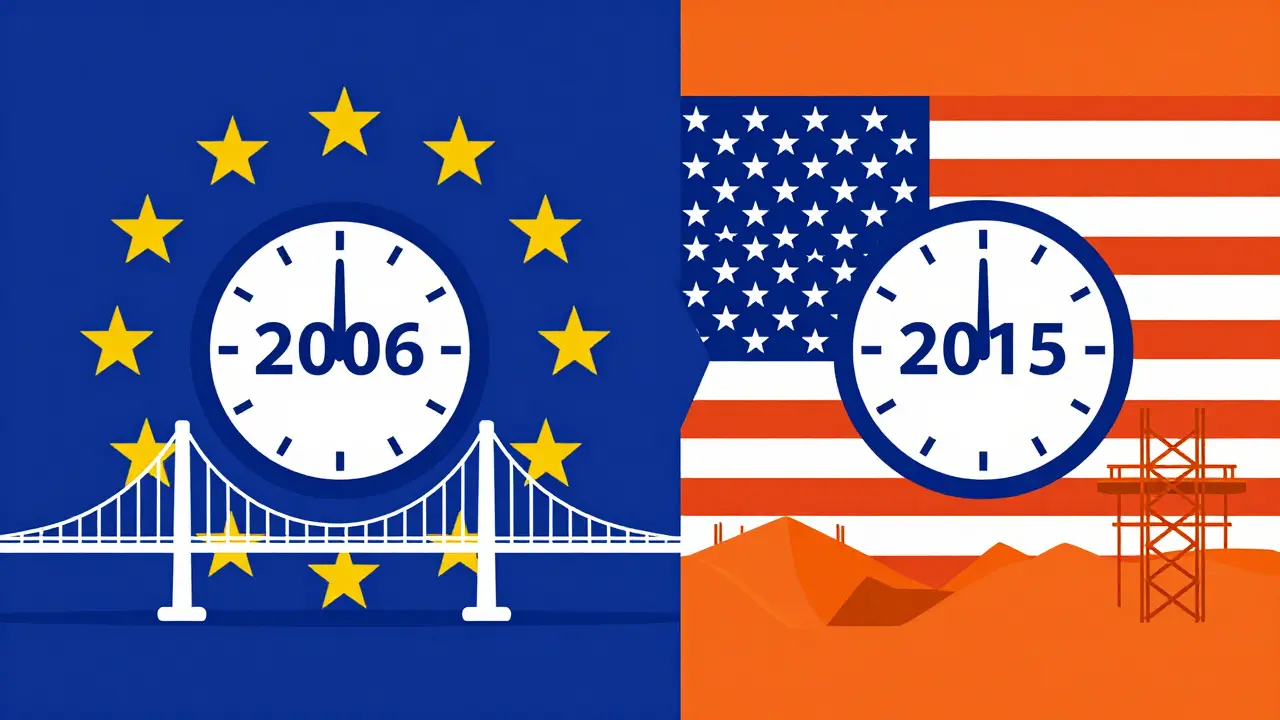
To understand the current landscape, you have to look back at the starting line. The European Medicines Agency (EMA) established the world's first regulatory framework for biosimilars in 2006. They approved Omnitrope that same year. This gave Europe a nearly decade-long head start. By the time the US passed the Biologics Price Competition and Innovation Act (BPCIA) in 2009, Europe was already figuring out how doctors and patients reacted to these new drugs.
The US didn't approve its first biosimilar, Zarxio, until March 2015. That five-year gap between legislation and approval created a "biosimilar void" that allowed originator companies to maintain high prices without competition for much longer than in Europe. According to IQVIA's 2024 assessment, this delay meant that by 2024, only 12 biosimilars were launched in the US compared to over 100 approved in Europe since 2006. The difference isn't just about speed; it's about building a culture of trust among physicians and payers.
Market Size and Growth Trajectories
When you crunch the numbers, the picture gets even more interesting. Market sizing varies depending on who you ask, but the trends are clear. In 2024, the European biosimilars market generated roughly USD 9.9 billion to USD 13.16 billion, depending on whether you follow Grand View Research or Precedence Research. It grew at a compound annual growth rate (CAGR) of 13% from 2020 to 2024.
The US market hit USD 10.9 billion in 2024, according to Alira Health, growing at an 11% CAGR from 2020. While Europe has historically held a larger share, the US is accelerating faster. IMARC Group projects the US market will reach USD 30.2 billion by 2033 at a CAGR of 18.5%. Meanwhile, Europe is projected to grow to USD 64.82 billion by 2034 at a slightly lower CAGR of 17.34%. North America is expected to lead regional market revenue by 2027, signaling a major shift in global power dynamics.
| Metric | Europe | United States |
|---|---|---|
| First Approval Year | 2006 | 2015 |
| 2024 Market Revenue | ~USD 9.9 - 13.1 Billion | ~USD 10.9 Billion |
| Biosimilars Launched (by 2024) | Over 100 | 12 |
| Projected CAGR (Next Decade) | 17.34% | 18.5% |
| Key Regulatory Body | EMA | FDA |
Regulatory Hurdles: The Switching Study Debate
One of the biggest friction points in the US market has been the concept of "interchangeability." To get this designation, which allows pharmacists to substitute a biosimilar for the reference product without the prescriber's intervention, the FDA historically required extensive switching studies. These studies proved that alternating between the biosimilar and the original drug didn't cause safety issues.
This requirement created a massive barrier. It was expensive, time-consuming, and scientifically debated. Dr. Rachel Sherman of the FDA's Center for Drug Evaluation and Research acknowledged this in June 2024, stating that previous requirements created unnecessary barriers. Consequently, the FDA proposed new guidelines eliminating the need for switching studies to achieve interchangeable designation. This move aligns the US closer to the European model, which relies on a "totality-of-evidence" approach requiring limited clinical data. As Dr. Hans-Georg Eichler of the EMA noted, robust scientific evaluation coupled with clear communication is more effective than extensive trials for demonstrating biosimilarity.

Adoption Drivers: Procurement vs. Fragmentation
Why did Europe adopt biosimilars so quickly? It comes down to system structure. European countries implemented structured pricing and substitution policies early on. Hospital tenders, particularly in Germany, France, and the UK, accelerated uptake. Dr. Marc Grégoire of Fresenius Kabi pointed out that European hospital procurement systems and mandatory substitution policies created ideal conditions for rapid uptake.
In contrast, the US healthcare system is fragmented. You have Medicare, Medicaid, private insurers, pharmacy benefit managers (PBMs), and independent pharmacies all making different decisions. This complexity slowed adoption. However, the Inflation Reduction Act of 2022 changed the game. By eliminating the Medicare Part D coverage gap and providing incentives for biosimilar adoption, the US government began pushing providers toward cheaper alternatives. Dr. Sarah Toner of the IQVIA Institute highlighted this as a significant catalyst for recent US market growth.
Therapeutic Focus and Patent Cliffs
The types of drugs also differ. Europe excels in oncology and rheumatology, where biosimilars have achieved over 80% market share in some countries for monoclonal antibodies used in autoimmune diseases. The US initially saw stronger adoption in supportive care products like filgrastim (colony-stimulating factors).
Now, the US is catching up in complex therapeutic areas thanks to massive patent expirations. Between 2025 and 2034, 118 biologics are expected to lose patent protection, presenting a $232 billion opportunity according to IQVIA. A prime example is Humira (adalimumab). As of 2024, 14 Humira biosimilars were approved in the US, though only 6 were commercially available due to patent settlements. This "patent thicket" strategy by originator companies delayed competition but is finally unraveling.
Manufacturing Powerhouses
Who makes these drugs? Europe, and specifically Germany, has emerged as a manufacturing powerhouse. Companies like Sandoz (Novartis), Fresenius Kabi, and Amgen have strong footholds there. The strategic position in the value chain attracts global developers. In the US, players like Pfizer, Merck, and Samsung Bioepis are driving innovation. As regulatory harmonization improves, we're seeing more cross-border collaboration, but local manufacturing capabilities remain a key competitive advantage for each region.
Future Outlook: Convergence and Cost Savings
Looking ahead to 2030 and beyond, the lines between the two markets are blurring. The FDA's regulatory shifts mirror the EMA's pragmatic approach. Both regions face challenges with next-generation biologics, which are harder to manufacture and require more rigorous validation. However, the long-term trajectory is positive. Biosimilars are projected to drive substantial healthcare cost savings, typically launching at 15-30% discounts compared to reference products. With North America potentially overtaking Europe in market size by 2027, the focus is shifting from "if" biosimilars will succeed to "how fast" they can penetrate remaining high-cost markets in immunology and endocrinology.
What is the main difference between a biosimilar and a generic drug?
Generics are exact copies of small-molecule drugs (like aspirin). Biosimilars are highly similar versions of large, complex biologic molecules (like proteins). Because biologics are made in living cells, they cannot be identical copies, only "highly similar" with no clinically meaningful differences in safety or efficacy.
Why did the US lag behind Europe in biosimilar adoption?
The US faced several barriers: a later regulatory framework (2009 vs 2006), complex "patent dance" litigation strategies by originator companies, stricter FDA requirements for interchangeability (switching studies), and a fragmented healthcare payment system that lacked the centralized procurement power seen in Europe.
How does the Inflation Reduction Act affect biosimilars?
The Inflation Reduction Act of 2022 incentivizes biosimilar adoption by eliminating the Medicare Part D coverage gap (donut hole) and encouraging Medicare Advantage plans to include biosimilars on their formularies. This creates financial pressure on providers to choose lower-cost biosimilars over expensive originator biologics.
What are "switching studies" in biosimilar regulation?
Switching studies are clinical trials that test whether patients can safely alternate between taking a biosimilar and the reference biologic product. The FDA historically required these for "interchangeable" designation, but proposed removing this requirement in June 2024 to align with European standards and accelerate market entry.
Which therapeutic areas see the most biosimilar usage?
In Europe, oncology and rheumatology (autoimmune diseases) are the largest segments, with some biosimilars capturing over 80% market share. In the US, supportive care products like filgrastim were initially dominant, but oncology and immunology are rapidly growing as major patents expire.
11 Comments

Guy Birtwhistle
May 9, 2026 AT 14:14
So Europe had a decade head start and still barely leads in revenue? That’s not just a 'rocky start' for the US, that’s a massive inefficiency on their end. The whole switching study debate was just originator companies buying time while they milked the cash cow dry. Classic move. 🙄

Kenny Pines
May 11, 2026 AT 05:07
lol yeah, it’s basically a pay-to-play system until the FDA finally said 'enough'. The emoji situation is dire when you realize how much money was wasted on redundant trials 😂📉

Liz and Nick
May 12, 2026 AT 16:28
i mean its not surprising really. big pharma always finds a way to keep prices high because people are sick and cant afford to die so they just pay it. its disgusting how they treat healthcare like a casino. why do we let them get away with this patent thicket nonsense? it should be illegal to delay life saving drugs for profit margins. nobody cares about your stock price when someone is dying of cancer

Brian Fibelkorn
May 14, 2026 AT 01:15
The epistemic failure here is staggering. You’re conflating market dynamics with moral failings without addressing the underlying incentive structures that drive R&D investment. If you remove the patent exclusivity period entirely, you eliminate the capital required for initial biologic development. The 'patent dance' is legally mandated, not some evil conspiracy. We need to understand the totality-of-evidence framework before screaming about morality. It’s lazy analysis.

David Rangkhal
May 14, 2026 AT 23:48
look i get the frustration but maybe we can focus on the solution instead of blaming everyone? the new guidelines from fda seem promising. if we can align us and eu standards more closely it might help patients everywhere. peace and love 🌍✨

Sarah Kwiatkowski
May 15, 2026 AT 18:41
I actually think this is a huge win for patient access! Seeing the CAGR jump to 18.5% in the US means we’re going to see way more options soon. It’s exciting to think that by 2033, the market could triple in size. More competition usually means better innovation and lower costs for everyone involved. Let’s keep pushing for those policy changes!

Brian LeClercq
May 15, 2026 AT 18:49
Don’t fall for the European propaganda. Their system works because they have centralized control over pricing, which stifles true innovation. The American model, despite its flaws, drives the highest quality breakthroughs because only the best survive the free market. The fact that the US is catching up proves our system is superior once we remove bureaucratic hurdles like those ridiculous switching studies. We don’t need nanny-state regulations; we need freedom.

Frances Kendall
May 16, 2026 AT 07:17
That’s a fascinating perspective, though I’d argue it overlooks the cultural dimension of healthcare. In Europe, health is viewed as a collective right, which fosters trust in biosimilars among physicians. In the US, it’s often transactional. The 'freedom' you mention is largely financial freedom for corporations, not necessarily clinical freedom for patients. The EMA’s approach to communication has been key in building that physician confidence, which is harder to replicate in a fragmented system.

Natali Brown
May 16, 2026 AT 14:15
I’ve been following this space for years, and honestly, the shift in the FDA’s stance on interchangeability is the most significant development since the BPCIA was passed. It’s heartbreaking to think about all the patients who paid premium prices for years just because of regulatory lag, but I’m optimistic that the IRA incentives will finally tip the scales. We need to support these transitions, even if they feel slow, because every percentage point of biosimilar adoption saves millions of dollars that can go back into research or coverage gaps. 💖

Kelsey Thomas
May 16, 2026 AT 23:21
Yeah, the data is pretty clear. Just interesting to see how the manufacturing hubs are shifting too. Germany vs US... 🏭💊

swetha r
May 18, 2026 AT 15:52
you think its just coincidence that the same companies making the original drugs are now suddenly 'innovating' biosimilars? no. they want to own both sides of the market so they can control the supply chain completely. its a trap. the government is letting them merge and acquire until there is no real competition left. wake up sheeple. the patents are just a smokescreen for total corporate domination of your body chemistry. they know what they are doing and they are laughing at us while we argue about cagr numbers. it is all an illusion designed to keep us dependent on their toxic sludge.
Write a comment