
Warfarin Tea Interaction Calculator
This tool helps you understand how your daily tea consumption may affect your warfarin therapy and INR levels. Based on data from the American Society of Hematology and Mayo Clinic studies.
Your Tea Intake
cups
If you're taking warfarin to prevent dangerous blood clots, your doctor likely told you to watch your diet. But what about green tea? It's a healthy drink, packed with antioxidants, and millions of people sip it daily. Yet for those on warfarin, even a daily cup might not be as harmless as it seems. The truth? Green tea can interfere with how well warfarin works - and the effect isn't simple. It can make your blood too thin or not thin enough, depending on how much you drink and how it's made.
How Warfarin Works - And Why Vitamin K Matters
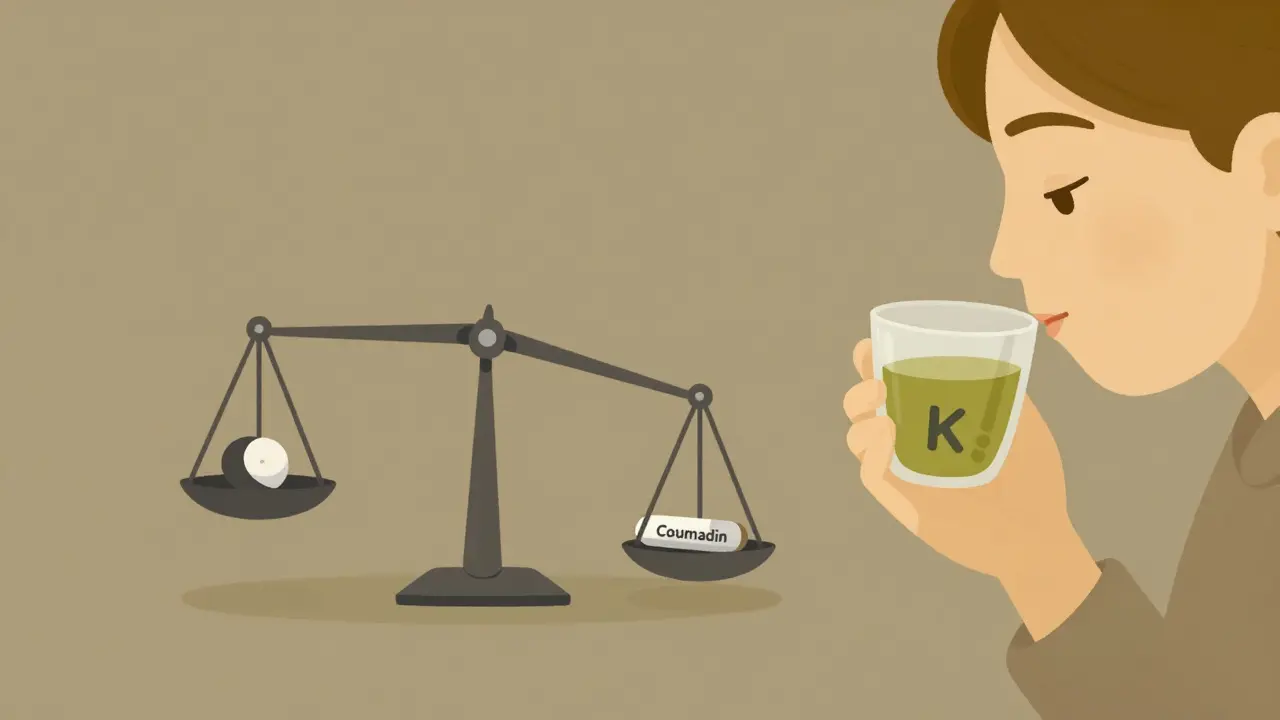
Warfarin (sold as Coumadin or Jantoven) doesn't dissolve clots. It stops new ones from forming. It does this by blocking vitamin K, a nutrient your body needs to make proteins that help blood clot. Without enough vitamin K, those clotting proteins can't do their job. That's the whole point - to keep blood from thickening too much.
But here's the catch: your body needs some vitamin K every day. Too little, and you risk bleeding. Too much, and warfarin loses its power. That's why doctors don't tell you to avoid vitamin K entirely. They tell you to keep it consistent. A sudden spike in vitamin K - say, from eating a big salad one day and nothing the next - can throw your INR off. And that's where green tea comes in.
Green Tea Has Vitamin K - But Not as Much as You Think
At first glance, green tea seems like a safe bet. After all, you're not eating the leaves. You're steeping them. But here's the surprising math:
- Dried green tea leaves: 1,428 mcg of vitamin K per 100 grams
- Brewed green tea: only 0.03 mcg per 100 grams
That’s a 99.98% drop. So why does it matter at all? Because if you drink gallons of it - not cups - you're still getting enough vitamin K to compete with warfarin. One documented case in 2006 showed a man's INR plummeting from 3.79 to 1.37 after drinking 0.5 to 1 gallon of green tea daily. That's like drinking 64 to 128 cups a day. Not normal. But it proves the interaction is real.
For most people, 1 to 3 cups a day (240-720 mL) doesn't move the needle. Studies from the American Heart Association and Mayo Clinic agree: moderate intake is fine. The problem starts when habits change. Someone who drinks one cup a week suddenly starts drinking five cups a day. Or they switch from regular tea to matcha.
Matcha Is the Real Wild Card
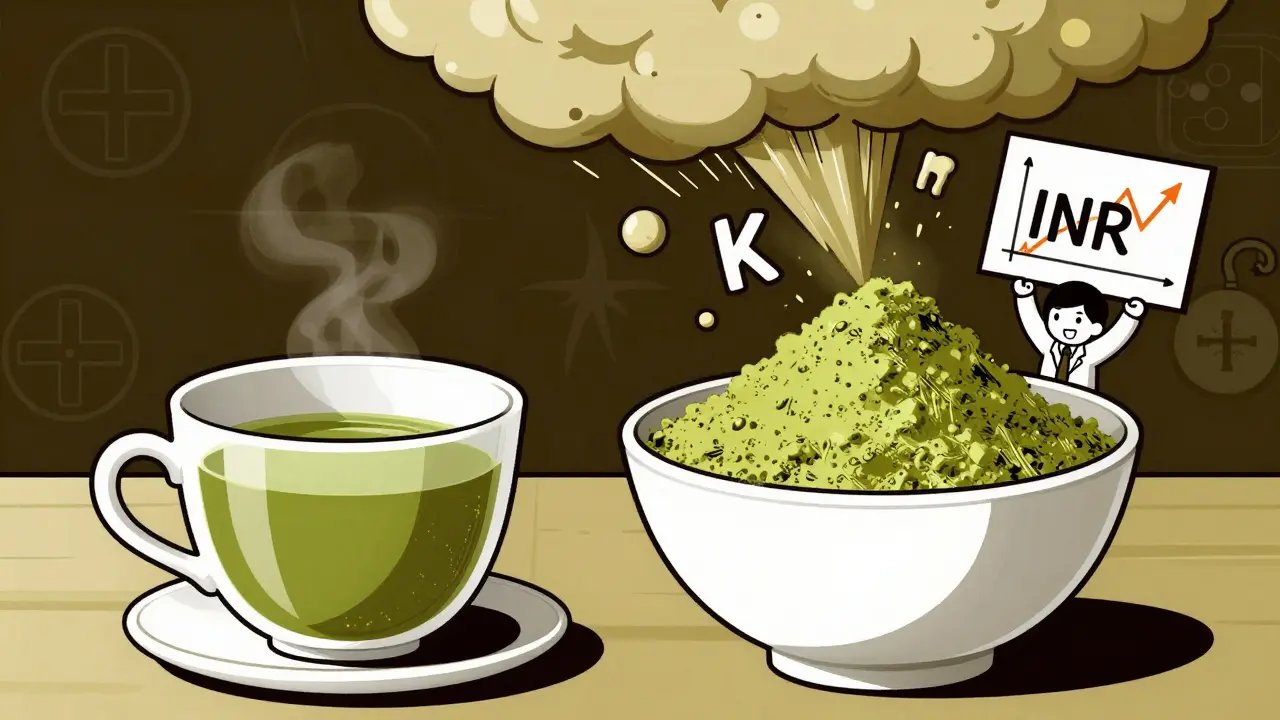
Matcha isn't just green tea with a fancy name. It's powdered whole leaves. You're not drinking an infusion - you're consuming the entire leaf. That means you're getting 10 to 20 times more vitamin K than in brewed tea.
Dr. Jane Chen at UCSF Medical Center found that patients switching to matcha often need warfarin dose adjustments. One patient in her practice saw their INR drop from 2.8 to 1.9 after two weeks of daily matcha lattes. That’s not a fluke. It’s a pattern. The same goes for green tea powders, energy bars, or supplements labeled "green tea extract." Those aren't regulated like drugs. Their vitamin K content can vary wildly.
And it's not just vitamin K. Green tea contains catechins - compounds that may actually thin your blood by blocking platelet activity. So you're getting two opposing forces: one side (vitamin K) fights warfarin. The other side (catechins) teams up with it. The net result? Unpredictable INR swings.
How Much Is Too Much? The Real Numbers
Forget vague advice like "drink in moderation." You need numbers:
- 1-3 cups per day (240-720 mL): Safe for most. No change needed in your warfarin dose.
- 4-6 cups per day (720-1,500 mL): Watch your INR. Your doctor may want to check it every two weeks instead of monthly.
- More than 1,500 mL per day: High risk. You likely need a higher warfarin dose. Talk to your provider immediately.
That’s the threshold the American Society of Hematology is now using in draft guidelines. It’s based on real data from thousands of patients. And it’s not just about volume - it’s about consistency. If you drink three cups every day, your body adapts. But if you go from zero to five cups in a week? That’s when INR crashes.
What About Other Teas? Green Isn’t the Only One
Black tea? Same story. It has less vitamin K than green, but if you're chugging 10 cups a day, it still matters. Herbal teas? That’s a different ballgame. Chamomile, hibiscus, or ginkgo tea? Those don’t have vitamin K - but they can affect how your liver processes warfarin. Ginkgo, for example, increases bleeding risk. Goji berry tea? One case report showed dangerous bleeding in a woman on warfarin who drank 3-4 glasses daily.
Cranberry juice? That’s a no-go. It blocks the liver enzyme that breaks down warfarin, causing INR to rise. Grapefruit? Same deal. But unlike green tea, these have consistent, strong effects. Green tea is trickier because it’s dose-dependent and variable.

What Should You Do? Practical Rules
You don’t need to quit green tea. But you do need a plan:
- Stick to one amount. If you drink one cup a day, keep it that way. Don’t skip for a week, then binge on weekends.
- Avoid matcha unless approved. If you love matcha, tell your anticoagulation clinic. They may need to adjust your dose.
- Track your intake. Use a simple journal or app like WarfarinWise. Logging your tea helps spot patterns before your INR goes wild.
- Get tested when things change. If you start or stop drinking green tea, ask for an INR check within 3-5 days.
- Don’t assume it’s safe. A 2022 survey found 62% of warfarin users didn’t know about this interaction until they had a problem.
Most people who drink 1-3 cups daily never have an issue. But for those who don’t know their limits - or who change habits suddenly - the risk is real. A single INR drop from 3.0 to 1.5 means your risk of stroke or clotting skyrockets. And a spike from 2.5 to 5.0? That’s bleeding territory.
Why This Matters More Than You Think
Warfarin is still the go-to drug for mechanical heart valves, certain clots, and patients with kidney issues. Newer blood thinners like apixaban or rivaroxaban don’t interact with vitamin K - but they’re not right for everyone. That means millions of people still rely on warfarin. And tea? It’s the second most consumed beverage in the world after water. In the U.S. alone, 28.6 million people drink green tea. That’s a lot of potential interactions.
Hospital costs from unstable INR are over $400 million a year. Nearly 19% of those cases involve diet. Green tea isn’t the biggest offender - leafy greens are. But it’s the sneaky one. People think it’s harmless. It’s not.
Bottom Line
You don’t have to give up green tea. But you do need to treat it like medicine - not just a drink. Know how much you’re drinking. Keep it steady. Avoid matcha unless you’ve talked to your doctor. And if you’re unsure? Get your INR checked. One test can prevent a stroke, a bleed, or a hospital stay. Your body doesn’t care if tea is "healthy." It only cares about the vitamin K in it - and whether it’s consistent.
14 Comments

Andrew Muchmore
March 19, 2026 AT 19:18
I drink 2 cups a day and my INR's been stable for 3 years. No changes, no drama. Just keep it consistent. That's the whole point.
Don't overthink it.

Paul Ratliff
March 20, 2026 AT 12:20
matcha be wild tho. i switched to it last year and my dr nearly had a heart attack. 1200ml of green tea? nah. 10g of matcha powder? yeah that’ll do it. my INR dropped like a rock. now i only do it once a week. lesson learned.

SNEHA GUPTA
March 22, 2026 AT 08:03
The body is not a machine that responds to inputs with predictable outputs. Green tea is not a variable to be controlled. It is a ritual, a tradition, a quiet moment in a chaotic day. To treat it as a drug is to lose the very essence of what makes it healing. Perhaps the real issue is not tea, but our fear of unpredictability.

Gaurav Kumar
March 24, 2026 AT 03:07
Americans always overreact. In India we drink 5 cups of green tea daily with no issues. Your healthcare system is broken. We don’t need to track INR like it’s a stock market. Drink tea. Live life. Stop being paranoid.
Also matcha is just fancy green tea. Nothing special.

Kendrick Heyward
March 24, 2026 AT 16:01
I knew it. Big Pharma doesn’t want you to know this. Green tea is a natural blood thinner. They don’t want you to heal naturally. That’s why they push warfarin. And now they’re trying to scare you away from tea. Wake up. 🤡

lawanna major
March 24, 2026 AT 19:50
This is why I love reading medical info that actually makes sense. You don’t have to give up your tea. You just have to be mindful. That’s not a burden. That’s self-care. Keep doing what you’re doing. You’re already ahead of 90% of people.

Ryan Voeltner
March 25, 2026 AT 06:36
The clinical evidence presented here is both methodologically sound and clinically significant. Consistency in dietary vitamin K intake remains the cornerstone of stable anticoagulation. Deviations in intake, regardless of source, introduce unnecessary variability into INR dynamics. The data on matcha is particularly compelling.

Robin Hall
March 26, 2026 AT 16:41
They say 'green tea' but what they really mean is 'corporate tea industry.' The FDA doesn't regulate supplements. The tea companies know this. They're hiding vitamin K content on labels. This is a controlled experiment. They're testing how many people will drink it without knowing. And you're falling for it.

becca roberts
March 27, 2026 AT 19:15
So let me get this straight - we’re being told to treat a beverage that’s been consumed for 2000 years like a prescription drug? And matcha is the villain now? Next they’ll ban sunlight because it has vitamin D. 😏

gemeika hernandez
March 28, 2026 AT 15:43
I read this and thought 'oh no I drink matcha every morning.' Then I looked at my INR log. It's been 2.3 for 6 months. So maybe it's fine? Or maybe I'm just lucky? I don't know anymore.

Nicole Blain
March 30, 2026 AT 16:07
green tea = 🍵
matcha = 🍵💥
warfarin = ⚠️
consistency = ✅
panic = 🤯

Kathy Underhill
March 31, 2026 AT 06:56
The key is not avoidance. It is awareness. The body adapts to consistent inputs. Sudden changes are the problem. Whether it's tea, greens, or even alcohol - stability matters more than quantity. This is not about fear. It's about respect for physiology.

Prathamesh Ghodke
March 31, 2026 AT 13:02
I’ve been on warfarin for 8 years. I drink 3 cups of green tea every day. My INR? Perfect. My doctor? Happy. The real lesson here? Don’t listen to fear. Listen to your numbers. And if you’re unsure? Ask. No shame in that.

Stephen Habegger
April 2, 2026 AT 00:16
This post saved my life. I started drinking matcha lattes after a trip to Japan. Didn’t think twice. Two weeks later I was in the ER. Now I stick to one cup of regular green tea. No matcha. No drama. Just peace of mind.
Write a comment