



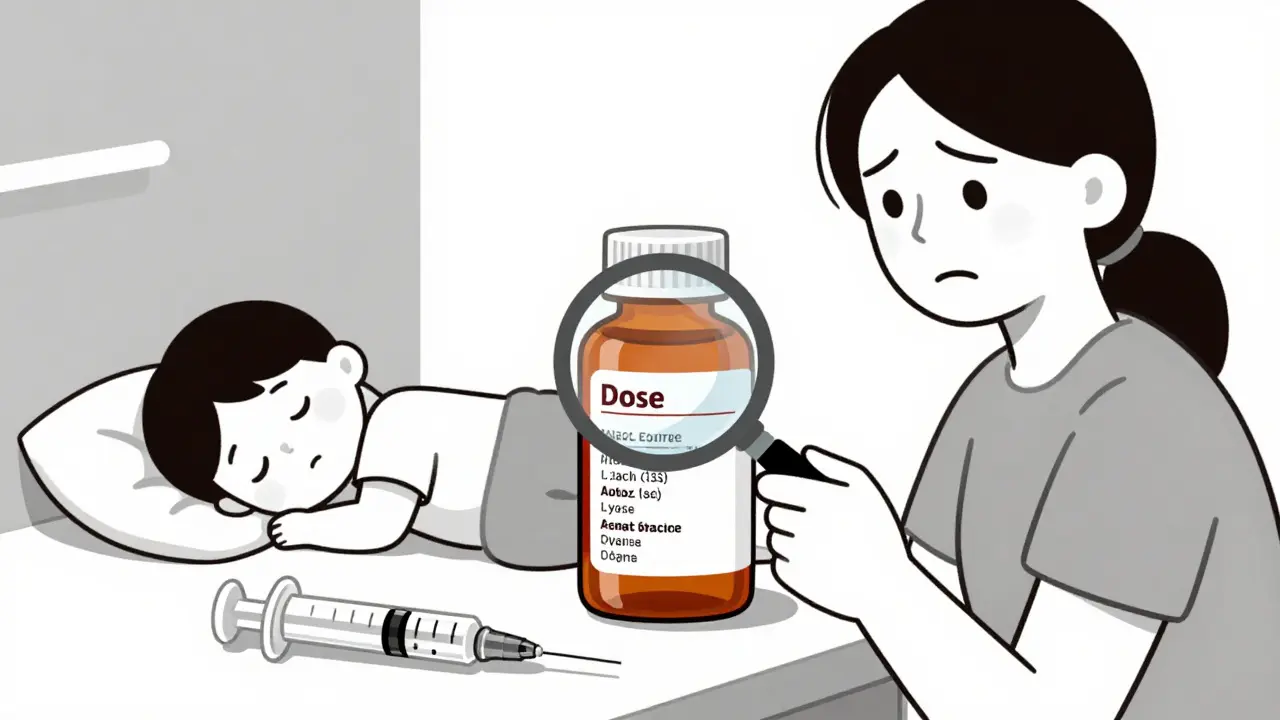
Every year, over 1.4 million children end up in emergency rooms because of medication errors - and most of them happen because parents are using age instead of weight to give medicine. It’s not your fault. The labels are confusing. The units are tiny. The warnings are buried. But here’s the truth: if you know how to read the label correctly, you can keep your child safe. No guesswork. No kitchen spoons. No panic at 2 a.m.
Why Weight Matters More Than Age
Age is a rough estimate. Weight is the real thing. A 2-year-old who weighs 30 pounds needs a different dose than a 2-year-old who weighs 18 pounds. But most labels still list dosing by age ranges - and that’s where things go wrong.
According to a study from Johns Hopkins Children’s Center, using age instead of weight leads to dosing errors in 23% of cases. That means nearly 1 in 4 kids gets either too little or too much. Underdosing won’t help their fever. Overdosing can wreck their liver.
The FDA, the American Academy of Pediatrics, and hospitals like St. Louis Children’s all agree: weight is the gold standard. If you know your child’s weight, use it. Always. Even if the label says "for ages 2-3" - check the weight chart next to it. That’s where the real answer lives.
What’s on the Label - And What to Look For
OTC children’s medicine labels changed in 2011. Before that, infant and children’s acetaminophen had different strengths. Some were 80mg per 0.8mL. Others were 160mg per 5mL. Parents mixed them up. Kids got too much. So the FDA made one rule: all liquid acetaminophen must be 160mg per 5mL.
Now, every bottle you buy must show this clearly:
- Active ingredient - "Acetaminophen 160mg per 5mL" - not "per teaspoon"
- Weight-based dosing chart - usually in pounds and kilograms, broken into ranges like 12-17 lbs, 18-23 lbs, etc.
- Age warning - "Do not use for children under 2 years" (or 6 months for ibuprofen)
- Dosing frequency - "Every 4 hours" for acetaminophen, "Every 6-8 hours" for ibuprofen
- Max daily dose - "Do not exceed 5 doses in 24 hours" for acetaminophen
- Concentration note - "Do not use with other medicines containing acetaminophen"
And here’s the one thing you must never ignore: "mL". Not teaspoons. Not tablespoons. Not "scoops." Only milliliters. Because a household teaspoon holds anywhere from 4.5mL to 7mL - depending on how you hold it. That’s a 50% error right there.
Acetaminophen vs. Ibuprofen: Key Differences
Not all kids’ medicine is the same. Acetaminophen (Tylenol) and ibuprofen (Advil, Motrin) work differently - and their labels reflect that.
| Feature | Acetaminophen (Tylenol) | Ibuprofen (Advil, Motrin) |
|---|---|---|
| Minimum age | 2 months (with doctor approval) | 6 months |
| Concentration | 160mg per 5mL | 100mg per 5mL |
| Dosing frequency | Every 4 hours | Every 6-8 hours |
| Max daily doses | 5 doses in 24 hours | 4 doses in 24 hours |
| Weight range example (24-35 lbs) | 5mL | 5mL |
| Key risk | Liver damage from overdose | Kidney stress, stomach irritation |
Notice something? For a child weighing 24-35 lbs, both medicines use 5mL. But the amount of active drug is different. Acetaminophen has 160mg per 5mL. Ibuprofen has 100mg per 5mL. That’s why you can’t swap them - even if the volume looks the same.
And here’s the catch: ibuprofen is not safe for babies under 6 months. Not even a drop. The FDA made this rule in 2020 because of kidney risks. Acetaminophen? It’s okay from 2 months - but only if you’ve talked to your pediatrician first.
What About Chewables and Drops?
Not all medicine comes in liquid. Chewable tablets? Infant drops? These are trickier.
Infant drops used to be 80mg per 0.8mL. That’s a tiny amount. You needed a special syringe. Now, most infant drops are gone. The FDA pushed for standardization - so now, even "infant" products are usually 160mg per 5mL. But if you still have old drops? Don’t guess. Check the label. If it says 80mg per 0.8mL, you need to give 0.8mL - not 5mL. One drop of wrong dosage can overdose a baby.
Chewable tablets? They’re usually 80mg each. Children’s tablets? 160mg. So if you’re giving a 2-year-old a chewable and think "one tablet = one dose," you’re giving them half the right amount. Always check the label. Don’t assume.
Why Kitchen Spoons Are Dangerous
You’ve heard it before. But here’s why it’s not just advice - it’s a medical emergency.
A 2022 study from Hyde Park Pediatrics found that 42% of dosing errors came from parents using kitchen spoons. One mom thought her teaspoon held 5mL. It held 7mL. Her 18-month-old got 40% more medicine than planned. She didn’t know. Her child got sick. She ended up in the ER.
Here’s the math:
- 1 teaspoon (tsp) = 5mL
- 1 tablespoon (TBSP) = 15mL
- Household teaspoon = 4.5mL to 7mL (varies by brand, wear, how you fill it)
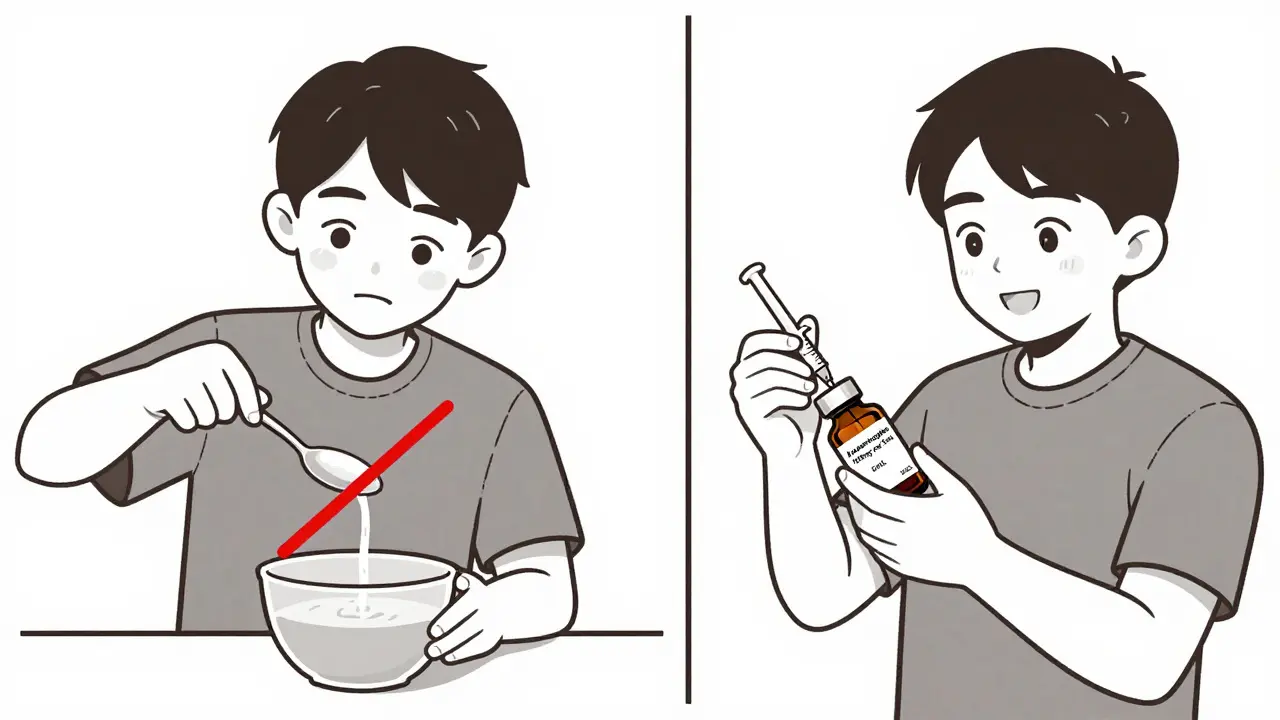
That’s why every label says: "Use only the dosing device that comes with the medicine." It’s not a suggestion. It’s a safety rule.
That device? Usually a plastic syringe or a dosing cup with clear mL markings. Never use a regular spoon. Never eyeball it. Always measure.
What If Your Child’s Weight Is Between Two Ranges?
Here’s a real-life scenario: Your child weighs 37 pounds. The chart says:
- 36-47 lbs: 5mL
- 48-59 lbs: 6mL
Do you give 5mL or 6mL?
The answer: Always round down. Go with the lower weight range. Why? Because the risk of overdose is higher than the risk of underdosing. Fever won’t kill your child. Liver damage might.
Experts from Pediatric Associates of NYC and St. Louis Children’s Hospital both say: when in doubt, use the lower dose. If you’re still unsure? Call your pediatrician. Don’t wing it.
Don’t Double Up - Even If It Seems Safe
One of the most common mistakes? Giving acetaminophen for fever, then giving a cold medicine later because "it has something else in it."
Here’s the problem: most cold, flu, and allergy medicines for kids also contain acetaminophen. So you give Tylenol. Then you give "Children’s Cold & Flu." Now your child has two doses of acetaminophen - and you didn’t even realize it.
That’s how 19% of acetaminophen overdoses happen. The label says: "Do not use with other medicines containing acetaminophen." That’s not fine print. That’s a life-or-death warning.
Rule: If you’re giving more than one medicine, check the "Active Ingredients" list on both bottles. If both say "acetaminophen" - don’t combine them.
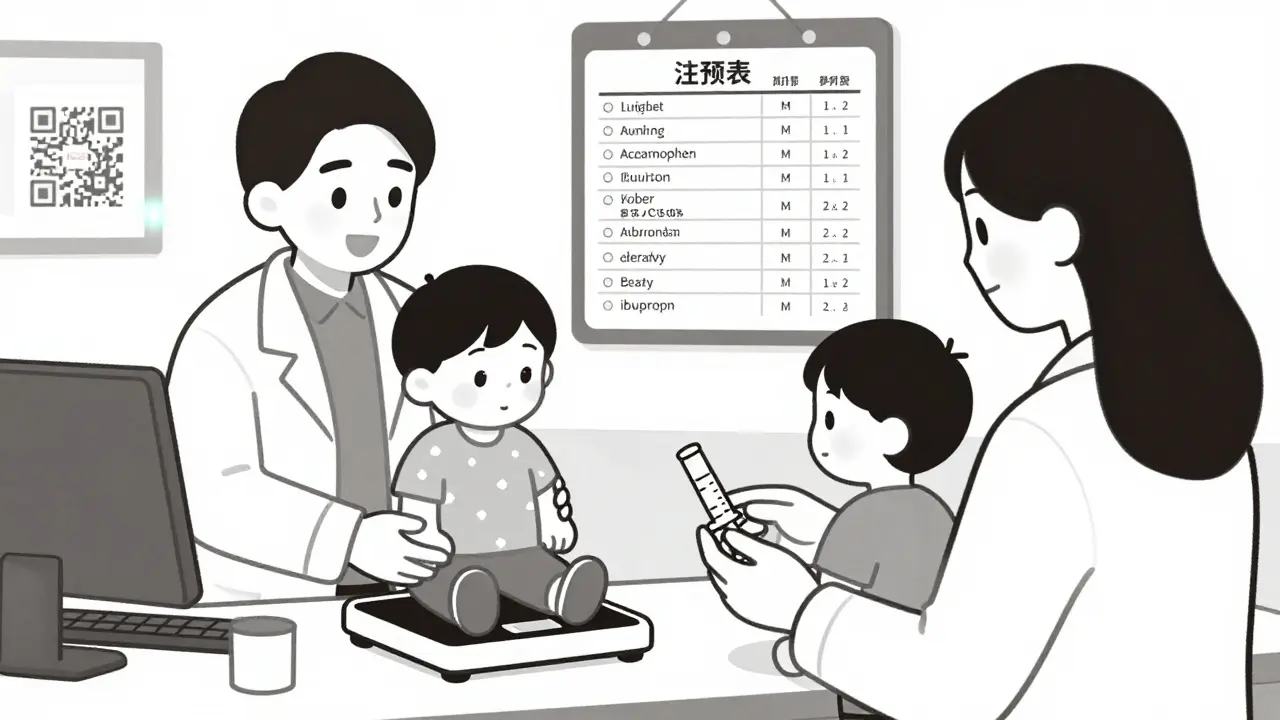
What You Need to Keep on Hand
Don’t wait until your child is sick to find the right tools. Get these now:
- A plastic dosing syringe (with mL markings, not teaspoons)
- A measuring cup that shows mL (not a regular cup)
- A digital scale to weigh your child (even a baby scale from the pharmacy works)
- A notebook to write down your child’s weight and the last dose time
Also: keep the original packaging. Don’t throw it out. You’ll need it when you’re tired, it’s 3 a.m., and your child has a 103°F fever.
What’s Changing in 2025-2026
The FDA is pushing for even clearer labels. By 2025, all children’s liquid medicines will include:
- "Syringe units" - like "1.0, 1.5, 2.0" - alongside mL
- Bolder "Liver Warning" labels for kids under 12
- QR codes that link to video instructions
Some companies are already doing this. But don’t wait for the new labels. Use what’s on the bottle now - correctly.
Final Rule: If You’re Not Sure, Call Your Doctor
There’s no shame in calling. Seriously. Pediatricians expect this question. They’ve seen it before. A parent with a feverish child, a confused label, and a shaking hand. That’s why they’re there.
Call if:
- Your child is under 3 months and has a fever
- You don’t know their weight
- The label looks different from last time
- You’re giving medicine for the first time
It’s better to call than to guess. One wrong dose can change everything.
Can I use a regular spoon if I don’t have a dosing syringe?
No. Household spoons vary in size by 20-30%. A teaspoon might hold 4.5mL or 7mL - that’s a 50% error. Always use the syringe or measuring cup that came with the medicine. If you lost it, go to a pharmacy and ask for a free dosing syringe. They keep them behind the counter.
What if my child’s weight isn’t listed on the chart?
If your child’s weight falls between two ranges, always use the dose for the lower weight range. For example, if they weigh 46 pounds and the chart lists 36-47 lbs (5mL) and 48-59 lbs (6mL), give 5mL. It’s safer to underdose than to risk an overdose. If you’re still unsure, call your pediatrician.
Is it okay to give ibuprofen to a 4-month-old with a fever?
No. Ibuprofen is not approved for children under 6 months old. The FDA banned it for infants under 6 months in 2020 due to risks of kidney injury. For babies under 6 months with a fever, use acetaminophen - but only after calling your pediatrician first.
How do I know if I’m giving too much acetaminophen?
The max is 5 doses in 24 hours - no more. Also, don’t give acetaminophen if your child is taking any other medicine that contains it (like cold or flu products). Signs of overdose include nausea, vomiting, loss of appetite, and yellowing of the skin or eyes. If you suspect an overdose, call Poison Control at 1-800-222-1222 (US) or your local emergency number immediately.
Why do some labels say "infant drops" and others say "children’s liquid"?
In the past, infant drops were stronger (80mg per 0.8mL) and children’s liquid was weaker (160mg per 5mL). Since 2011, the FDA required all liquid acetaminophen to be 160mg per 5mL - so "infant drops" are mostly gone. If you still have old infant drops, check the concentration. Never mix them with children’s liquid. Always use the dosing device that came with that specific product.
If you’re reading this because your child is sick right now - stop. Breathe. Find the label. Find the weight. Find the mL. Use the syringe. You’ve got this.
11 Comments

Richard Harris
March 14, 2026 AT 12:44
ive been using the syringe since my kid was 6 months old and honestly it changed everything. no more guessing, no more panic at 2am. just read the weight, measure the ml, done. also bought a cheap digital scale off amazon-best 15 bucks i ever spent. thanks for the reminder, this stuff matters.

Kandace Bennett
March 15, 2026 AT 06:10
OMG YES 🙌 I’m so glad someone finally said this. If you’re still using a spoon, you’re basically playing Russian roulette with your kid’s liver. I saw a mom do this at Target last week-used a soup spoon for Tylenol. I had to walk over and say ‘Ma’am, that’s 7mL not 5.’ She looked at me like I was from Mars. 🤦♀️ #ParentingIsHardButNotThatHard

Tim Schulz
March 15, 2026 AT 15:10
Oh wow. A whole article about not using kitchen spoons. I mean, wow. Groundbreaking. Next up: ‘How to stop putting your socks on the wrong feet.’ 🤡 I’m just amazed we’re still having this conversation in 2025. Did we forget we have measuring tools now? Or did we just decide that chaos is cute? 😘

Jinesh Jain
March 16, 2026 AT 08:31
Interesting read. I’ve been giving my daughter medicine based on weight since she was born. We weigh her every month. The dosing syringe is always in the diaper bag. But I wonder-do pediatricians in rural areas actually teach this? Or do they just hand out labels and hope for the best?

douglas martinez
March 17, 2026 AT 06:57
This is an exceptionally well-researched and clearly presented guide. The emphasis on weight-based dosing, the distinction between acetaminophen and ibuprofen concentrations, and the warning against polypharmacy with OTC cold remedies are all critical points that deserve wider dissemination. I encourage all caregivers to print and post this near their medicine cabinet.

Sabrina Sanches
March 18, 2026 AT 11:00
weight not age weight not age weight not age. always use the syringe. never use a spoon. call the doc if unsure. write it down. keep the box. i did all this. my kid is fine. you can too. trust the process. you got this.

Shruti Chaturvedi
March 19, 2026 AT 16:46
when my daughter was sick last winter i read the label three times before giving anything. i weighed her on the bathroom scale with her in my arms then subtracted my weight. it was messy but it worked. now i keep a notebook by the medicine cabinet. if you’re unsure just pause. breathe. and check again. safety first always

Katherine Rodriguez
March 19, 2026 AT 22:06
why is this even a thing? we’re adults. we have smartphones. we have scales. we have apps. yet somehow parents still think a teaspoon is a medical device? this isn’t a parenting tip. this is basic human competence. if you can’t measure 5mL you shouldn’t be giving medicine. period. end of story.

Devin Ersoy
March 21, 2026 AT 16:10
so let me get this straight-we’re celebrating a 2011 FDA regulation like it’s the moon landing? the real revolution? parents finally stopping using spoons? nah. the real revolution is that we’re still having this conversation. imagine if we applied this level of scrutiny to vaccines, school lunches, or screen time. but nope-let’s just praise someone for not poisoning their kid with a tablespoon. 🙃

Scott Smith
March 22, 2026 AT 09:06
My wife and I started using a digital scale and labeled syringes after our first ER trip. We keep the original packaging for every bottle, even if it’s empty. We write down the time and dose in a notebook. It’s not glamorous. But it’s how we keep our kids safe. You don’t need a PhD. You just need to be consistent.

Sally Lloyd
March 22, 2026 AT 18:32
Did you know the FDA doesn’t actually require pharmacies to give out syringes? I looked it up. They just recommend it. So if you don’t ask, you get nothing. And what if the pharmacy runs out? What if they give you the wrong one? What if the label is wrong? Who’s really in charge here? I think we’re being manipulated.
Write a comment