



![Capoten (Captopril): Official Info, Uses, Dosage, Side Effects, Warnings [2025]](/uploads/2025/08/thumbnail-capoten-captopril-official-info-uses-dosage-side-effects-warnings.webp)

SSRI Hyponatremia Risk Calculator
This tool estimates your risk of developing hyponatremia (low sodium levels) from SSRIs, a serious side effect for older adults. Hyponatremia can cause confusion, dizziness, and falls.
Important: This is for educational purposes only. Always consult your doctor before making any medication changes.
Risk Assessment
Risk Assessment Results
0%
Key Recommendations:
If you're over 65: Get a baseline sodium test before starting an SSRI. Check sodium again at 2 weeks. If sodium drops below 135 mmol/L, stop the SSRI immediately.
If you're on diuretics: This combination significantly increases risk. Discuss alternatives with your doctor.
If you're female: Be extra vigilant about symptoms like confusion or dizziness.
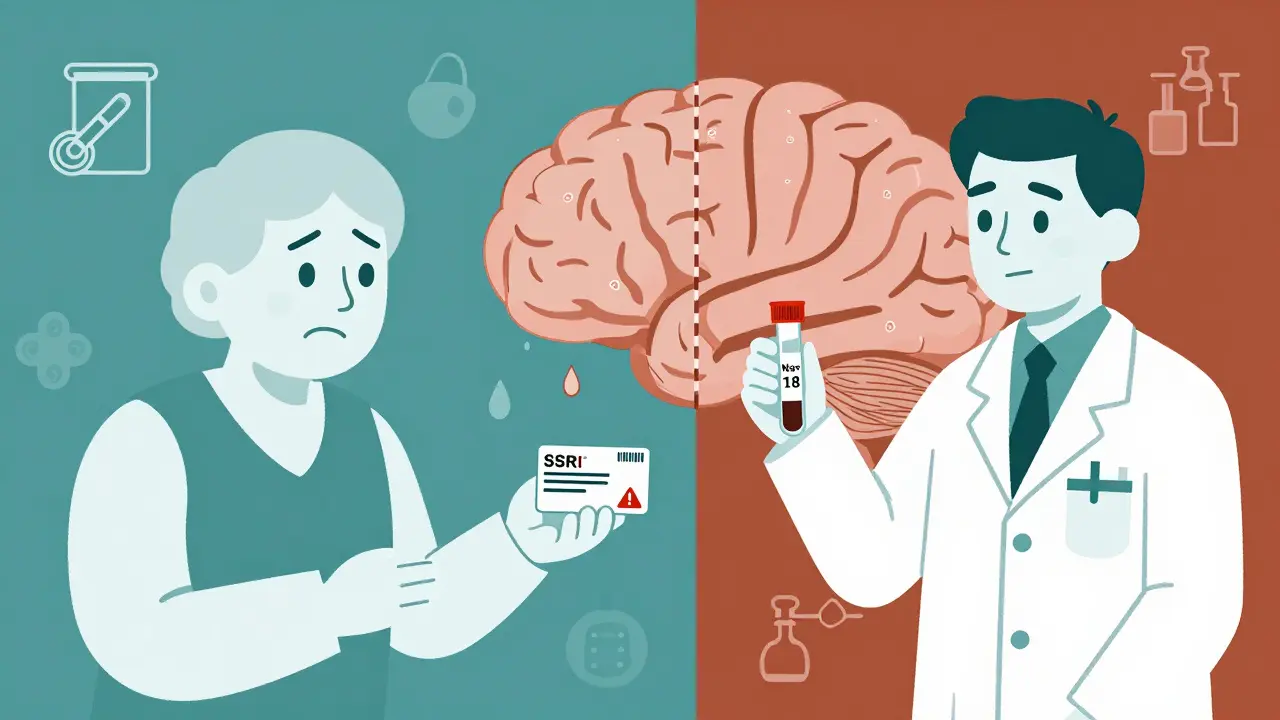
When someone starts an SSRI for depression, they expect to feel better - not to become confused, dizzy, or disoriented. But for older adults, especially those over 65, a hidden danger lurks beneath the surface of these commonly prescribed antidepressants: hyponatremia. This isn’t a rare glitch. It’s a well-documented, preventable condition that can turn a simple medication change into a life-threatening emergency.
What Is Hyponatremia, and Why Does It Happen with SSRIs?
Hyponatremia means your blood sodium level has dropped below 135 mmol/L. Sodium isn’t just table salt - it’s essential for nerve function, muscle control, and fluid balance. When levels fall too low, water floods into your brain cells, causing swelling. That’s when confusion, headaches, nausea, and seizures start.
SSRIs like citalopram, sertraline, and fluoxetine trigger this by overstimulating serotonin receptors in the brain. That sends a signal to the kidneys to hold onto water instead of flushing it out. The result? Your blood gets diluted. Sodium levels drop. And your body doesn’t know how to fix it.
This isn’t just theoretical. A 2024 meta-analysis of over 30 studies found that nearly 1 in 20 people taking SSRIs develop hyponatremia. For those over 65, the risk jumps to nearly 1 in 6. And it usually shows up within two to four weeks - right when people think the medication is "working."
Who’s Most at Risk?
Not everyone who takes an SSRI gets hyponatremia. But certain factors make it much more likely:
- Age 65+ - Your kidneys don’t handle fluid the way they used to. The risk is 3.7 times higher than in younger adults.
- Female - Over 65% of reported cases are in women, possibly due to body composition and hormone differences.
- Low body weight - People under 60 kg (132 lbs) have less fluid volume, so even small water retention changes hit harder.
- Already on diuretics - Thiazide diuretics (like hydrochlorothiazide) increase the risk by over four times. Many older adults take these for high blood pressure - often without realizing the danger when combined with SSRIs.
- Chronic kidney issues - If your eGFR is below 60, your kidneys are already struggling to regulate fluids.
These aren’t edge cases. They’re common. A 78-year-old woman on sertraline and a thiazide diuretic? That’s a perfect storm. A 2022 case report described her sodium plunging to 118 mmol/L - less than what you’d see in severe dehydration - within 10 days. She ended up in intensive care.
Why Symptoms Are Often Mistaken for Dementia or Aging
Confusion. Memory lapses. Slurred speech. These aren’t just "getting older." They’re red flags.
In elderly patients, hyponatremia symptoms mimic dementia, depression, or just "being tired." That’s why it takes, on average, 7.2 days to get the right diagnosis. Families and even doctors often assume it’s Alzheimer’s or a stroke. One Reddit user shared how their 82-year-old mother became "completely confused" two weeks after starting citalopram. Her sodium was 122 mmol/L. She was hospitalized. The medication was stopped. It took days for her to return to normal.
And here’s the cruel twist: the very people who need antidepressants most - older adults with late-life depression - are the ones most likely to suffer this side effect. It’s a catch-22. Treating depression can worsen cognition. And worsening cognition gets blamed on aging, not the drug.
Which SSRIs Are Riskiest? The Data Doesn’t Lie
All SSRIs carry some risk - but not equally.
Based on the 2024 meta-analysis:
- Citalopram - Highest risk (odds ratio 2.37)
- Sertraline - Very high risk (OR 2.15)
- Fluoxetine - High risk (OR 1.98)
- Paroxetine - Moderate risk (OR 1.82)
Why does this happen? It’s tied to how strongly each drug binds to the serotonin transporter (SERT). The tighter the grip, the more ADH is released - and the more water your body holds.
But here’s the good news: not all antidepressants are created equal.
Mirtazapine: The Safer Alternative for Older Adults
When you’re over 65, mirtazapine isn’t just an option - it’s often the smarter first choice.
Compared to SSRIs, mirtazapine has less than half the risk of hyponatremia. Studies show it’s only 0.47 times as likely to cause low sodium. That’s not a small difference. For every 1,000 older adults prescribed SSRIs, about 19 will develop hyponatremia. With mirtazapine? Only 7.
The American Geriatrics Society’s 2023 Beers Criteria explicitly lists SSRIs as potentially inappropriate for seniors because of this risk. They recommend mirtazapine or bupropion instead.
And it’s not just theory. Between 2018 and 2023, SSRI prescriptions for patients over 65 dropped by 22.3%. Mirtazapine prescriptions for that group jumped 34.7%. Doctors are catching on.
Dr. Elena Martinez, lead author of the 2024 meta-analysis, put it bluntly: "Mirtazapine should be considered first-line for elderly patients requiring antidepressant therapy."
What Should You Do Before Starting an SSRI?
It’s not enough to just "take the pill and wait." You need to act before it starts.
Step 1: Get a baseline sodium test. Do this within 7 days before starting any SSRI. If you’re over 65, have kidney disease, or take diuretics - this is non-negotiable.
Step 2: Repeat the test at 2 weeks. That’s when hyponatremia most often appears. If sodium drops below 135, stop the SSRI. Don’t wait for confusion or falls.
Step 3: Monitor monthly for the first 3 months. Especially if you’re high-risk. Many doctors don’t know this. A 2023 survey found 63.4% of primary care physicians were unaware of the 2-4 week onset window.
Step 4: Talk to your doctor about alternatives. If you’re over 65, ask: "Is mirtazapine or bupropion a better fit for me?" If your doctor says "SSRIs are safer," ask for the evidence. The data says otherwise.

What Happens If Hyponatremia Is Detected?
If your sodium is between 125 and 134 mmol/L:
- Stop the SSRI immediately.
- Limit fluids to 800-1000 mL per day (about 3-4 cups).
- Sodium usually returns to normal in 3-4 days.
If it’s below 125 mmol/L - that’s an emergency. You need hospital care. Doctors will give you a slow IV drip of 3% hypertonic saline. But they must be careful. Fixing sodium too fast can cause brain damage from osmotic demyelination. The rule: no more than 6-8 mmol/L increase in the first 24 hours.
Recovery takes time. Even after sodium normalizes, brain fog and fatigue can linger for days. And if the SSRI is restarted later, the risk returns - often faster than before.
Why Is This Still Underdiagnosed?
Only 28.7% of patients surveyed in 2023 were told about hyponatremia risk before starting SSRIs. That’s not negligence - it’s ignorance. Many doctors still think this is a rare side effect. It’s not. It’s one of the most common electrolyte problems linked to psychiatric meds.
The FDA updated SSRI labels in 2022 to include hyponatremia warnings. The European Medicines Agency is reviewing SSRI safety as we speak. But in clinics? The message hasn’t fully landed.
And that’s the real danger. Mild hyponatremia - sodium at 130-134 - often goes unnoticed. But even that small dip increases fall risk. And falls in older adults? That’s how people end up in nursing homes - or worse.
The Bigger Picture: Changing How We Treat Depression in Older Adults
SSRIs aren’t going away. They work. For many, they’re life-saving. But blanket prescriptions for seniors? That’s outdated.
The future is personalized. If you’re 70, have high blood pressure, and take a water pill - mirtazapine is the better starting point. If you’re 40, no other health issues, and your depression is severe - an SSRI might still be fine, as long as you get tested.
By 2027, mirtazapine is projected to make up over 40% of antidepressant prescriptions for patients over 65. That’s not a trend. That’s a correction.
The cost of ignoring this? $1.27 billion a year in the U.S. alone - mostly from hospital stays and ER visits. That’s not just money. It’s lost independence. Lost time. Lost dignity.
It’s time to stop treating depression in older adults the same way we treat it in younger people. Their bodies work differently. Their risks are different. And their safety should be the priority - not convenience.
Can SSRIs cause confusion in elderly patients?
Yes. SSRIs can cause confusion in elderly patients due to hyponatremia - low sodium levels triggered by the drug. This happens when the medication causes the body to retain too much water, diluting sodium in the blood. The resulting brain swelling leads to symptoms like disorientation, memory problems, and dizziness - often mistaken for dementia or aging. The risk is highest in those over 65, especially within the first two to four weeks of starting treatment.
Which antidepressants are safest for older adults?
Mirtazapine is the safest antidepressant for older adults regarding hyponatremia risk. Studies show it has less than half the risk of low sodium compared to SSRIs. Bupropion is another low-risk option. SSRIs like citalopram, sertraline, and fluoxetine carry the highest risk. For seniors, especially those on diuretics or with kidney issues, guidelines now recommend mirtazapine as a first-line choice over SSRIs.
How long does it take for hyponatremia to develop after starting an SSRI?
Hyponatremia typically develops within two to four weeks after starting or increasing the dose of an SSRI. This is why doctors recommend checking sodium levels at the two-week mark - before severe symptoms like confusion or seizures appear. Delaying testing beyond this window increases the chance of missed diagnosis.
Should elderly patients avoid SSRIs completely?
Not necessarily - but they should avoid starting SSRIs without proper screening. If an elderly patient needs an antidepressant, mirtazapine or bupropion are safer first choices. If an SSRI is still preferred, baseline sodium testing must be done before starting, and a follow-up test at two weeks is essential. With monitoring, SSRIs can be used safely - but only if the risk is acknowledged and managed.
Can low sodium from SSRIs be reversed?
Yes. In mild cases (sodium 125-134 mmol/L), stopping the SSRI and limiting fluid intake usually brings sodium back to normal within 3-4 days. In severe cases (below 125 mmol/L), hospital treatment with controlled IV saline is required. Recovery is possible, but brain symptoms like confusion may linger for days after sodium normalizes. Restarting the same SSRI later carries a high risk of recurrence.
If you’re caring for an older adult on an SSRI and they’ve become more confused, sluggish, or unsteady - don’t assume it’s just aging. Ask for a blood test. Sodium levels are easy to check. A simple test could prevent a hospital stay - or worse.
11 Comments

Andy Thompson
January 19, 2026 AT 22:53
So now the government is using SSRIs to control the elderly? 😏 I knew it. They dilute the sodium so we get confused and stop asking questions about the border, the vaccines, and the deep state. Next they’ll put fluoride in the tap water to make us docile. 🤡 #MindControl #AmericaFirst

sagar sanadi
January 20, 2026 AT 15:09
SSRIs bad. Mirtazapine good. Pharma = liars. Why? Because money. Simple.

kumar kc
January 22, 2026 AT 01:55
This is why we can't have nice things. People take pills like candy and wonder why they're falling apart.

Renee Stringer
January 23, 2026 AT 08:21
I wish more doctors would actually read the guidelines instead of just reaching for the prescription pad. It’s not that hard to check sodium levels.

Crystal August
January 25, 2026 AT 07:29
So let me get this straight - we’re supposed to trust a 2024 meta-analysis but not the 30 years of SSRIs being prescribed? Also, who wrote this? A pharmaceutical rep trying to sell mirtazapine? 🤨

Courtney Carra
January 26, 2026 AT 00:33
It’s not about the drug. It’s about the system. We treat depression like a broken pipe - fix the flow, don’t ask why the pipe is cracked. But the body isn’t a machine. It’s a story. And when we ignore the story - the loneliness, the grief, the silence - we just pour more chemicals into the wound. 🌱

Shane McGriff
January 26, 2026 AT 06:42
This is exactly the kind of info we need more of. I’ve seen it firsthand - my aunt went from sharp as a tack to barely recognizing her own photos after starting sertraline. The doc said "she’s just getting older." We got her sodium checked - 124. Stopped the med. She came back. Don’t wait for a fall. Test early, test often. You owe it to your loved ones.

Jacob Cathro
January 27, 2026 AT 04:44
LMAO so SSRIs cause hyponatremia? Shocking. Next you’ll tell me oxygen causes dehydration. Also, "mirtazapine is safer" - yeah right, it makes you gain 30 lbs and sleep 14 hours a day. Great trade-off. And who even uses "odds ratio" in a reddit post? Try "like, it’s kinda risky" next time. 🤡

pragya mishra
January 28, 2026 AT 21:34
You people are so obsessed with lab numbers you forget people need help NOW. My mom was suicidal. You want her to wait for a sodium test while she cries in the dark? That’s not safety - that’s cruelty.

Manoj Kumar Billigunta
January 29, 2026 AT 09:56
I get your point, but let’s not throw the baby out with the bathwater. SSRIs saved my uncle’s life - he was silent for two years, didn’t eat, didn’t talk. After starting citalopram? He started gardening again. He’s 72. Yes, they tested his sodium. Yes, he was monitored. It’s not about avoiding meds - it’s about using them wisely. Talk to your doctor. Get tested. Stay informed. You’re not alone.

Thomas Varner
January 30, 2026 AT 12:42
I mean... I’m just here for the data. But also, why does every medical post on Reddit turn into a war between "pharma bad" and "science good"? The truth is in the middle. Test. Monitor. Adjust. And for god’s sake, don’t let your grandma take sertraline without a baseline. That’s just common sense.
Write a comment