




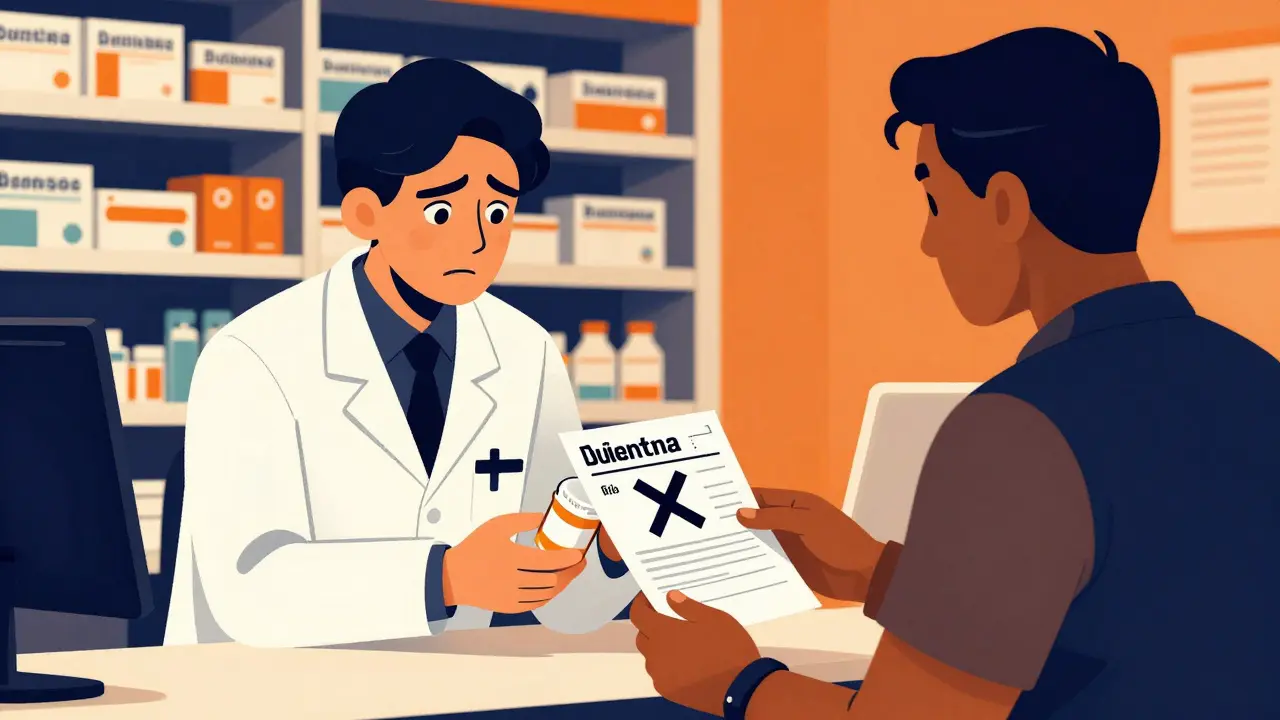
Imagine you’ve been stable on a specific medication for years. Your doctor writes the prescription, but when you pick it up, the pharmacist hands you a different box with a lower price tag. You take it, and suddenly your symptoms flare up. This isn’t just bad luck; it’s a clash between cost-saving laws and clinical necessity. The mechanism that allows doctors to stop this swap is called prescriber override. It is the legal tool physicians use to mandate that a specific brand-name drug be dispensed instead of a cheaper generic equivalent.
Understanding how this works is critical for both patients who rely on precise dosing and doctors navigating a complex web of state laws. While generics save the healthcare system billions, they are not always interchangeable for every patient. Here is exactly when and how prescribers can force brand dispensing, and why getting the paperwork right matters more than you think.
The Legal Backbone: Why Generics Are the Default
To understand the override, you first have to understand the rule it breaks. In the United States, the default setting for almost every prescription is generic substitution. This stems from the 1984 Hatch-Waxman Act, which created a fast-track approval process for generic drugs. The goal was simple: lower costs without sacrificing safety.
Today, all 50 U.S. states have generic substitution laws. According to data from the National Conference of State Legislatures, 35 of these states operate under "mandatory substitution" frameworks. This means pharmacists are legally required to switch a brand-name prescription to a generic one unless told otherwise. The other 15 states have "permissive" laws, giving pharmacists the discretion to substitute if they choose. Regardless of the type, the economic pressure is immense. Generic drugs saved the U.S. healthcare system approximately $2.2 trillion between 2010 and 2019. Because of this, insurance companies and pharmacy benefit managers (PBMs) aggressively push for generics, making the prescriber override a powerful, albeit heavily scrutinized, exception.
When Is a Brand Name Medically Necessary?
Doctors don’t use prescriber overrides lightly. Doing so often triggers prior authorizations, higher copays for patients, and scrutiny from insurers. Overrides are typically reserved for scenarios where switching brands poses a genuine health risk. The most common justification involves Narrow Therapeutic Index (NTI) medications.
NTI drugs have a very small window between a therapeutic dose and a toxic one. Examples include warfarin (a blood thinner), phenytoin (for seizures), and levothyroxine (for thyroid conditions). Even tiny variations in bioavailability-the amount of drug that actually reaches your bloodstream-can cause serious issues. If a patient is stabilized on Brand A, switching to Generic B might drop their blood levels below the effective range or spike them into toxicity. Research by the Institute for Safe Medication Practices documented dozens of adverse events linked to inappropriate substitutions of these specific drugs when override instructions were ignored or poorly processed.
Other valid reasons for an override include:
- Allergies to inactive ingredients: Generics must have the same active ingredient as the brand, but fillers, dyes, and binders can differ. Some patients react severely to lactose, gluten, or certain dyes found in generic formulations.
- Documented therapeutic failure: If a patient has tried a generic and experienced side effects or loss of efficacy, and returned to stability on the brand, a doctor can mandate the brand.
- Biosimilar interchangeability: As biologic drugs become more common, similar rules apply, though the FDA’s Orange Book is currently being updated to handle these complex biological comparisons.
How It Works: Decoding the DAW Codes
You won’t find a big red button labeled “Force Brand” on a prescription pad. Instead, the system relies on standardized codes known as Dispense as Written (DAW) codes, managed by the National Council for Prescription Drug Programs (NCPDP). These codes tell the pharmacy’s computer system exactly what to do.
| Code | Meaning | Who Initiates? |
|---|---|---|
| DAW-1 | Substitution Not Allowed by Prescriber | Doctor |
| DAW-2 | Patient Requests Brand Name | Patient |
| DAW-3 | Generic Selected by Pharmacist | Pharmacist |
| DAW-4 | Generic Unavailable | System/Pharmacy |
| DAW-7 | Brand Mandated by Law | Regulation |
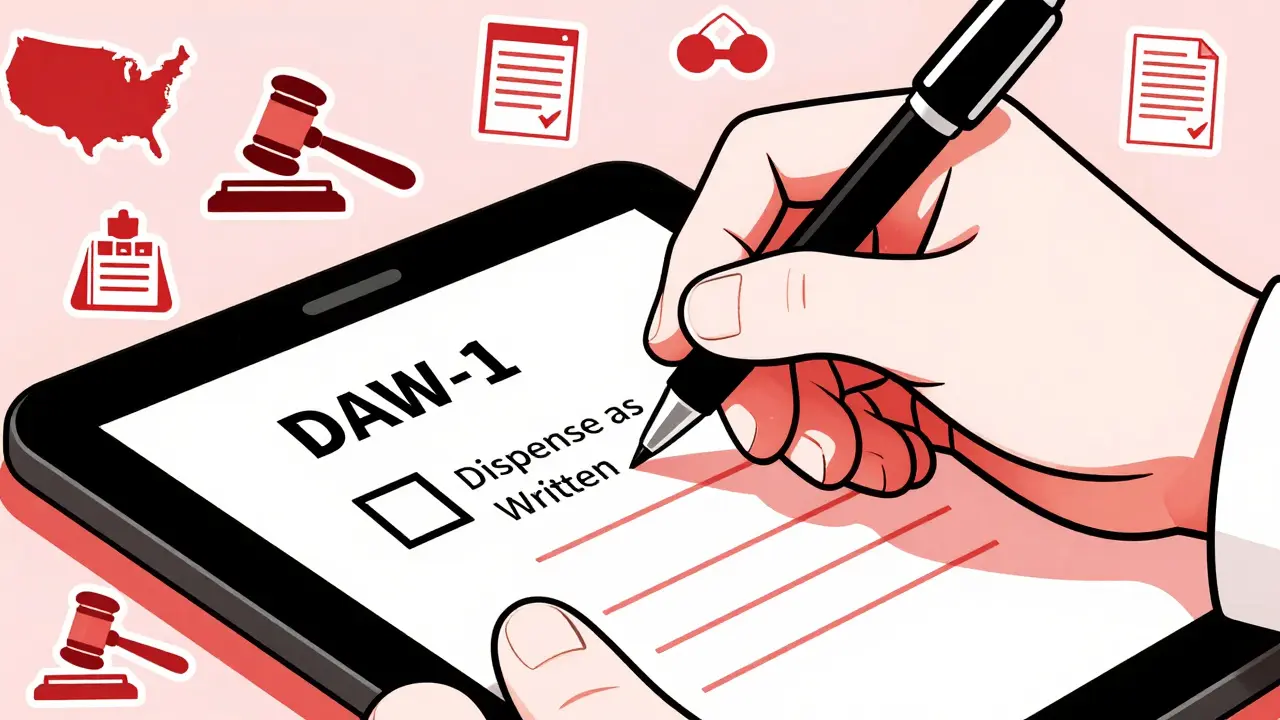
For a prescriber override, the critical code is DAW-1, which signifies 'Substitution Not Allowed by Prescriber'. When a doctor sends a prescription electronically, they must select this specific flag. If they send a paper prescription, they must follow state-specific handwritten protocols. Using the wrong code, or leaving it blank, results in automatic substitution. Studies show that DAW-1 usage varies wildly by drug class, hitting nearly 15% for anticonvulsants due to the high stakes of seizure control, but dropping significantly for less sensitive medications like antibiotics.

The Patchwork Problem: State-by-State Variations
This is where things get messy. There is no single federal law governing how a doctor must write “no substitution.” Each state has its own rules, creating a nightmare for physicians who practice across borders or telehealth platforms serving multiple jurisdictions.
In Illinois, for example, Section 225 ILCS 85/25 mandates that prescribers check a specific box labeled “May Not Substitute.” In Kentucky, the doctor must handwrite “Brand Medically Necessary” directly on the script. Massachusetts accepts “No Substitution,” while Michigan requires “DAW” or “Dispense as Written.” Oregon allows written, telephonic, or electronic communication but explicitly bans default settings that automatically assume no substitution.
If a doctor in California uses the Texas format for a patient picking up meds in New York, the pharmacy may reject the override. A 2019 study found that only 58.3% of physicians correctly understood their own state’s override requirements. This lack of clarity leads to unintentional substitutions. Dr. Jerry Avorn of Harvard Medical School has noted that this patchwork creates unnecessary administrative burdens and increases the risk of medication errors, particularly for mobile professionals.
Costs, Conflicts, and Clinical Reality
While overrides protect patient health in specific cases, they come with a heavy financial tag. Research published in the Journal of Managed Care & Specialty Pharmacy found that DAW-1 prescriptions cost an average of 32.7% more than substituted generics. For payers, this adds up quickly. Express Scripts reported that inappropriate DAW-1 designations accounted for over 18% of avoidable brand-drug spending in 2021.
This creates tension. Pharmacists and insurers view excessive overrides as a waste of resources. Dr. William Shrank, Chief Scientific Officer at UnitedHealth Group, argues that many physicians overestimate the clinical significance of minor formulation differences between brands and generics, leading to unnecessary overrides. However, dismissing all overrides is dangerous. The American Pharmacists Association acknowledges that overrides are clinically necessary in 5-7% of cases according to therapeutic guidelines. The challenge is distinguishing between the 5% that need protection and the 95% that don’t.
Patients also feel the pinch. In many insurance plans, choosing a brand name via override pushes the patient into a higher tier of coverage, resulting in significantly higher out-of-pocket costs. Sometimes, patients request the brand themselves (DAW-2) because they trust it more, even if the doctor didn’t mandate it. Understanding the difference between a medical necessity (DAW-1) and a patient preference (DAW-2) is crucial for billing and coverage.
Best Practices for Doctors and Patients
To ensure overrides work correctly and keep patients safe, both sides of the prescription need to be proactive.
For Physicians:
- Know your state’s syntax: Don’t guess. Check the local pharmacy board’s website for the exact phrase or checkbox required. Using non-standard terminology like “Please give brand” often fails to trigger the DAW-1 code in electronic systems.
- Use EHR templates wisely: Customize your Electronic Health Record templates to match state requirements. One study showed that clinics using standardized override templates reduced claim rejections by over 60%.
- Document the reason: Always note in the patient’s chart why the brand is necessary (e.g., “Failed generic trial due to rash”). This documentation protects you during prior authorization reviews.
For Patients:
- Ask questions: If you’re switched to a generic and feel worse, tell your doctor immediately. Don’t just suffer through it.
- Verify the label: Check your pill bottle. Does it say “Dispense as Written”? If your doctor ordered the brand but you got a generic, call the pharmacy before taking it.
- Understand the cost: Ask your pharmacist if the brand name will increase your copay. If it’s a life-or-death issue, the cost is worth it. If it’s a preference, ask if there are savings programs available.
The Future of Prescriber Overrides
The system is slowly modernizing. The FDA updated its Orange Book in early 2023 to better handle biosimilars, which will impact how biologics are substituted in the future. Additionally, the NCPDP is working to integrate override requirements directly into e-prescribing standards, aiming to reduce manual errors. Congress has even discussed the Standardized Prescriber Override Protocol Act, which would create uniform federal requirements, potentially ending the state-by-state confusion.
However, until those changes fully take effect, the prescriber override remains a vital, albeit imperfect, tool. It balances the massive economic benefits of generic drugs with the nuanced reality of human biology. When used correctly, it prevents hospitalizations and saves lives. When used incorrectly, it drives up costs without benefit. The key lies in clear communication, accurate coding, and a deep understanding of when a brand name truly matters.
What does DAW-1 mean on a prescription?
DAW-1 stands for 'Dispense as Written - Substitution Not Allowed by Prescriber.' It is a code sent by the doctor to the pharmacy instructing them to provide the exact brand-name medication prescribed, rather than substituting it with a generic equivalent. This is usually done for medical reasons such as allergies to generic fillers or sensitivity to bioequivalence variations.
Can a pharmacist refuse a prescriber's override request?
Generally, no. If a prescriber correctly marks a prescription as DAW-1 according to state laws, the pharmacist is legally obligated to dispense the brand name. However, if the insurance company denies coverage for the brand name due to lack of prior authorization, the pharmacist may contact the doctor to discuss alternatives or appeal the decision, but they cannot unilaterally substitute the drug against the doctor's explicit order.
Why do some doctors insist on brand names when generics are cheaper?
While generics are chemically similar, they can contain different inactive ingredients (fillers, dyes) and may have slight variations in how quickly they dissolve in the body. For drugs with a narrow therapeutic index, like thyroid medication or blood thinners, these small differences can lead to treatment failure or side effects. Doctors use overrides to ensure patients stay on the specific formulation that has proven effective for them.
Does my insurance cover brand-name drugs if my doctor overrides the generic?
It depends on your plan. Many insurance policies require 'prior authorization' for brand-name drugs, meaning the doctor must prove to the insurer that the generic is medically unsuitable. If approved, the insurance covers the brand, but your copay might be higher than it would be for a generic. If not approved, you may have to pay the full cash price for the brand name.
What is the FDA Orange Book and how does it relate to overrides?
The FDA Orange Book is a database that lists approved drug products and their patent information. It assigns therapeutic equivalence codes to generics. An 'A' rating means the generic is considered therapeutically equivalent to the brand and can be substituted. A 'B' rating means it is not deemed equivalent. Pharmacists use this book to determine if a substitution is safe, but a prescriber override (DAW-1) bypasses this check, mandating the brand regardless of the rating.