


GI Bleeding Risk Calculator: SSRI + NSAID Combination
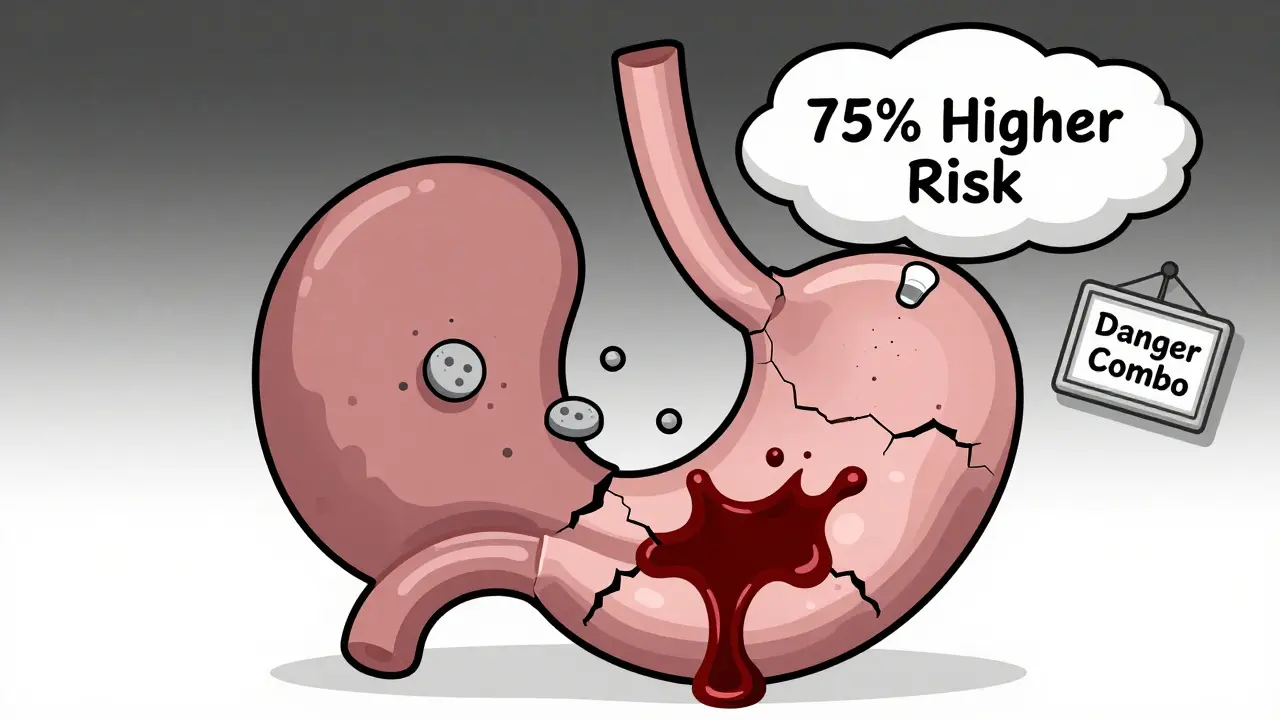
This tool calculates your risk of gastrointestinal bleeding when taking both an SSRI and NSAID together, based on key risk factors. Remember: The combination increases bleeding risk by 75% compared to NSAID use alone.
Risk Score
0%
Your estimated risk of upper GI bleeding when taking both medications
Without PPI
0%
With PPI
0%
Recommendations:
When you’re taking an SSRI for depression or anxiety, and you also need pain relief for arthritis or a bad back, it’s easy to assume that combining SSRIs and NSAIDs is harmless. After all, both are common, over-the-counter, or routinely prescribed. But the truth is far more dangerous than most people realize. Together, these two drug classes can dramatically increase your risk of life-threatening gastrointestinal bleeding - and many doctors still don’t talk about it.
Why This Combination Is So Risky
SSRIs, like fluoxetine, sertraline, or escitalopram, work by boosting serotonin in the brain. But serotonin isn’t just a mood chemical. It’s also critical for blood clotting. Platelets rely on serotonin to stick together and seal off damaged blood vessels. SSRIs block the serotonin transporter on platelets, leaving them sluggish and unable to form clots effectively. This isn’t a side effect - it’s a direct pharmacological action. NSAIDs - think ibuprofen, naproxen, diclofenac - do something else entirely. They damage the stomach lining by shutting down prostaglandins, the body’s natural protective shield. Without that shield, stomach acid eats away at tissue. The result? Ulcers, erosions, and bleeding. Put them together, and you get a perfect storm. One drug weakens your blood’s ability to stop bleeding. The other creates the bleeding in the first place. It’s not additive. It’s multiplicative. A 2022 meta-analysis in Nature Scientific Reports found that people taking both an SSRI and an NSAID had a 75% higher risk of upper GI bleeding than those taking NSAIDs alone. That’s not a small increase. That’s the same risk level as taking warfarin.The Numbers Don’t Lie
Let’s put that 75% increase into real terms. If you’re on an NSAID alone, your annual risk of upper GI bleeding is about 1.5%. Add an SSRI, and that jumps to 2.6%. Sounds low? Consider this: in the U.S., over 264 million SSRI prescriptions are filled each year. About 70 million NSAID prescriptions go out too. Even if only 10% of those users are on both, that’s over 20 million people at elevated risk. The risk climbs sharply with age. People over 65 have a 4-5 times higher baseline risk of GI bleeding. Combine that with SSRIs and NSAIDs, and the numbers become terrifying. One 2002 study in JAMA Internal Medicine found that older adults on both drugs had more than a 12-fold increase in bleeding compared to non-users. And it’s not just bleeding - it’s sudden, silent, and often fatal. Many patients show no warning signs until they collapse from internal blood loss.Not All NSAIDs Are Created Equal
Some NSAIDs are worse than others. Naproxen and diclofenac carry the highest bleeding risk. Ibuprofen is a bit safer, but still dangerous when paired with SSRIs. Celecoxib, a COX-2 selective inhibitor, is the least risky NSAID - but even then, it’s not risk-free. A 2017 study showed celecoxib still increased bleeding risk by 16% compared to placebo when used with SSRIs. The same goes for SSRIs. Paroxetine and fluoxetine have the strongest effect on platelet serotonin. They’re more likely to cause bleeding than sertraline or citalopram. But no SSRI is completely safe. If you’re on any SSRI, and you’re taking any NSAID, you’re at increased risk.What About Acetaminophen?
Here’s the good news: acetaminophen (paracetamol) doesn’t touch platelets or the stomach lining. It doesn’t interfere with serotonin reuptake. It doesn’t cause ulcers. And according to a 2023 meta-analysis of over 1.2 million patients, it has no increased bleeding risk when taken with SSRIs. If you need pain relief while on an SSRI, acetaminophen is your safest bet. It’s not perfect - it can harm the liver if you take too much or drink alcohol - but for GI safety, it’s the clear winner. Many patients who switched from NSAIDs to acetaminophen reported no bleeding issues for years afterward.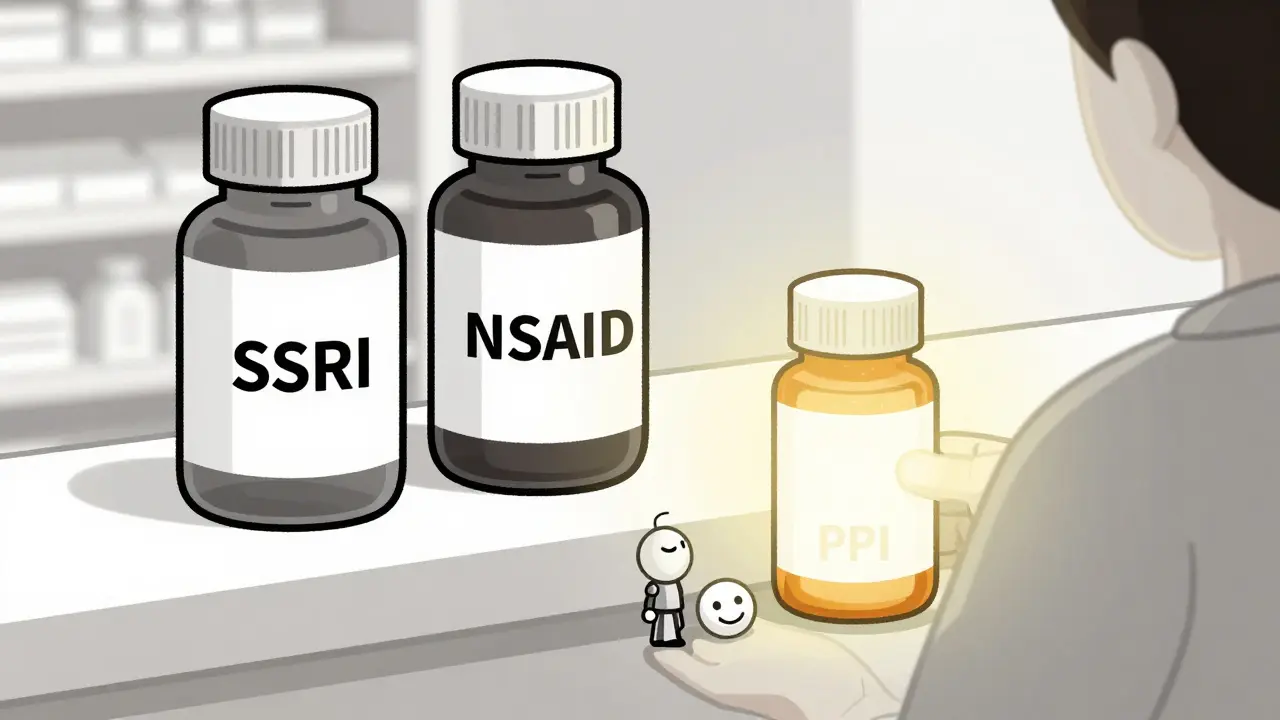
Prevention Isn’t Optional - It’s Essential
The American Gastroenterological Association (AGA) has been clear since 2020: if you must take both an SSRI and an NSAID, you need a proton pump inhibitor (PPI) like omeprazole or pantoprazole. PPIs cut the risk of bleeding by about 70%. That means instead of a 2.6% annual risk, you’re looking at closer to 0.8%. But here’s the problem: most patients don’t get this advice. A 2021 study in 12 primary care clinics found that nearly 30% of patients on both drugs were not prescribed a PPI. After a simple clinician education program, that number dropped to 9% within six months. The fix isn’t complicated - it’s just not being done. If you’re on an SSRI and your doctor prescribes an NSAID, ask: “Do I need this NSAID? Can I switch to acetaminophen? Should I be on a PPI?” If they say, “It’s fine,” push back. This isn’t a minor interaction. It’s a major safety issue.Who’s at Highest Risk?
You’re at higher risk if you:- Are over 65 years old
- Have a history of ulcers or GI bleeding
- Take low-dose aspirin (even 81 mg)
- Use corticosteroids (like prednisone)
- Have liver or kidney disease
- Take more than one NSAID or use them long-term
Real Patient Stories
On Drugs.com, over 600 patients have reviewed the combination of SSRIs and NSAIDs. Nearly 30% reported GI side effects. Over 12% said they had actual bleeding episodes. One user wrote: “I was on sertraline and ibuprofen for six months. One morning, I woke up vomiting blood. ER. Transfusion. Two weeks in the hospital. No one warned me.” Reddit threads from r/antidepressants show similar stories. Over 60% of users who posted about this interaction said they had no idea the combination was dangerous until they were hospitalized. The worst part? Many of these cases were preventable. A simple PPI could have saved them from surgery, blood transfusions, and months of recovery.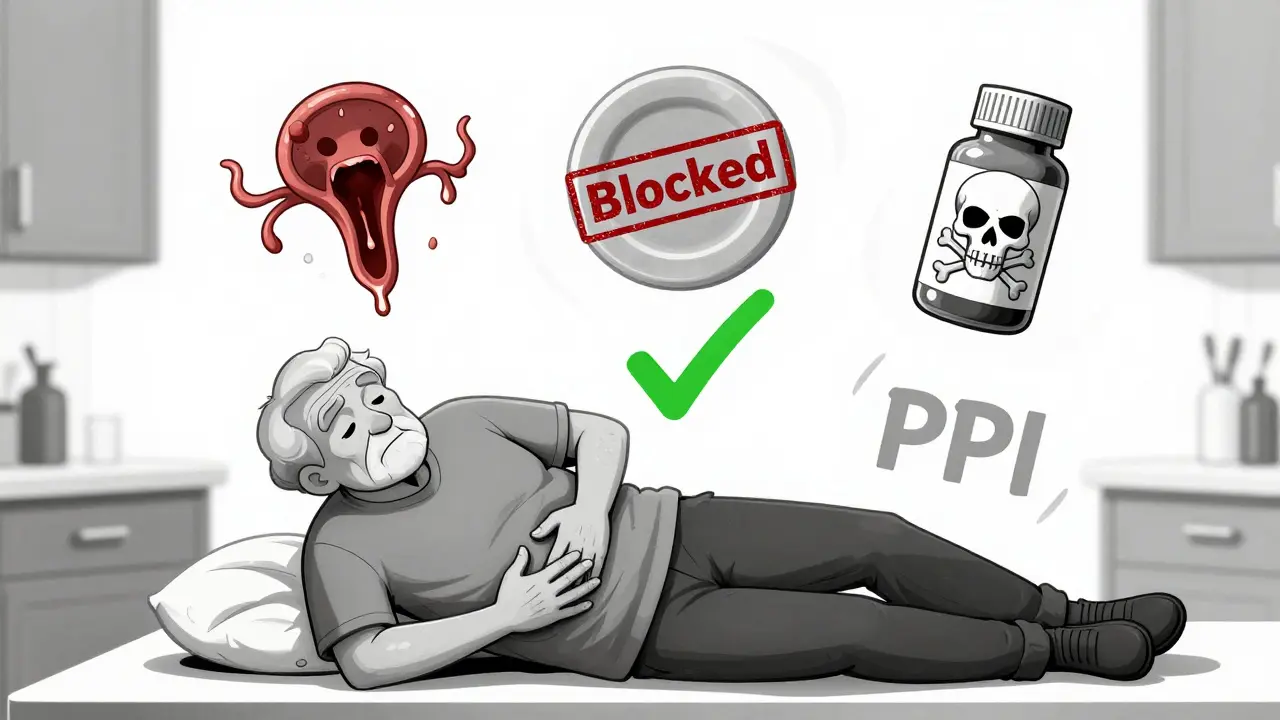
What You Can Do Today
If you’re on an SSRI and taking NSAIDs:- Stop the NSAID. Try acetaminophen instead. It works for most types of pain.
- If you absolutely need an NSAID (e.g., severe arthritis), ask for a PPI. Omeprazole 20 mg daily is cheap, effective, and available over the counter.
- Don’t take aspirin with SSRIs. Not even the “baby” kind. It’s a triple threat.
- Monitor for warning signs: black or tarry stools, vomiting blood, dizziness, fatigue, or sudden abdominal pain.
- Ask your doctor to review all your medications - including supplements like fish oil or ginkgo, which also increase bleeding risk.
The Bigger Picture
This isn’t just about one drug combo. It’s about how medicine still overlooks silent, deadly interactions. SSRIs and NSAIDs are among the most prescribed drugs in the world. Yet, the warning labels are buried. Prescribers don’t get trained on it. Patients don’t know to ask. The FDA added a warning to SSRI labels in 2019. The EMA did the same in 2021. But enforcement? That’s up to doctors. And many still don’t get it. The economic cost? Over $1.2 billion a year in the U.S. alone - for hospitalizations, ER visits, and long-term care. That’s money spent on problems that could have been prevented with a $10-a-month PPI.What’s Next?
New tools are coming. The GI-BLEED risk calculator, now integrated into Epic EHR systems, uses 12 factors - including your specific SSRI, NSAID, genetics, and age - to give you a personalized risk score. It’s accurate 89% of the time. New antidepressants are being tested too. Vortioxetine, for example, shows promise with 40% less bleeding risk than traditional SSRIs. But they’re not widely available yet. For now, the answer is simple: avoid the combo. If you can’t avoid it, use a PPI. And always, always ask your doctor: “Could this combination hurt me?”Can SSRIs and NSAIDs cause internal bleeding?
Yes. SSRIs reduce platelet function, making it harder for blood to clot. NSAIDs damage the stomach lining, creating a site for bleeding. Together, they significantly increase the risk of upper gastrointestinal bleeding - including bleeding in the stomach or duodenum. Studies show a 75% higher risk compared to NSAID use alone.
Is it safe to take ibuprofen with sertraline?
Not without precautions. Ibuprofen with sertraline increases GI bleeding risk. The safest approach is to avoid NSAIDs entirely and use acetaminophen for pain. If you must take ibuprofen, ask your doctor for a proton pump inhibitor (PPI) like omeprazole to protect your stomach.
What’s the safest painkiller to take with an SSRI?
Acetaminophen (paracetamol) is the safest option. It doesn’t affect platelets or the stomach lining, and studies show no increased bleeding risk when taken with SSRIs. It’s effective for headaches, muscle pain, and arthritis. Just don’t exceed 3,000 mg per day, and avoid alcohol.
Do all SSRIs carry the same bleeding risk?
No. SSRIs vary in how strongly they inhibit serotonin reuptake in platelets. Paroxetine and fluoxetine have the strongest effect and are linked to higher bleeding risk. Sertraline and citalopram are weaker, but still carry some risk. No SSRI is completely safe when combined with NSAIDs.
Should I stop my SSRI if I need an NSAID?
Never stop an SSRI without talking to your doctor. Abruptly stopping antidepressants can cause withdrawal symptoms or relapse. Instead, ask about switching from NSAIDs to acetaminophen or adding a PPI. Your mental health matters - but so does your GI safety. There’s a safer way.
13 Comments

Sanjaykumar Rabari
February 25, 2026 AT 14:22
The system is rigged. Doctors get paid to push pills. PPIs? They're just another profit center. You think they care about your stomach? They care about their bonus. This whole 'bleeding risk' thing is a distraction. The real danger is losing your autonomy to pharmaceutical lobbies. Wake up.

Kenzie Goode
February 26, 2026 AT 06:51
I had no idea this was even a thing. My doctor just handed me naproxen and said 'take as needed.' I've been on sertraline for five years. I feel so vulnerable right now. Thank you for writing this. I'm switching to acetaminophen tomorrow.

Dominic Punch
February 27, 2026 AT 18:30
This is exactly why we need better patient education. I've been a pharmacist for 18 years and I still see this combo daily. The science is crystal clear: SSRIs + NSAIDs = bleeding risk. The fix? PPIs. Cheap, effective, available OTC. Yet patients are left in the dark. If you're on an SSRI and your doc prescribes an NSAID, ask for the PPI. Don't wait until you're vomiting blood. Your gut will thank you.

Valerie Letourneau
February 28, 2026 AT 12:38
Thank you for this comprehensive and deeply necessary overview. As someone who manages chronic pain alongside anxiety, I appreciate the clarity on acetaminophen as a safer alternative. I will be sharing this with my care team. The economic burden you mention is staggering-yet preventable. We must advocate for systemic change, not just individual caution.

Khaya Street
March 1, 2026 AT 23:30
So basically, if you're poor and need pain relief, you're screwed? Acetaminophen doesn't work for real arthritis. And PPIs? They cost money. Insurance won't cover them 'just in case.' This isn't medical advice-it's a luxury for the middle class.

Brooke Exley
March 3, 2026 AT 05:45
YESSSS. I switched from ibuprofen to Tylenol after reading this. My stomach hasn't felt this good in years. I used to get that gnawing ache every morning-now it's gone. Also, I stopped taking fish oil. Who knew? I feel like I just unlocked a secret level of health. Thank you for the wake-up call!

Lou Suito
March 5, 2026 AT 01:30
75% increase? That's not statistically significant. You're cherry-picking studies. I read a 2024 paper that said the risk was 1.2% higher. Also, you didn't mention that SSRIs reduce bleeding risk in stroke patients. And what about coffee? Coffee causes bleeding too. Why aren't we banning coffee?

William James
March 6, 2026 AT 09:34
It's funny how we treat the body like a machine. We patch one part, break another. SSRIs fix the mind, but break the gut. NSAIDs fix the pain, but break the gut. We're so obsessed with symptom management we forget the whole system. Maybe the real solution isn't more pills-but rest, movement, and reducing inflammation at the source. Just a thought.

David McKie
March 6, 2026 AT 18:09
Oh great. Another fear-mongering article. 'Life-threatening bleeding!' Wake me up when it's worse than vaping or 5G. This is why people don't trust medicine anymore. You're scaring people into avoiding NSAIDs, which are perfectly safe for 99% of users. Meanwhile, your real agenda is to sell PPIs. I'm not buying it.

Southern Indiana Paleontology Institute
March 7, 2026 AT 10:19
Y'all need to stop being so soft. Back in my day, we took aspirin and Prozac and didn't cry about it. This is why America's falling apart. Weakness. You want pain relief? Take the pill. If you bleed, you bleed. That's life. Stop asking for handouts. PPIs? Use your own damn money.

lela izzani
March 9, 2026 AT 03:34
Thank you for including the AIMS65 score. As a nurse practitioner, I use this tool daily. I wish every primary care provider did. The fact that 30% of patients aren't getting PPIs is unacceptable. We need standardized protocols. Not just education-mandatory alerts in EHRs. This isn't optional. It's clinical hygiene.

Spenser Bickett
March 10, 2026 AT 19:40
Oh wow. So the solution to 'I'm depressed and my back hurts' is... more pills? You're telling me to take an SSRI (which I need) and then add a PPI (which I don't want) and switch to acetaminophen (which doesn't work for me)? So now I'm on three drugs instead of two? And you call this 'prevention'? This isn't medicine. It's bureaucratic tango.

Christopher Wiedenhaupt
March 11, 2026 AT 07:34
Just wanted to say I’ve been on sertraline and naproxen for three years. No issues. Maybe I’m lucky. Or maybe the risk is overstated. I’m not saying ignore it-but don’t panic either. Talk to your doctor. Don’t trust internet posts. That’s my two cents.
Write a comment