




FDA Interaction Significance Checker
Use this tool to evaluate if a specific AUC (Area Under the Curve) change is considered "clinically significant" according to the ICH M12 standards cited in the article.
Enter the ratio (AUCR) or fold-increase.
Analysis Result:
Ever opened a medication guide and felt like you were reading a foreign language? You aren't alone. Between the dense jargon and the sprawling tables, figuring out if two medications will clash can feel overwhelming. But here is the reality: the FDA drug interaction tables is a structured framework used in prescribing information to alert healthcare providers about potential drug-drug interactions (DDIs). Getting this right isn't just about following rules-it's about safety. In fact, these labeling systems help prevent an estimated 1.3 million adverse drug events every year.
Whether you are a clinician, a pharmacy student, or a curious patient, the key is knowing where to look. The FDA doesn't put all the interaction data in one spot because different people need different levels of detail. A doctor needs a quick dosing change, while a pharmacologist needs the raw data. To make sense of it, you have to navigate three specific sections of the label like a map.
The Three-Step Map for Finding Interaction Data
If you try to read a label from start to finish, you'll get bogged down. Instead, follow this workflow used by the American Society of Health-System Pharmacists to get answers quickly.
- Start with Section 7 (Drug Interactions): This is your headquarters. About 85% of the actionable recommendations live here. If a drug is contraindicated or requires an immediate warning, this is where you'll find it. It tells you what the problem is.
- Move to Section 12 (Clinical Pharmacology): This is the "why" section. If Section 7 says a drug interacts, Section 12 explains the science. It contains data from clinical trials and in vitro studies, showing exactly how much a drug's concentration increases or decreases in the blood.
- End at Section 2 (Dosage and Administration): Once you know there is a problem and why it happens, you need the fix. Section 2 provides the actual dosing adjustments-like "reduce dose by 50%"-which appear in about 73% of labels that identify significant interactions.
Understanding the "Math" of Interactions: AUC and Fold-Changes
When you dive into Section 12, you'll see a lot of talk about AUC (Area Under the Curve). In plain English, AUC is just a measure of the total drug exposure in your body over time. The FDA uses specific numerical thresholds to decide if an interaction is "clinically significant."
According to the ICH M12 Guideline-the global gold standard updated in August 2024-the numbers usually break down like this: for enzymes like the CYP family, an AUC ratio (AUCR) of 1.25 or higher (meaning a 25% increase) or 0.8 or lower (a 20% decrease) is a red flag. For transporters, the bar is often higher. For example, if a P-gp inhibitor causes a 1.5-fold increase in drugs like digoxin, it's considered significant.
| Mechanism | Threshold for Significance | Example Entity |
|---|---|---|
| CYP Enzymes | AUCR ≥ 1.25 or ≤ 0.8 | CYP3A4 |
| P-gp Transporters | AUC Fold-increase ≥ 1.5 | Digoxin |
| OATP Transporters | AUC Fold-increase ≥ 2.0 | OATP1B1 Substrates |

The Tricky Part: Drug Classes vs. Specific Drugs
One of the biggest headaches for pharmacists is the "class trap." Sometimes a label will say a drug interacts with a whole class, like "Beta Blockers." But here is the catch: not every drug in that class behaves the same way. A 2023 FDA analysis found that 42% of labels are inconsistent here, listing a broad class when only one or two specific drugs in that group actually cause a problem.
When you see a class listed, don't just assume every drug in that group is off-limits. Check the specific drug's label or use the Drugs@FDA database to see if the interaction is a known issue for that specific molecule. This is especially critical in complex polypharmacy cases-where a patient is taking five or more medications-because the risk of an incorrect assumption is much higher.
Common Pitfalls and How to Avoid Them
It is easy to misread the urgency of a warning. There is a huge difference between "Avoid concomitant use" and "Dose adjustment required." A 2024 audit showed that nearly 30% of providers actually mix these up in simulated scenarios. Here is a quick rule of thumb to keep them straight:
- Contraindicated: Do not use these together. Period. The risk outweighs any possible benefit.
- Avoid Concomitant Use: Strong warning. You should only do this if there are no other options and you can monitor the patient extremely closely.
- Dose Adjustment Required: You can use both, but you must change the amount of one drug to keep it safe.
Another gap to watch out for is age. Most interaction tables are based on adults. However, the elderly-who make up about 35% of drug users-often metabolize drugs differently. If your patient is 80, a "moderate" interaction might actually be "severe" because their kidneys or liver aren't processing the drug as efficiently.
The Future: Machine-Readable Data and Dynamic Labels
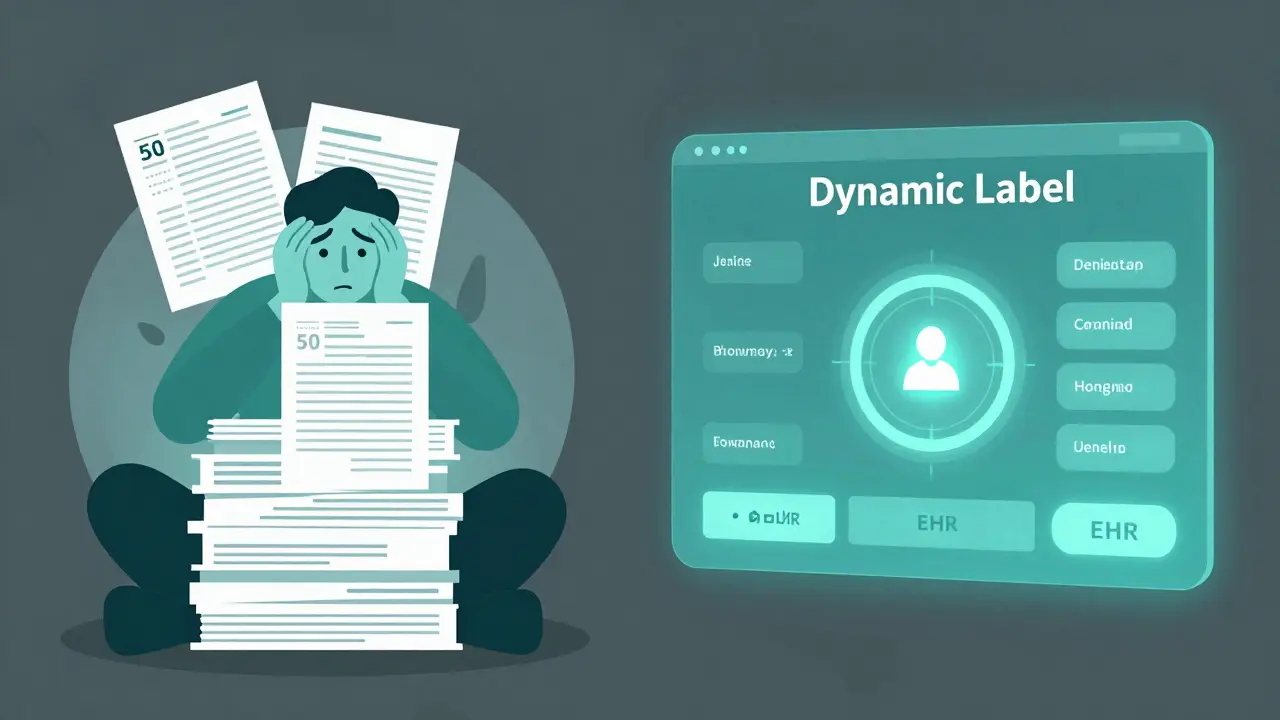
The days of scrolling through a 50-page PDF are numbered. The FDA is moving toward "machine-readable" data, expected by 2025. This means instead of a human reading a table, your Electronic Health Record (EHR) system will automatically pull the data and alert you. We are also seeing a shift toward "dynamic labeling" planned for 2026, where labels can be updated in real-time as new evidence comes in, rather than waiting for a formal regulatory cycle.
While these tools are great, they don't replace the need to understand the basics of pharmacokinetics. Knowing how CYP3A4 or BCRP transporters work allows you to predict an interaction even if the label is a bit vague.
What is the difference between Section 7 and Section 12?
Section 7 is the "Action" section; it tells you what to do (e.g., avoid a drug or change a dose). Section 12 is the "Science" section; it provides the pharmacokinetic data and trial results that justify the recommendations in Section 7.
What does an AUC ratio of 1.25 actually mean?
An AUC ratio (AUCR) of 1.25 means that when two drugs are taken together, the exposure of the drug in the bloodstream increases by 25% compared to when it is taken alone. According to ICH M12 guidelines, this is the threshold where an interaction is typically considered clinically significant.
Are all drug interaction tables in FDA labels up to date?
Not necessarily. While all new drugs approved since 2020 follow the structured labeling approach, "legacy" drugs approved before 2010 are slower to update. Only about 63% of those older drugs have been updated to current standards.
Why should I be careful with drug class warnings?
Because not all drugs in a class share the same metabolic pathway. A label might warn against a whole class of drugs, but only one or two specific members of that class actually cause the interaction. Treating the whole class as a risk can lead to unnecessary medication changes.
Where can I find more detailed information if the label is unclear?
The Drugs@FDA database is the best official source for updated labels. For those needing deeper training, the FDA provides free online modules, such as the "Navigating Drug Interaction Information" course, to help professionals interpret technical pharmacology data.