

Imagine picking up a new prescription, but the instructions are in a language you barely understand. You glance at the label, see words that look familiar but don't quite make sense, and hope for the best. For millions of people, this isn't a hypothetical scenario-it's their daily reality. Medication safety is the practice of preventing harm from medication use through accurate information, proper handling, and clear communication. When language barriers enter the picture, the risk skyrockets.
According to the U.S. Census Bureau, roughly 25 million people in the United States have Limited English Proficiency (LEP), which refers to individuals who speak English less than "very well" and may struggle with complex medical terminology. This group faces a stark reality: they are 1.5 to 3 times more likely to experience adverse drug events than those who are fluent in English. The gap isn't just about vocabulary; it's about survival. Misunderstanding a dosage or a warning can lead to hospitalizations, severe health complications, or worse. This article breaks down how to bridge that gap, ensuring everyone gets clear, safe instructions regardless of the language they speak.
The High Cost of Miscommunication
Why does this matter so much? Because medication errors are not just inconvenient-they are dangerous. A study by the University of California found that properly translated medication instructions can reduce error rates by up to 62%. That’s a massive difference between staying healthy and ending up in the ER. The problem often starts with the prescription label itself. These labels contain "SIG codes," which are technical directions like "take 1 tab PO QID." To a pharmacist, that means "take one tablet by mouth four times a day." To someone without medical training, especially if it’s not in their native tongue, it might mean nothing-or something entirely different.
Consider the case documented in WebM&M where a patient drank albuterol nebulization solution because the container looked like a syringe and the label was unclear. Or the Korean patient mentioned by a pharmacist on Reddit who took blood thinners twice daily instead of once because "daily" was misunderstood as "every day" rather than "once per day." These aren't rare anomalies; they are symptoms of a systemic failure. The Institute for Safe Medication Practices reported that relying on family members or ad-hoc interpreters creates a 65% higher rate of medication errors. It’s simply not safe to guess.
What Makes Instructions Actually Clear?
You might think a Google Translate printout is enough, but the data says otherwise. Automated translation services without medical validation produce error rates as high as 38%, according to an FDA safety communication. So, what works? Effective medication instruction systems need three things: plain language, cultural relevance, and professional validation.
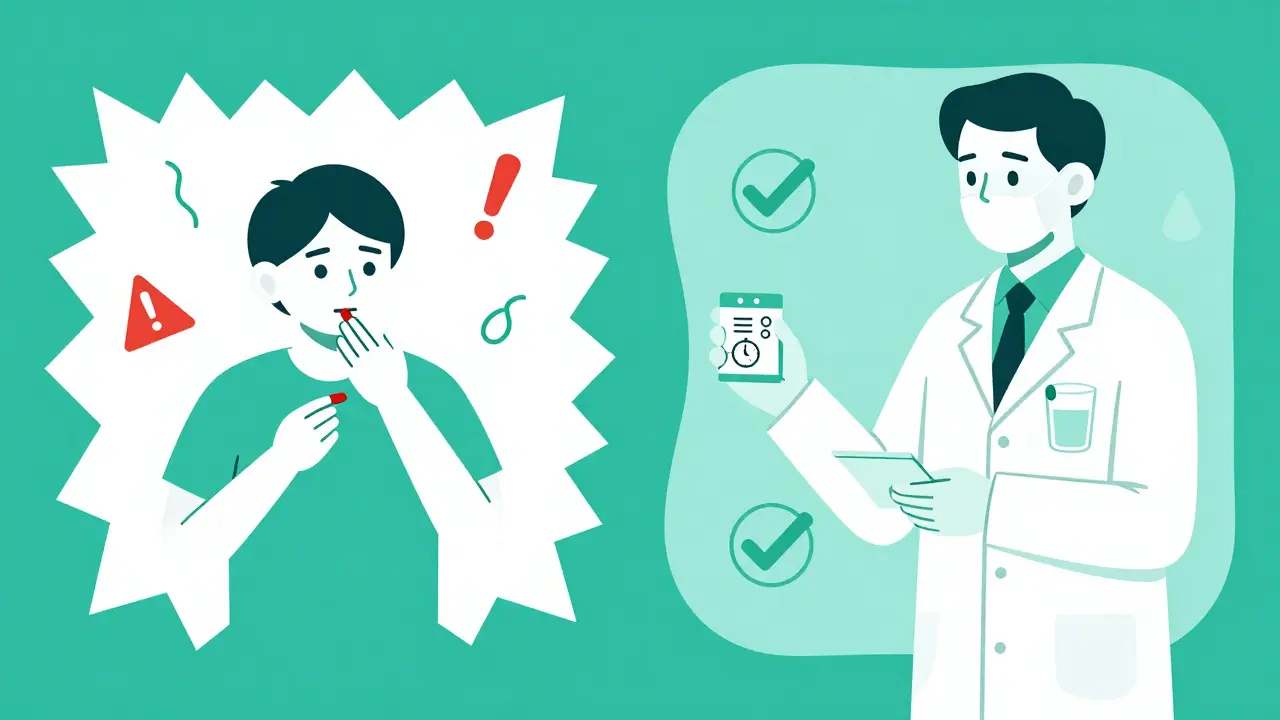
First, the reading level matters. Even native English speakers struggle with medical jargon. Translations should aim for a maximum 6th-grade reading level. This means short sentences, active voice, and avoiding complex metaphors. Second, visuals help. Using universal symbols validated by ISO 3864 standards, such as a clock icon for timing or a glass of water for swallowing with food, bridges gaps that words cannot. Third, and most importantly, the translation must be done by professionals who understand both the language and medical context.
The ConcordantRx study demonstrated this powerfully. They developed standardized instructions in Chinese, Korean, and Russian using patient-centered language. The result? 100% comprehension among tested LEP patients, compared to only 45% with traditional translations. Another UK service evaluation showed that 89% of patients reported high understanding when instructions were in their preferred language, versus just 22% with English-only labels. Clarity isn't a luxury; it's a clinical necessity.
Tools and Technologies Bridging the Gap
Pharmacies are increasingly turning to technology to solve this problem, but not all tools are created equal. Specialized vendors like RxTran is a pharmacy translation service that integrates with management systems to provide certified multilingual labels. offer translations in over 25 languages, including Amharic, Arabic, Bengali, and Vietnamese. These services connect directly to major pharmacy management systems like Rx30, QS/1, and PioneerRx via API, automating the process so pharmacists don't have to manually search for translations during busy hours.
| Method | Comprehension Rate | Error Risk | Cost Estimate |
|---|---|---|---|
| Professional Translation Services | 95-100% | Low | $2.50 - $5.00 per rx |
| Bilingual Staff (Untrained) | 42% | Moderate | Variable |
| Automated/AI Translation | ~38%* | High (43% error rate) | Low |
| Family Members/Ad-hoc | Variable | Very High (+65%) | $0 |
*Note: Automated translation error rates based on unvalidated medical texts.
While these technologies are promising, implementation has hurdles. Only 32% of pharmacies have seamless integration with translation services. Many still rely on outdated databases or lack systematic processes to identify a patient's language preference. The learning curve for staff to effectively use these tools averages 4-6 weeks. But the investment pays off. A University of Michigan study found that bilingual labeling systems reduced medication errors by 58% and improved adherence by 37%. That’s better health outcomes and fewer costly mistakes.
Regulatory Landscape and Your Rights
It’s not just good practice; it’s the law. Title VI of the Civil Rights Act of 1964 prohibits discrimination based on national origin, which includes providing meaningful access to healthcare services. The Department of Health and Human Services reinforced this in 2000, requiring providers to offer language assistance. Yet, enforcement varies. In California, pharmacies must provide translation services for the top five non-English languages in their area. New York City requires coverage for the top ten. Despite these mandates, only 57% of community pharmacies actually provide translated labels.
If you are a patient, you have the right to ask for an interpreter. Under federal guidelines, hospitals and large clinics must provide qualified interpreters at no cost. In community pharmacies, while not always legally mandated to provide free interpreters, they are expected to make reasonable efforts to communicate clearly. If you feel your instructions are unclear, speak up. Ask them to show you with pictures, write out the steps in your language, or call a professional interpreter service. Don’t settle for "good enough" when your health is on the line.
Practical Steps for Patients and Caregivers
So, what can you do today to stay safe? Here is a checklist for navigating medication pickups when English isn't your first language:
- Identify your language preference early: Tell the pharmacist or technician immediately that you need instructions in your native language. Most modern systems can flag this quickly.
- Ask for visual aids: Request pictograms or diagrams. Look for icons that show how many pills to take, when to take them, and any warnings (like "avoid sunlight" or "take with food").
- Use the "Teach-Back" method: After the pharmacist explains the instructions, repeat them back in your own words. If they correct you, keep going until it’s perfect. This confirms understanding.
- Avoid relying on children: While it’s tempting to ask your child to translate, medical terminology is complex. Children may miss nuances or feel embarrassed discussing sensitive health issues. Use professional services instead.
- Check for red flags: If the label looks like machine-generated text with awkward phrasing, ask for a review. Poorly translated labels can be just as dangerous as no labels.
For caregivers, patience is key. Take time to sit down with the patient and go over each medication together. Write down questions beforehand so you don’t forget them in the moment. And remember, confusion is common-even for English speakers. Don’t be afraid to admit when you don’t understand.
The Future of Language Access in Pharmacy
The industry is moving forward, albeit slowly. By 2026, predictions suggest 85% of pharmacies will have integrated language access services. Drivers include regulatory pressure, like the CMS requirement for Medicare Part D plans to report language access metrics, and economic incentives. Pharmacies with comprehensive language access see 22% higher patient satisfaction and 15% lower costs related to medication errors.
New developments include the ONC’s 2024 rule requiring Electronic Health Records (EHR) to include language preference fields that automatically trigger translation services. This means your language preference could follow you from doctor to pharmacist seamlessly. However, risks remain. AI-powered translations are growing, but without strict validation, they pose significant safety hazards. There is also a shortage of certified translators for less common languages like Navajo or Hmong, where only 12 certified medical translators exist nationwide. Until these gaps are filled, human oversight remains critical.
Is it legal for a pharmacy to refuse to provide translated instructions?
Federal law under Title VI of the Civil Rights Act requires meaningful access to healthcare services, which includes language assistance. While specific requirements vary by state (e.g., California and New York have stricter rules), refusing to make reasonable efforts to communicate can constitute discrimination. You have the right to request an interpreter or translated materials.
Can I use my phone’s translation app to read my prescription label?
It is risky. Unvalidated automated translations have been shown to produce error rates as high as 38-43% in medical contexts. Medical terminology is nuanced, and small errors can lead to serious harm. It is safer to ask for professionally translated labels or a certified interpreter.
What should I do if I don’t understand my medication instructions?
Do not leave the pharmacy confused. Ask the pharmacist to explain again using simple language or visuals. Use the "teach-back" method by repeating the instructions back to them. If needed, request a professional interpreter. Never guess how to take a medication.
Are there apps that help with medication safety for non-English speakers?
Some apps offer general translation, but few are medically validated for prescription labels. Look for services integrated into pharmacy systems like RxTran or those endorsed by healthcare providers. Always verify that the translation source is certified for medical use.
How much does professional translation cost for prescriptions?
Professional pharmacy translation services typically cost between $2.50 and $5.00 per prescription. While this adds to operational costs, it significantly reduces expensive medication errors and improves patient adherence, offering a strong return on investment for healthcare providers.