






When you hear the words vitiligo and phototherapy together, it’s easy to assume they’re part of the same plan - like mixing two medicines to make one stronger solution. But that’s not how it works. In fact, phototherapy and depigmentation are opposites. One tries to bring color back. The other removes what’s left. They’re not combined. They’re chosen - based on how much of your skin has lost pigment.
What Vitiligo Really Is
Vitiligo isn’t just a skin condition. It’s an autoimmune disorder where your body’s immune system attacks melanocytes - the cells that make your skin color. This leads to white patches that can show up anywhere: face, hands, armpits, even inside your mouth. About 1 in 50 people worldwide have it, with higher rates in places like India. It doesn’t hurt. It doesn’t itch. But it can change how you see yourself.Phototherapy: Bringing Color Back
If you have vitiligo covering less than 80% of your body, phototherapy is usually the first step. The goal? Repigmentation. You want your skin to regain its natural tone. The most common and effective method today is narrowband ultraviolet B (NB-UVB) light. It uses a specific wavelength - 311 to 313 nanometers - that targets the skin without burning it deeply. You’ll typically go to a clinic two or three times a week. Each session lasts only a few minutes. The light doesn’t cure vitiligo, but it helps your body’s leftover melanocytes - especially those hiding in hair follicles - start making pigment again. Studies show that after six months, about 37% of people see at least half their patches repigment. After a year, that number jumps to over 56%. For some, especially on the face and neck, repigmentation can reach 70-80%. But not all areas respond the same. Hands, feet, lips, and areas with no hair follicles barely react. That’s why people with vitiligo on their fingers often give up - they don’t see results, even after months of treatment.How Phototherapy Works: More Than Just Light
Phototherapy isn’t just about shining UV light. It does two things at once. First, it calms down the immune attack on melanocytes. Second, it wakes up dormant pigment cells. That’s why it works better when paired with topical treatments like tacrolimus or pimecrolimus. These creams, applied right before light therapy, can boost repigmentation by 25-30%. There are other light options too. PUVA uses a drug called psoralen with UVA light. It works, but it’s older and riskier - nausea is common, and long-term use raises skin cancer risk. Excimer lasers deliver targeted UVB to small patches. Great for spots on the face or elbows, but useless if you have patches all over your back.Home Phototherapy: Convenience vs. Risk
Many people now use home phototherapy units. These are FDA-approved devices like the Philips TL-01. They cost between $2,500 and $5,000 upfront. But they save time - no driving to clinics, no waiting rooms. A 2020 study found home users stuck with treatment 35% more often than clinic-goers. That’s huge. Compliance is the biggest reason treatment fails. But there’s a catch. Home users are 22% more likely to get burns. Why? Because dosing is tricky. Too much light, too soon, and your skin reddens, blisters, or peels. That’s why tracking sessions with apps is critical. UC Davis Health found that patients using smartphone trackers had 92% adherence. Those who didn’t? Half quit before six months.
Depigmentation: When You Choose to Go All White
Now, here’s where people get confused. If vitiligo covers more than 80% of your body, doctors may suggest depigmentation. Not as a last resort - as a deliberate choice. The idea? Remove the remaining pigment from your normal skin so everything matches. It’s not about fixing vitiligo. It’s about creating a uniform look. The only approved treatment for this is monobenzone cream. It’s not a moisturizer. It’s a chemical that permanently destroys melanocytes. You apply it to pigmented areas - arms, legs, face - twice a day, every day, for months. It takes 6 to 12 months to see full results. Once done, your skin stays white forever. You’ll need to avoid sun exposure. Your skin becomes extremely sensitive. You’ll need sunscreen daily, even indoors. This isn’t for everyone. It’s irreversible. And it’s only recommended when repigmentation isn’t possible or when the emotional toll of patchy skin outweighs the risks of depigmentation. Most patients choose it after years of failed treatments. It’s a psychological decision as much as a medical one.Why You Don’t Mix Them
You can’t do phototherapy and depigmentation at the same time. They cancel each other out. Phototherapy tries to bring pigment back. Depigmentation tries to burn it away. If you try both, you’ll end up with uneven results - some patches darkening, others fading - and your skin could get damaged. The American Academy of Dermatology says clearly: these are separate treatment paths. You pick one based on your disease extent. If you have 30% vitiligo? Go for NB-UVB. If you have 90%? Talk to your dermatologist about depigmentation.Cost, Time, and Real-Life Barriers
Phototherapy is affordable compared to newer drugs. A full year of NB-UVB costs between $1,200 and $2,500. Topical ruxolitinib cream? Over $5,000 a year. But cost isn’t the only hurdle. Time is. Two to three visits a week. For a year. That’s 100-150 sessions. Many people start strong. Then work gets busy. Kids need rides. Weather gets bad. Suddenly, you miss a week. Then two. Progress stalls. The JAMA Dermatology meta-analysis says you need at least six months to even know if it’s working. Most people give up before then. Insurance doesn’t always cover everything. Even with coverage, out-of-pocket costs can hit $1,000 a year. And if your vitiligo is on your hands? You’re more likely to quit. Only 15-20% of people see improvement there - even after a full year.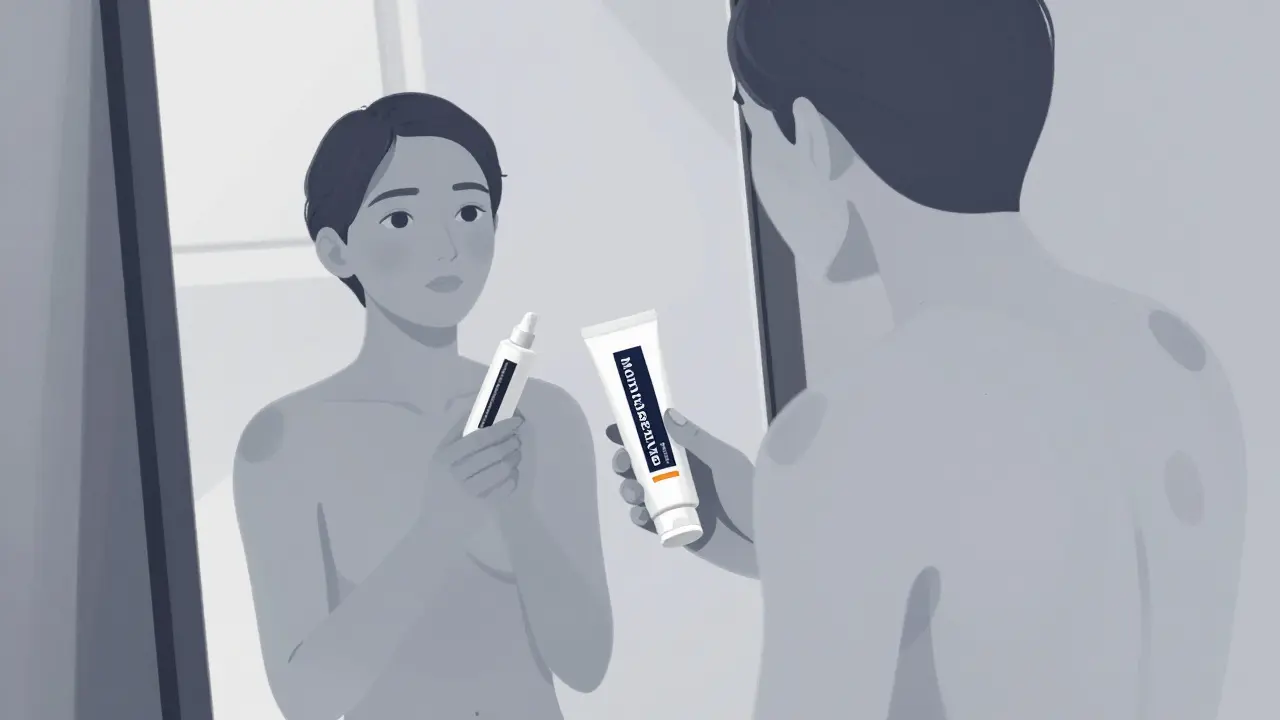
New Hope: Combining Light With Drugs
The future isn’t about mixing light with depigmentation. It’s about combining light with drugs that help the light work better. The 2023 Ruxotmel trial showed that using ruxolitinib cream with NB-UVB led to 54% of patients achieving over 50% repigmentation in just 24 weeks - compared to 32% with light alone. That’s a big deal. It means fewer sessions. Faster results. Especially for stubborn areas. New tech is helping too. The Vitilux AI device, cleared by the FDA in October 2023, uses your smartphone camera to measure your skin tone and adjust the light dose automatically. It cuts dosing errors by 37%. That means fewer burns. More confidence.What to Do Next
If you have vitiligo and are considering treatment:- Get a full-body assessment from a dermatologist who specializes in vitiligo.
- Ask what percentage of your skin is affected. That determines your path.
- If under 80%: Start with NB-UVB phototherapy. Ask about adding a topical cream.
- If over 80%: Discuss depigmentation - understand the permanence and lifestyle changes.
- If you’re tired of clinic visits: Ask about home phototherapy. Get trained properly.
- Track your progress. Use an app. Take photos monthly. Don’t rely on how you feel.
Support Is Out There
You’re not alone. The Vitiligo Support International forum has over 15,000 members. The AAD’s Vitiligo Navigator program gives you personalized calendars and tips. Reddit’s r/vitiligo community has real stories - from people who gave up, to those who found peace with depigmentation, to others who got their color back after two years. The truth? Vitiligo doesn’t have one fix. But it does have options. And the right one depends on your skin, your life, and your goals.Can phototherapy and depigmentation be used together for vitiligo?
No, they should never be used together. Phototherapy aims to restore pigment to white patches, while depigmentation removes the remaining natural pigment from unaffected skin. Using both at the same time would cause conflicting results - some areas darkening, others fading - and could damage your skin. They are two separate treatment paths chosen based on the extent of vitiligo, not combined therapies.
How long does it take to see results from NB-UVB phototherapy?
Most people need at least six months of consistent treatment to see noticeable repigmentation. The JAMA Dermatology meta-analysis found that 37% of patients achieved at least 50% repigmentation by six months, and 57% reached that mark by 12 months. Facial areas often respond faster - sometimes within three to four months - while hands and feet may show little change even after a year. Doctors recommend continuing treatment for 12 to 18 months before deciding if it’s working.
Is home phototherapy as effective as clinic-based treatment?
Yes, studies show home phototherapy is just as effective as clinic-based NB-UVB. A 2020 trial found that 78% of home users achieved over 50% repigmentation at six months, compared to 82% in-clinic users. The big difference? Compliance. Home users missed fewer sessions because they didn’t have to travel. However, home users had a 22% higher rate of mild burns due to incorrect dosing. Proper training and using an app to track sessions and doses can reduce this risk.
Why doesn’t phototherapy work well on hands and feet?
Hands and feet have fewer hair follicles, and melanocytes - the pigment-producing cells - are mostly located in those follicles. Phototherapy works by activating these dormant cells. Since there are so few in the palms and soles, there’s little to activate. Studies show only 15-20% repigmentation in these areas, even after 12 months of treatment. That’s why many patients stop therapy when they don’t see results on their fingers or toes.
Is depigmentation permanent? What are the risks?
Yes, depigmentation with monobenzone cream is permanent. Once the pigment is removed, it does not come back. The process takes 6 to 12 months and requires daily application to normal skin. Risks include extreme sun sensitivity - your skin can burn easily, even through windows. You’ll need to use high-SPF sunscreen daily and avoid prolonged sun exposure. Some people also report itching, redness, or contact dermatitis. It’s a major decision, usually only recommended when vitiligo covers more than 80% of the body and repigmentation treatments have failed.
12 Comments

saurabh singh
January 4, 2026 AT 23:51
Been through this myself in Mumbai - NB-UVB saved my face but my hands? Still white after 14 months. I didn't quit. I started using tacrolimus before each session. Now I can hold my kid's hand without feeling like a ghost. It's not magic, but it's hope.
Don't let the stats scare you. Your skin isn't a spreadsheet.

Dee Humprey
January 6, 2026 AT 07:59
Just wanted to say thank you for writing this. I’ve been too scared to even ask my derm about depigmentation. Now I know it’s not giving up - it’s choosing peace. 🌿

Enrique González
January 7, 2026 AT 15:16
Home phototherapy changed my life. No more missing work. No more awkward small talk with the clinic receptionist who always asks if I’m ‘getting better.’
But yeah - I burned my neck twice. Now I use the Vitilux app. No more mistakes. Just progress.

Jay Tejada
January 8, 2026 AT 19:31
Depigmentation? Sounds like the skincare version of ‘if you can’t beat ‘em, join ‘em.’
Also, monobenzone is basically bleach with a PhD.

Jason Stafford
January 10, 2026 AT 14:43
They don’t want you to know this, but phototherapy is just a front. The real cure is being suppressed by Big Pharma because repigmentation doesn’t require lifelong prescriptions. Monobenzone? Cheap. Easy. No patents. That’s why they push ruxolitinib at $5K a year.
Ask yourself - why is the FDA clearing AI devices that reduce dosing errors… but not funding studies on natural melanocyte regrowth?
Wake up.

Allen Ye
January 11, 2026 AT 08:43
There’s a deeper philosophical layer here that rarely gets discussed. Vitiligo isn’t just a loss of pigment - it’s a loss of cultural belonging. In many societies, skin tone is tied to identity, marriageability, employment. Phototherapy isn’t medical - it’s social armor.
Depigmentation, then, becomes an act of radical self-reclamation - not surrender, but sovereignty. You don’t fix your skin. You redefine what ‘normal’ means.
And yet, the medical system frames both as ‘treatments’ - as if the problem lies in the skin, not in the world’s gaze.
That’s why I’m skeptical of ‘cures.’ We’re not broken. We’re just not convenient.
What if the real treatment is not changing our skin, but changing how we’re seen?
And if that’s true - then maybe the most powerful thing we can do isn’t light therapy or cream - but speaking up. Loudly. Together.

John Wilmerding
January 11, 2026 AT 17:11
Thank you for the comprehensive overview. As a dermatology resident, I appreciate the nuanced distinction between treatment pathways. The data on compliance with home phototherapy is particularly compelling - adherence rates are often the limiting factor in chronic dermatologic therapies.
For patients considering depigmentation, I strongly recommend psychological counseling prior to initiation. The permanence and sun sensitivity requirements are non-trivial and frequently underestimated.

Stephen Craig
January 12, 2026 AT 11:43
Light doesn’t heal. It reminds the body it’s still alive.
Maybe that’s the real treatment.

Jacob Milano
January 12, 2026 AT 14:05
I used to hate mirrors. Now I take photos every Sunday. Not to track progress - to remember how far I’ve come.
My first patch appeared when I was 12. I cried for three days. Now I’m 31. I’ve got a tattoo on my forearm that says ‘melanin is not a defect.’
Phototherapy gave me back my face. But my courage? That was mine all along.
To anyone reading this - you’re not losing color. You’re becoming a canvas. And canvases don’t need to look like everyone else’s to be beautiful.

Aaron Mercado
January 14, 2026 AT 11:09
WARNING: DO NOT TRUST HOME PHOTOTHERAPY UNITS!! I saw a guy on Reddit who used his device 3x a day - burned his chest so bad he needed skin grafts!!
And the FDA? They’re in the pocket of the manufacturers!!
Also - why is monobenzone even legal?! It’s basically a chemical weapon for skin!!
And don’t get me started on ruxolitinib - it’s just JAK inhibitors repackaged!!
Someone needs to investigate this!!
Someone!!

Ashley Viñas
January 15, 2026 AT 06:02
It’s fascinating how people romanticize vitiligo like it’s some kind of spiritual awakening. Meanwhile, I’m just trying to get a job without someone asking if I’m ‘covered in paint.’
Phototherapy didn’t give me ‘courage.’ It gave me 150 hours of my life back - and still didn’t fix my hands.
Depigmentation? I did it. And yes - I wear sunscreen indoors now. Because reality doesn’t care about your poetry.

Vikram Sujay
January 15, 2026 AT 06:39
In India, we have a saying: ‘The sun does not judge the color of the skin - only the warmth of the heart.’
Phototherapy is a tool. Depigmentation is a choice. Neither defines you.
What matters is how you walk forward - with or without pigment.
Thank you for this post. It speaks with clarity - not noise.
Write a comment